

The 450th anniversary of Titian’s death on 27 August 1576 offers an opportunity to revisit a Venetian master whose long career coincided with the emergence of early capitalism. His seventy-year creative life spanned almost three-quarters of the sixteenth century, a period of profound social transformation. His art reflects both the enduring spirit of Renaissance humanism and the growing instability of the world that sustained it. Venice was a major Mediterranean power, trading as far as Holland and England. Its mercantile oligarchy was neither feudal nor fully capitalist, creating an unusual environment for artists.
The British Marxist art critic John Berger argues that Titian was among the first artists to transform painting from a courtly craft into an independent profession. He negotiated fees, accumulated wealth, cultivated powerful patrons and claimed an unusual authority. His career therefore marks a transition from feudal patronage towards the art market, revealing both the opportunities and anxieties created by the new economic order.
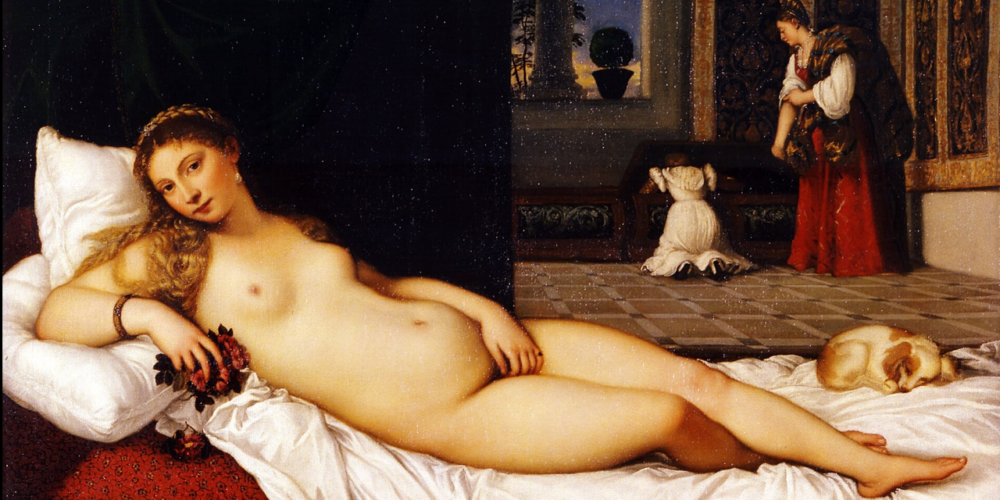
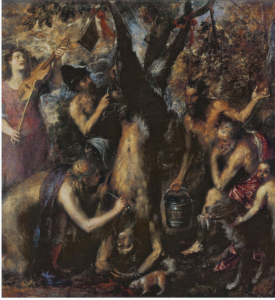
Four works trace this transformation: Assumption of the Virgin, Venus of Urbino, the Portrait of Ippolito Riminaldi, and The Flaying of Marsyas. Together, they move from the monumental confidence of High Renaissance humanism, through withdrawal into private life and growing uncertainty, to the radical expressive freedom of Titian’s final years.
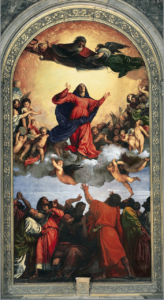
Assumption of the Virgin and Monumental Humanism (1516–1518)
The Assumption of the Virgin, painted for the Frari Church, established Titian’s monumental style. Its enormous figures and dramatic intensity reportedly astonished the commissioning monks. Breaking with the tranquil altarpieces of the fifteenth century, Titian created a dynamic language of powerful brushwork and harmonies of red, blue and gold. The red garments of God, Mary and the apostles form a vertical axis connecting heaven and earth.
The apostles are animated rather than meditative, reflecting Titian’s engagement with the High Renaissance art of Florence and Rome. Most importantly, Mary becomes an active protagonist rather than a passive object of devotion. Her powerful body rises towards heaven, her robes billow and her arms express both astonishment and acceptance. Titian gives her the physical and psychological grandeur associated with Michelangelo.
The painting embodies the confidence of Venice at the height of its republican power: sacred history unfolds through the same bodies, light and movement experienced by the viewer.
Venus of Urbino and the Retreat into Private Life (1538)
By the late 1530s, the world of the High Renaissance was collapsing. Florence had become a Medici duchy; the Sack of Rome had shattered Italian political confidence; and the Counter-Reformation increasingly challenged the classical and worldly culture of the Renaissance. Venice remained independent but was increasingly isolated between Habsburg and Ottoman power.
In Venus of Urbino, Renaissance humanism moves from the public world of church and civic life into the private household. Venus lies in a richly furnished Venetian interior, where mythology and everyday life merge. Servants search a cassone, or wedding chest, while a small dog symbolises fidelity and the roses in Venus’s hand evoke erotic love.
Titian sets the sensuality of Venus’s body against the ordered world of domestic labour, marriage and property. His innovative technique makes contours dissolve into atmosphere, uniting flesh, linen, silk, velvet and stone through subtle shifts of colour and light.
Venus also meets the viewer’s gaze directly, transforming the classical nude from an object of contemplation into a participant in human exchange. Yet the painting’s celebration of individual beauty remains inseparable from the social relations of property, marriage and domestic labour.
Ippolito Riminaldi and the Inner Crisis of Humanism (c. 1528)
The Portrait of Ippolito Riminaldi reveals a darker dimension of Renaissance culture. Riminaldi, a jurist from Ferrara, appears against a restrained background, with the portrait concentrating on his face and hands. His closed book signifies humanist learning, while the contrast between his bare and gloved hands suggests a division between inner life and social identity.
Titian’s softened contours and subtle shadows make the face appear unstable, while the sharply focused eyes convey intense awareness. The sitter seems physically present but psychologically distant, enclosed within his dark clothing.
The portrait becomes a visual expression of divided consciousness: a humanist who has inherited the ideals of Renaissance culture but finds himself in a world increasingly beyond human control.
The Flaying of Marsyas and Titian’s Late Style (c. 1570–1576)
By the 1570s, the world that had sustained Venetian humanism was disappearing. The Inquisition, Habsburg domination, economic uncertainty and the plague of 1576 formed the background to Titian’s final years.
In The Flaying of Marsyas, the myth of Apollo’s punishment of the satyr becomes a profound meditation on suffering. Stable Renaissance classicism dissolves into a radically new visual language. Titian uses large, open brushstrokes and sometimes applies colour with his fingers. The painted surface becomes a chaotic whirlwind rather than an illusion of stable reality.
This instability is itself expressive. Titian abandons the illusion of a secure external world because that stability has become historically impossible. Broken form, gesture and colour become a language of violence, suffering and endurance.
For Berger, Titian was among the first painters to make the physical act of artistic creation visible. As Renaissance ideals appear to fail, the artist’s hand and brushstroke become an assertion of human agency in the face of catastrophe. Titian’s enduring achievement lies in refusing both illusion and despair. His final works suggest that the world, despite its material density, suffering and uncertainty, can still be known, endured and – even against historical odds – loved.