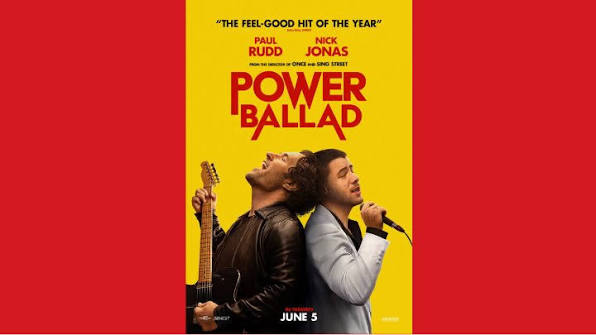



Power Ballad
By Tomás Ó Braonáin
Dir: John Carney (2026)
What if you made something, and it was taken from you? What if you had to watch the thing you brought into existence generates enormous profits; none of which made their way back to you? Would it affect your conception of yourself? Would it challenge how you approached work and creativity? Would it have an impact on your relationship with those around you? Such questions are posed by John Carney’s (Once, Sing Street) latest film, Power Ballad.
Rick Power (Paul Rudd) is a middle-aged musician on the Irish wedding band circuit, haunted by his unrealised dream of success in the music industry. A chance encounter at an upper-class wedding with ex-boyband pop musician Danny Wilson (Nick Jonas) leads to a fruitful evening of musical collaboration as Power shares an unfinished song idea with Wilson. Wilson, struggling with writer’s block upon his return to the United States, releases the song himself, never crediting Rick for his collaboration.
The song becomes an international hit, launching Wilson to solo stardom, while back in Ireland, Rick is tormented by its popularity. He experiences mockery and derision as he insists on his authorship of the song, setting in motion a chain of events that sees the deterioration of his relationship with those closest to him: his wife, his daughter and his bandmates. This sets the stage for the rest of the film, which follows a somewhat predictable feelgood summer movie pattern as Rick wrestles with his frustrated ambitions and feelings of betrayal, attempts to rebuild his destroyed relationships and stand up for the value of his labour.
It is perfectly serviceable musical comedy-drama, part of Carney’s body of such films. It doesn’t reach the euphoric highs of Sing Street or the elegiac melodrama of Once, but it tells its story well enough that the film moves easily through its three-act structure. Paul Rudd’s well-rehearsed likeable everyman is easy to spend time with and Nick Jonas turns in a nuanced performance as someone just ambiguous enough to be sympathetic as he wrestles with his decision to exploit the creative labour of someone else.
While the film does a good line in exploring the themes of love, family and of music as a great unifier—all Carney staples—where the film really succeeds is in showing how alienation affects a working person. Rick is haunted by hearing his song playing on the radio—credited to someone else—to the point that it causes a breakdown in his relationships with others. When he confronts Wilson, he expresses it in so many words: everyone’s refusal to accept his role in creating the song is ruining his life and straining his sanity. In the Economic and Philosophic Manuscripts of 1844, Karl Marx describes the condition of the alienated worker as one in which “the life which he has conferred on the object confronts him as something hostile and alien.” That is precisely Rick’s predicament. The song has become a global success, but it no longer belongs to him; indeed, its success serves as a constant reminder of his own exclusion from it. Every time he hears it played, he is confronted by the fact that something he helped create has become a source of misery rather than fulfilment.
While the subject matter of Power Ballad might be fairly well-removed from the average worker’s experience of alienation (how many people do you know who have written a hit single?), it invites the question: how would you feel if someone else was making big money off the back of your hard work? Something you probably do have some experience with.
3 / 5 stars