
“In my opinion, the greatest act of treachery ever perpetrated by the Free State Government was when De Valera brought over to Ireland the British hangman Albert Pierrepoint, who just a few years previously had hanged three other Irishmen – Barnes, McCormack and Tom Williams – to hang another soldier of the Irish Republic, namely Charlie Kerins.”
– Jimmy Roe, September 1988.
Jimmy Roe was born in Albert Place, West Belfast, on 14th December 1927 to George (an IRA member in the 1920s) and Emilia Roe, an Italian descendant from those who had fought with Garibaldi’s Redshirts. Roe grew up with his brother George and two sisters, Anna and Marie, under the twin influences of the Gaelic Athletic Association (GAA) and radical republicanism. In turn, Roe exhibited a keen interest and enthusiasm for the GAA.
In addition, Jimmy represented Antrim in hurling and football, playing on the Antrim team remembered for their defeat of Cavan during the 1951 Ulster football final. He was also instrumental in the development of Casement Park, which would later become the senior venue for Antrim GAA.
Moreover, Roe, an upholsterer by trade, was proud of his class and, as a young man, he would join Na Fianna, later progressing to the ranks of the IRA. Furthermore, he would become associated with the republican struggle from the 1940s, befriending such stalwart figures as Seamus Twomey, Dickie Glenholmes and Bobby Story. During the nationalist uprising in the North in 1969, he became a member of the 1st Battalion of the Provisional IRA, going on to become the Belfast brigade quartermaster. More importantly, on June 27th, 1970, Jimmy fought in the first major engagement of the Provisional IRA, the Battle of St Matthew’s Church in the Short Strand.
It is worth noting that he was part of a delegation who met Taoiseach Jack Lynch, seeking arms for the defence of the besieged nationalist population. According to Jimmy, they also met the future Taoiseach Charles Haughey upstairs in the Cremore House in Finglas.
In the early hours of 9th August 1971, internment without trial began. The British army moved into nationalist areas, entering homes and violently arresting hundreds of men. Roe, now Adjutant of Belfast, was forced to go into hiding but was arrested in May 1972 and interned without trial in Cage 22, Long Kesh concentration camp, with friends Peter Corrigan and Paul Fox (both killed in action). While in the Kesh he was involved in the prisoners’ protest, resulting in the burning down of the prison camp on October 15th, 1974. When questioned on a visit to Long Kesh, “How long will this war continue?” he replied, “As long as the Vietnam war.”
Bobby Devlin wrote of Roe’s time in Long Kesh (An Interlude with Seagulls):
“Jimmy Roe used to tackle the Long Kesh Governor with complaints on behalf of his constituents in Cage 22. On one particular occasion Jimmy was trying to get ‘Steradent’ or something similar for cleaning his false teeth but he was informed that it was against the rules. The verbal conflict between Jimmy and the Assistant Governor over how the false teeth should be cleaned reached a heated climax, with Jimmy pulling out his ‘sparklers’ and leaving them on the table with this immortal phrase: ‘If I can’t clean them then you fucking well clean them,’ and he stormed out.”
Roe was released from Long Kesh concentration camp in July 1975 after over three years of internment and reported back to the movement. He became a tireless worker with the Green Cross Association on behalf of the prisoners and the driving force behind the Prisoners’ Dependent Club in Andersonstown. During this period, he was involved in the West Belfast Co-Op, community and housing projects. In 1976 this was shut down by the British Government.
Roe also went on to work for the National Graves Association, in which he was instrumental in the campaign to secure the release of Tom Williams’s body from Crumlin Road Gaol. Jimmy’s sister Marie, who died while he was interned in Long Kesh, had known Tom Williams.
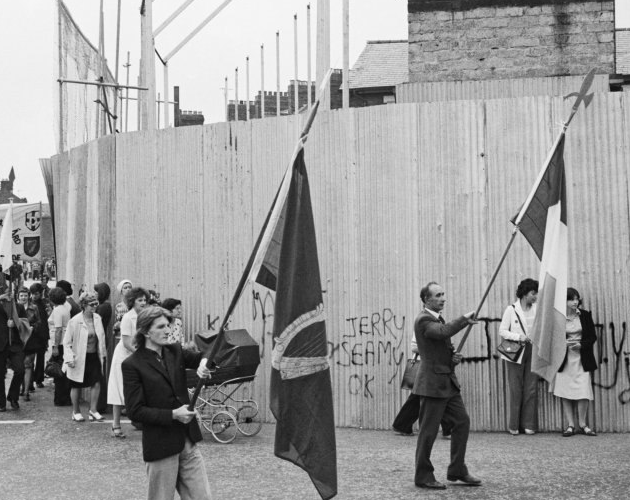
To conclude, until his untimely death on August 12th, 1996, he was still involved in all aspects of the republican struggle. Therefore, it was not a surprise when the RUC harassed his republican funeral from St Agnes’ Church on the Andersonstown Road. Former prisoners from all shades of republicanism, including prominent republicans, marched alongside the hearse carrying the tricolour-draped coffin en route to Milltown Cemetery. At one stage, two of the pallbearers were Australian First Nations activists in Belfast for a conference.
A graveside oration was given by Alex Maskey, who said: “Jimmy was fiercely loyal to those around him, to the Republican Movement and, in a very particular way, the prisoners. Your passing represents a huge loss; the struggle and community were strengthened by your participation.”