


Does the concept of polycrisis capture the current conjuncture?
The world is on fire. Every day we wake up to news of brutal wars, reckless environmental destruction, oligarchy brazenly flaunting its wealth and power amidst escalating economic inequality, election of politicians who are blatantly corrupt and hostile to the class interests of those who elected them, news reporting that is narrow, deluded or deceitful, universities dominated by myopia, conformity and cowardice, popular culture obsessed with celebrity narcissism, superhero fantasy, and ludicrous gaming, supermarkets stacked with junk food, rampant drug addiction, mass shootings, rising rates of suicide and other indicators of mass mental illness, swelling levels of homelessness, crumbling public infrastructure, dismantling of the public sphere, extreme individualism, breakdown of social discipline, erosion of community.
Most people are caught up in these phenomena, experiencing them one by one, living disconnected lives amidst these seemingly disconnected phenomena.
But are they disconnected? Is there some kind of connective tissue running through the chaos, the craziness, the injustice, the myopia, the deception that unfold before us daily? Is there an underlying dynamic generating the many manifestations of destruction, decadence and despair in contemporary society?
How to explain the cascading crises of our time?
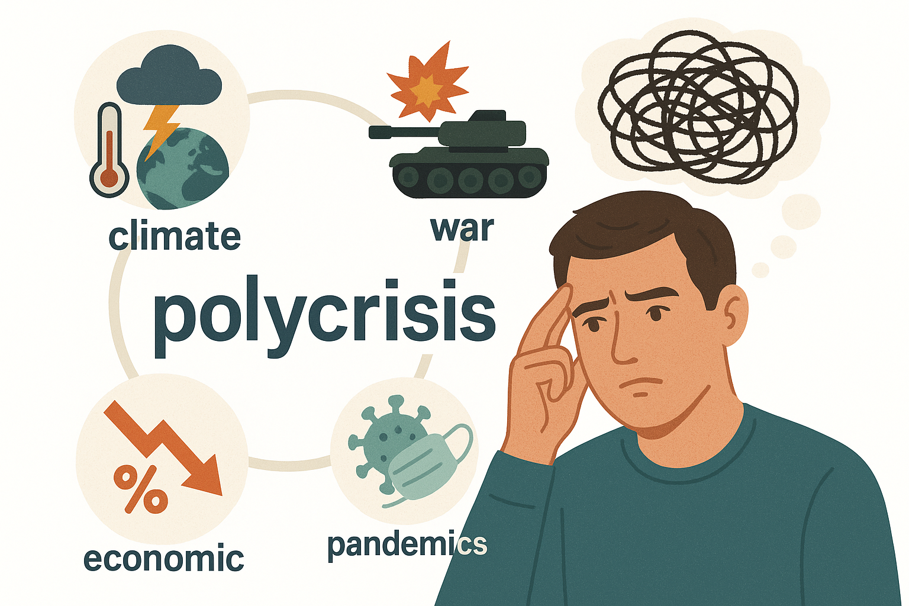
Among attempts to conceptualise the multiple crises of this conjuncture, the concept of polycrisis has come to the fore. It articulates the multiplication of crises, their entanglement with each other, their acceleration in scale, time and space, as well as the emergence of impacts irreducible to particular factors.
However, instead of following the logic of this trajectory, it tends to back away and deny common causes or solutions. It not only displays a resistance to organising concepts but declares systemic analysis impossible. This intensifies a crisis of meaning, which blocks attempts to come to terms with all other crises.
For Adam Tooze, the most prominent theorist of this position, the crises are disparate but interact in such a way that the whole is even more overwhelming than the sum of the parts. These multiple sources of systemic risk amplify each other and bring a diversity of challenges. However, he insists that there is no single dominant contradiction or source of tension or dysfunction. He goes right up to the threshold of comprehension, but then retreats, standing on his own light and refusing lucidity. He actively embraces ambiguity and advocates living with “the loose ends of history”.[1]
In contrast, there is Marxism.
Perry Anderson sees Tooze as treating politics as elite agency, episodic decision-making and institutional contingency, rather than in terms of the structural contradictions of capitalism.[2] The editors of Monthly Review note that “Tooze delights in creating flow charts of polycrises consisting of numerous free-floating signifiers of crisis with arrows pointing in each and every direction, lacking any center, thus presenting a perfect prescription for paralysis… In contrast, fundamental explanations of the overarching economic, social, and ecological crises are present within contemporary Marxist analysis.”[3]
Tooze explicitly rejects such an analysis, accusing Marxists of “capitalocentrism”. He acknowledges Marxism’s strength in diagnosing the inherent crises caused by capitalism but argues that it fails to account for the scale, speed, and complexity of contemporary crises. He insists on the impossibility of identifying a common cause or solution to these crises. He accuses Marxism of structural determinism that cannot capture the complexity of contemporary crises. He opts for pluralism and ambiguity in analysis and liberal technocratic governance in practice as offering the only hope.[4]
So, even when intellectuals attempt to connect the crises, unless they name the system, they fail to discern the deeper dynamism generating the cascading crises. The system operates in such a way as to generate multiple crises that cannot be resolved within the system. This produces a crisis in meaning, due to fragmentation and disarray of a system in the process of disintegration.[5]
Capitalism is a system no longer able to conceptualize itself as a system, no longer able to sustain credible criteria of truth or morality, no longer able to prevent the turbulence of destruction from prevailing over the vitality of creation. It is a system in the throes of a protracted process of decline, unleashing waves of irrationality, disorientation, injustice and despair. It is an empire in freefall, lashing out in every direction, no longer able to conceptualise and control the world but determined to destroy any force that dares to do so, let alone resist it.[6]
Only Marxism grasps that all these crises are rooted in a systemic crisis demanding systemic analysis. Only Marxism has the capacity to provide real meaning, perspective, foundations, and purpose, because it is a coherent, credible and comprehensive worldview capable of grasping the causes and connections of cascading crises. Other attempts at explanation mistake contributing factors for ultimate causes, giving small answers to big questions and offering only facile, false or futile solutions. Marxism is the only sound basis for a meaningful analysis of the current conjuncture.
Notes
[1] Adam Tooze, “Defining Polycrisis—From Crisis Pictures to the Crisis Matrix”, Chartbook 130, June 24, 2022, and “Polycrisis and the Critique of Capitalocentrism”, Chartbook 343, January 6, 2025, adamtooze.substack.com.
[2] Perry Anderson, “Situationism à l’envers?”, New Left Review 119, September–October 2019, 47–93.
[3] “Notes from the Editors”, Monthly Review 77-6, November 2025, 65. https://monthlyreview.org/articles/mr-077-06-2025-10_0/.
[4] Tooze, op. cit.
[5] Helena Sheehan, “Capitalism and the Crisis of Meaning in Our Time”, Monthly Review, June 2026, 54–65. https://monthlyreview.org/articles/capitalism-and-the-crisis-of-meaning-in-our-times/
[6] Helena Sheehan, “Capitalism and Cognition”, Monthly Review, July–August 2026, 126–134. https://monthlyreview.org/articles/capitalism-and-cognition/