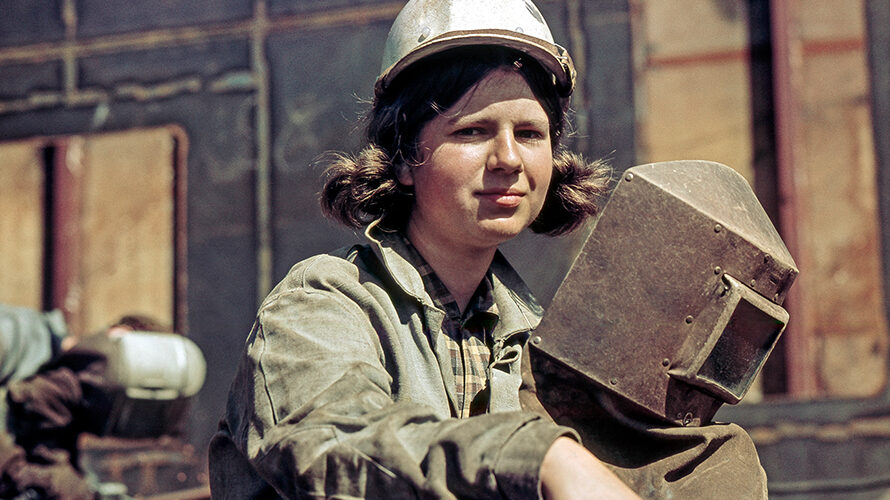



The German Democratic Republic (GDR) was founded in October 1949, four months after the Federal Republic of Germany (FRG). From its first year, the emancipation and social participation of women were core objectives of its socialist project, with equal rights anchored in its constitution. What followed was perhaps the most comprehensive transformation of women’s lives achieved in a single generation.
In reproductive health, the GDR began producing a contraceptive pill in 1965, making it freely available. In 1972, it passed a Termination of Pregnancy Act, legalising abortion and becoming the first German state to give women the right to terminate a pregnancy within the first twelve weeks, no questions asked. In the FRG, abortion remained a criminal offence until 1974 and legally restricted thereafter. To this day, abortion in Germany is technically illegal.
Support for working mothers was a cornerstone of GDR social policy. A year after its foundation, the GDR passed the Protection of Mothers and Children and the Rights of Women Act, establishing fourteen weeks of paid maternity leave, extended to eighteen weeks in 1972 and twenty-six weeks in 1976. From 1976, mothers with two or more children were entitled to one year’s paid leave; this was extended to all mothers in 1986, and in justified cases to fathers. Child benefits began in 1950 from the fourth child onward, extended in 1972 to 20 Marks per month for the first and second child and 50 Marks for the third, rising in 1987 to 50, 100 and 150 Marks respectively. From 1972, first-time married couples under twenty-six received an interest-free loan of 5,000 Marks, with repayment cancelled when children were born. A maternity grant of 1,000 Marks was introduced for every child.
The expansion of childcare was key to enabling women’s high employment rates. Crèche places per hundred children aged zero to three rose from 80 in 1955 to 165 in 1965, 256 in 1970 and 304 in 1972. By the early 1970s, there were more places than children, allowing full coverage and flexible care. By 1980, 60% of children aged zero to three attended crèches; by the late 1980s, coverage had reached approximately 80%. Kindergarten places for ages three to six exceeded 90% by 1980 and approached 95% by the late 1980s.
Women’s employment rose from 61.2% in 1955 to 81.9% in 1970 and 91.2% in 1989 – among the highest rates in the world at the time. By the late 1980s, women made up 55% of students in higher education and technical colleges. The state promoted women’s professional development through “women’s promotion plans” aimed at furthering women’s careers.
In the West, professions such as crane operator, construction worker, bus driver, locksmith, engineer, steelworker and miner were almost exclusively male domains. In the GDR, women routinely did all of these jobs. In 1959, around 39,390 women worked in construction, approximately 8.7% of the sector’s workforce. In 1970, 5,181 university-trained engineers graduated; from 1972, women consistently accounted for over 25% of students enrolling in the technical sciences.
Gender was never a barrier to who you could become. Women did not need to define themselves in opposition to men; equality was a given, not a demand. This is not to imply that patriarchy had vanished – it lingered – but it was not the organising principle of life. Women were persons first; gender came second, if at all. Remarkably, this transformation happened within a single generation, an incredibly short time to undo centuries of patriarchy. Women’s rights, accessible childcare, full employment and free education shaped both women’s possibilities and self-perception.
Then came the annexation. On 1 July 1990, the monetary, economic and social union came into force. The GDR Mark was pegged to the D-Mark at a 1:1 rate – massively overvaluing the GDR currency. Economists estimated a realistic rate would have been closer to 1:4.43. GDR goods became instantly uncompetitive, and industrial production collapsed. The Treuhandanstalt privatised or wound up some 8,000 GDR state-owned enterprises between 1990 and 1994. Three million jobs were destroyed, 30% of enterprises closed, and two-thirds were sold, often for a symbolic one Deutschmark.
Women bore the brunt of the job losses. Their unemployment rate was nearly double that of men in 1991. Today, almost three-quarters of long-term unemployed people in the East are women. A key reason was the collapse of cheap childcare: crèches and kindergartens closed in huge numbers. Nearly 90% of GDR women were qualified professionals. After annexation, many qualifications were not recognised by the Federal Republic, forcing women out of the workforce. The forty-year project of women’s emancipation was systematically dismantled.
The academic purge was equally ruthless. At Humboldt University, 75% of academics and 70% of research assistants were dismissed, while nearly all social science lecturers were replaced by West Germans. Today, despite being 19% of the population, East Germans hold only 8.1% of top academic positions.
Who writes history? Since the annexation of the GDR, the West has determined that no positive memory whatsoever must remain. The memory of the GDR – its achievements, contradictions and history – will not be erased. The future belongs to those who remember, and those who remember will, we hope, one day rebuild.
A much more detailed version of this article is available at: https://www.anclogan.ie/contested-memory-the-german-democratic-republic-and-its-erasure/