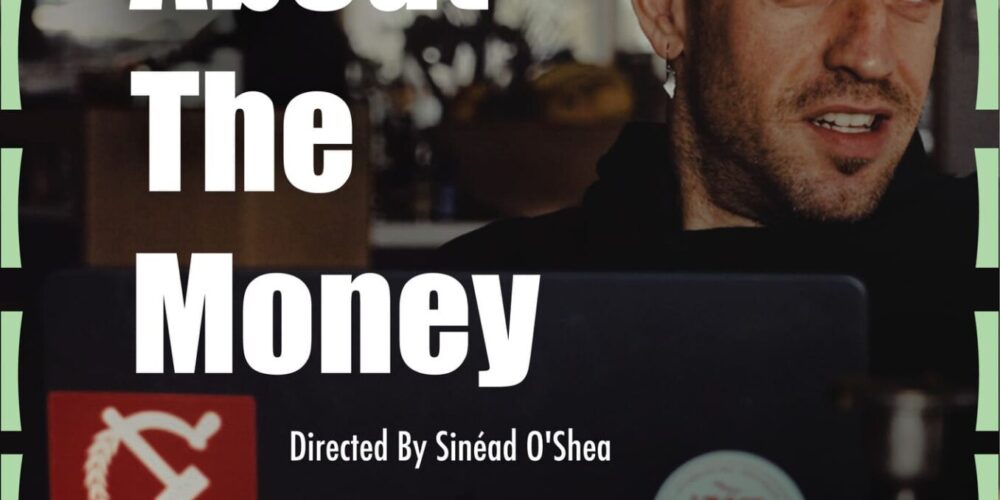


Sinéad O’Shea’s documentary All About the Money was screened in Dublin on 26 September as part of the IFI Documentary Festival 2026, followed by a Q&A with O’Shea. Her documentary is a story of Fergie Chambers, in particular following his activities in the period from 2023 to 2025. It premiered at the Sundance Film Festival early this year, and received mixed reactions there, but also back home in Ireland—for different reasons. Some of the audience at Sundance, according to O’Shea, were appalled by the implied politics of it. Some of the people in Dublin I talked to after the Sundance premiere were appalled by the lack of politics in it. Unsurprisingly, after seeing the film at the IFI, I side with the second camp (and admittedly, with Chambers himself).
It is a strange feeling to watch All About the Money mere days after the Spanish government has decided to allow the Trump administration’s extradition request for Fergie Chambers to be processed by Spanish courts. Activist and supporter of humanitarian and progressive causes around the world, Chambers has been arrested in Spain as a result of a US crackdown on solidarity, anti-imperialist activities, and communist organising. O’Shea’s documentary covers a segment of his work, from organising in the US and Palestine solidarity activities there, to his move to Tunisia, and then finally his move to Ireland.
It is a personal story, a humanising story if you will, of a man in very specific circumstances. It was the humanising aspect, O’Shea explained in the Q&A, that baffled some of the American audiences who felt utmost resistance to the concept of a communist with a plan of putting generational wealth to a use for the cause. The expectation was, as Mark O’Connell cynically proposed in the Q&A, that such a story would necessarily have to be presented as a sort of “gotcha”, an irreconcilable contradiction between communist theory, praxis, and activism, and functioning under capitalism. O’Shea did not go down this vulgar path, and she tells a story of a complex personality through the window of the years she spent talking to him and documenting his work.
However, the actual politics of Fergie Chambers are largely absent from this account. O’Shea admits that Chambers would have probably preferred it to be more political and less “psychological”; his disagreement with a version of the documentary he was shown before the release is documented in the last title card of the film. He nevertheless allowed the distribution of the film, and this story is now touring the festivals, and O’Shea uses the opportunity in the Q&As after screenings to turn the attention of the viewers to the ongoing legal struggle of Chambers in Spain, and to call for support.
The story told by All About the Money is interesting, somewhat controversial for certain audiences, and makes sense to others. But in engaging with the very materialist grounding of the apparent contradiction of the communist millionaire, it fails to invoke any sort of materialist analysis. In All About the Money, things just happen. There is an alienation of Chambers from the groups he is in, the geopolitics that shape the landscape he navigates, and the theoretical underpinnings of his worldview. Like every story, it makes choices about what to tell and what to leave out—so a perceptive viewer sees holes in the shape of certain people, organisations, and countries which were left out of the stories of Chambers’ past, Palestine solidarity activism, and political positions.
It is a difficult story to tell, there is no doubt about it—the arrest of Chambers after the film was made, and the major symbolic weight of his struggle against extradition in the realm of anti-imperialist solidarity, show that it is a long, complex, impactful story so many of us play a part in, and while it may be personified and kept on a file in a three-lettered agency somewhere under a name of one man, it has to be analysed, told, and learned from through the lens of politics and the collective. This is not the first, or the last, time I’m calling for politics in media that portray communists. In reviews of Hotel Lux and Among Communists, I noted an issue that non-political (or non-politicised) authorship gives us two-dimensional red characters with little sense to their eccentricity, swapping their materialist world outlook for very basic idealism. Telling political stories without politics has become an art form in itself, and I am not sure I have the appreciation for it; not in the moment when we are in dire need of clear political understanding, education, and inspiration.