

This summer, Belfast saw the worst of its colonial legacy, and the best of its working-class resistance. In June, racist pogroms tore through the city while the state stood by. By August, Féile an Phobail offered a different vision: solidarity over division; internationalism over ethnonationalism.
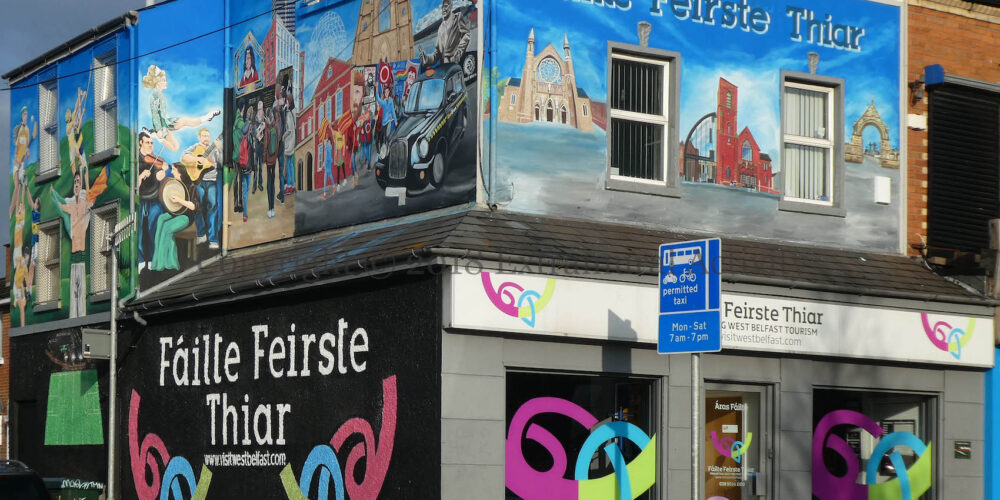
At the heart of that vision is the Belfast Gaeltacht, which has become the base of a revival that has, in recent years, reached global audiences. The Irish language is at its strongest in decades, raising urgent questions about the kind of Ireland we want to build.
At the CPI’s Féile event, I spoke with Feargal Mac Ionnrachtaigh, a West Belfast community activist, and Dan Lambert, manager of hip-hop trio Kneecap, about the Belfast Gaeltacht, the new Gaelic revival, and what a progressive Irish indigeneity might look like.
Gaeltacht Bhéal Feirste
Ireland’s newest Gaeltacht is both a living resistance to Stormont and Westminster’s hostility towards the Irish language, and one with a rich, radical tradition. From the Gaeltacht’s inception, Feargal argues, “Gaeilge was rooted first and foremost in anti-imperialism.” Facing a state that existed only to oppress, building a Gaeltacht under the nose of British imperialism presented the opportunity for young people to imagine a different kind of politics. The project was completed in 1969, just as the streets of Belfast erupted in a different pogrom, when loyalist thugs and PSNI officers unleashed a wave of sectarian violence that saw hundreds of families displaced.
The Gaeltacht swelled with new speakers, as the self-starters behind the project rebuilt the houses in just ten months, despite constant attacks from state and paramilitary forces. More than just a language revival movement, Gaeilge was interwoven with a decolonial, anti-capitalist politics, becoming integrated into struggles for civil rights, self-determination, housing, and labour. Tenants’ unions and workers’ cooperatives sprung up alongside the Gaeltacht to alleviate deprivation in a militarised West Belfast. “It was decolonial in its essence,” Feargal says, “it was about giving self-respect back, and helping people to organise themselves as a collective.”
Its radicalism would persist through na Trioblóidí and past the Good Friday Agreement. Gaeilge in the Six Counties flourished, as British militarisation withered; West Belfast’s Gaelscoileanna are built over the same barracks that sought to quell the city’s anti-colonial movement.
It is also the same radicalism that has brought Kneecap to global success, not only making Gaeilge “cool and sexy”, in the words of Dan Lambert, but also upholding Belfast’s history of resistance. For Dan, Kneecap’s success is due to “all the people who kept the language alive before, whether that’s people in the Gaeltacht, whether that’s people who were in prison… that’s where the credit lies.”
Towards an Irish Indigenous Politics
The experience of the Belfast Gaeltacht is a far cry from that of Free State Gaeilgeoirí. While our state is not as openly hostile to the language, it sees Gaeilge as a sacrifice to its priorities as a junior partner in imperialism. Growing up before the “Kneecap Effect”, Irish was parochial and backwards in a new, cosmopolitan Ireland. There was a shame around speaking a language that would often elicit the question, “What kind of job do you think you’ll get with that?” Now, the fiercely political Celtic Revival has seen groups like Connemara’s Bánú housing campaign carrying the tradition of weaving the language with the struggle for social rights.
Ireland’s Gaeltacht movement can be seen as part of a wider and ongoing revalorisation of indigenous identity since the 1990s. The parallels between the former militarisation of West Belfast and the Zionist occupation of the West Bank, and the experience of recovering a language after centuries of shame and colonial violence, show the importance of an internationalist, decolonial politics.
However, coloniality in Ireland is being pulled in three directions, between progressive revival, neocolonial complicity, and fascist nativism. Our island is deeply enmeshed in settler-colonial violence: the British state has implicated the Six Counties in the Gaza Genocide through its collaboration with Israeli arms manufacturer Elbit Systems, while Irish companies like Smurfit-Kappa pulp ancestral forests in Colombia to make cardboard. Meanwhile, the same far-right that led the Belfast and Dublin pogroms has appropriated Ireland’s colonial history, using white supremacist terms like “the Great Plantation” to cast migrants as a threat to the “native Irish”.
How then can we build a progressive, decolonial Irish indigeneity? The Belfast Gaeltacht offers an example. When the racist pogroms tore through Belfast, the community did not wait for the state to respond – they organised. As Feargal recalled, the Anaka Women’s Collective “went into these areas and pulled families out of burning homes, while the PSNI stood idly by and watched them.” Far from ethno-nationalism, “true connection to the Irish language”, as Dan puts it, “leads to solidarity, an international solidarity with the working class.”
The Belfast Gaeltacht shows us the power of building collectives and building connections. The struggle for the Irish language, the struggle for Palestinian liberation, and the struggle against racism in our streets, are not separate, but deeply connected. In a summer of colonial violence and working-class resistance, this is the vision Féile an Phobail offered us: a different Ireland, being built street by street.