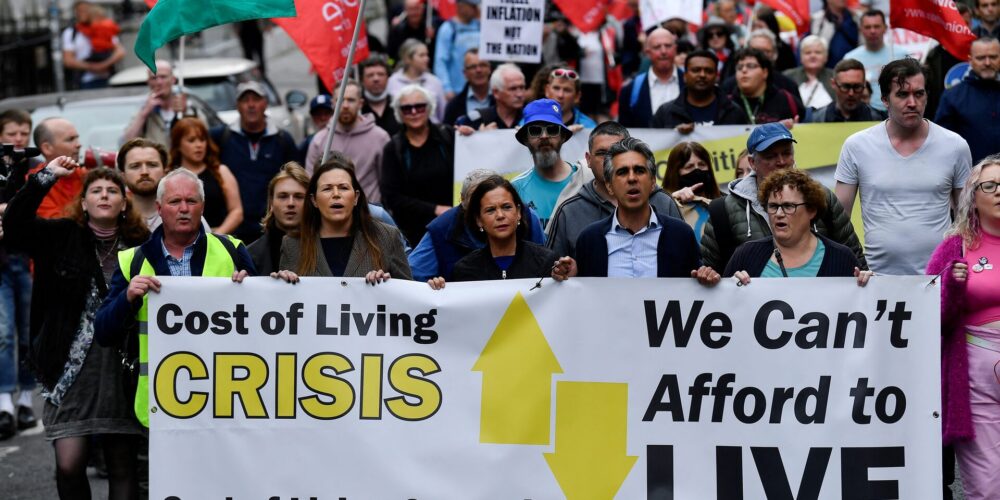



For most workers, whether living standards are improving comes down to something fairly tangible: what comes into the household and what has to go out again. A pay rise matters because it increases the claim a worker can make on the goods and services produced by society, but that gain can quickly disappear if rent, mortgage payments, electricity, childcare or transport rise faster. In August, consumer prices in Ireland were 3.7 per cent higher than a year earlier, while housing, water, electricity, gas and other fuels had risen by 8.5 per cent and transport by 5.4 per cent. A lower rate of inflation does not reverse the increases that have already taken place; it simply means that prices are rising more slowly from their new level. These pressures now sit directly behind the developing public-service pay dispute, where unions have moved towards coordinated industrial action following the expiry of the previous agreement without a successor deal in place, arguing that pay must protect living standards and that outstanding commitments under the previous agreement must also be honoured.
The struggle for higher wages therefore has an immediate relevance, but the argument over what wage struggles can achieve is hardly new. Marx developed Value, Price and Profit out of a debate within the First International over whether trade unions could improve workers’ position by fighting for higher wages. He rejected the argument that workers should abandon those struggles simply because they could not abolish the wage system itself: workers who refuse to resist reductions in wages or fight for increases do not escape capitalism, but leave capital with greater freedom to determine the terms on which their labour is bought. At the same time, Marx warned against allowing the struggle over wages to become the limit of working-class politics, because winning a better price for labour does not remove the relationship that requires workers continually to sell their labour in order to live.
Those limits become clearer once the wage has been earned, since workers must still secure the necessities required to reproduce everyday life. Rent, mortgage interest, energy, food, transport, childcare, insurance and healthcare all make claims upon household income, although they do so through very different economic relationships and should not be collapsed into a single category. The exploitation of labour takes place in production, but once the wage is paid, part of it is then absorbed through rent, interest and the cost of essential goods and services, much of which is privately owned and organised for profit, often within markets characterised by concentrated economic power.
In this way, a portion of the income returned to workers as wages flows back towards landlords, financial institutions and private firms. The same problem can arise through public spending when the State subsidises rents, energy bills or privately provided services without expanding the public assets and productive capacity that could reduce those costs over time. What connects these different relationships from the standpoint of the worker is that the greater the share of income required simply to meet basic needs, the less remains for everything else.
Housing shows how quickly gains made at work can be absorbed outside it, with a worker potentially winning a wage increase through collective bargaining only to see much of it disappear through higher rent. Continually increasing household income so that workers can chase rising market rents leaves the underlying relation largely untouched, whereas expanding public and cost-based housing changes the terms on which the need itself is met. The same principle extends, in different forms, to healthcare, childcare, energy and transport.
Two workers receiving the same wage can consequently experience very different standards of living if one has access to secure affordable housing, healthcare, childcare and public transport while the other must purchase those needs largely through private markets. Public provision still requires real resources, including labour, materials, buildings and infrastructure, but meeting those costs collectively changes how they are distributed and reduces the extent to which access depends upon the purchasing power of an individual household at the point of need.
Higher wages and universal public provision should therefore be understood as connected parts of the struggle over living standards. Workers need a greater share of the wealth they produce, while having an equally clear interest in reducing the portion of that income that must immediately be surrendered to landlords, financial institutions and private providers simply to maintain an acceptable standard of life. The more necessities are brought into universal public provision and secured as social rights, the less household security depends upon the size of the individual wage alone.
Ireland’s economic structure gives this argument particular force because the enormous wealth recorded within the economy does not translate automatically into greater control over the conditions that determine living standards. GDP grew by 8 per cent in 2025, driven by an expansion of 14.5 per cent in multinational-dominated sectors, while domestic-dominated sectors grew by 2.2 per cent. The CSO has had to develop measures such as modified GNI precisely because multinational activity can significantly distort the picture given by headline GDP.
Foreign investment provides real employment, exports, skills and tax revenue, but Ireland’s dependence upon externally controlled capital also means that major investment decisions and important areas of productive capacity remain tied to decisions taken elsewhere. The State can therefore collect substantial revenues while housing, energy, care and infrastructure remain heavily dependent upon private provision, with public money used to support households in immediate need while also subsidising private rents and services and transferring substantial sums to landlords and private firms, rather than building the publicly owned assets and productive capacity that could reduce those costs over time.
Very high levels of measured wealth can therefore coexist with shortages of housing, infrastructure and other forms of productive capacity. Financial resources on their own cannot build houses without land, skilled workers, materials and construction capacity, just as public money cannot secure affordable energy indefinitely by compensating households whenever international prices rise. Subsidies and emergency supports can be necessary when people are under immediate pressure, but there is a material difference between relieving costs produced by an existing system and developing the capacity to meet those needs on different terms.
Once this is recognised, questions of ownership and investment become increasingly difficult to avoid. Rent regulation can protect tenants, but its reach remains constrained where housing is scarce and predominantly organised as a private asset. Energy supports can protect household income, but they do not determine the ownership of future generation or the direction of investment. Higher wages can improve living standards, but the gains remain vulnerable where large parts of the wage are continually absorbed through the cost of necessities. Reforms can go a considerable distance, especially where organised labour is strong enough to force concessions, but the further they move from easing the effects of the market to controlling supply and investment, the more directly they challenge existing ownership and power.
There are therefore limits to how far living standards can be separated from questions of economic control and power, although those limits are neither fixed nor knowable in advance. A stronger trade-union movement can increase labour’s share of the wealth it produces; public housing, healthcare, childcare, transport and energy can reduce the amount workers must spend merely to live; and greater public control over finance, infrastructure and strategic investment can increase society’s ability to decide what productive capacity is developed and for what purpose.
The cost of living extends far beyond the management of household budgets during periods of high inflation. It concerns the division of wealth between labour and capital, the extent to which necessities are organised through private markets, and the ownership of the resources upon which society depends. Living standards can be defended through immediate struggles over wages, rents, prices and services, but making those gains durable ultimately requires a shift in the balance of class power itself.