


This is the second in a five-part series on the politics of power. The first asked what makes rights and freedoms real. This article examines what happens when they come into conflict.
Consider a home. To the person living in it, whether tenant or owner-occupier, it is somewhere to live and build a life. But housing can also be owned as an asset: rented for return, accumulated in portfolios, or held in expectation that its value will rise.
When these purposes conflict, a wider hierarchy of rights becomes visible. A landlord possesses ownership and control over a house; a tenant depends upon its use in order to live securely. Both can make claims in the language of rights, yet they do not enter the conflict from equal positions.
The previous article argued that rights and freedoms become real only when sufficient power exists to establish and defend them. But rights can also conflict. When they do, whose rights prevail?
Capitalist society presents individuals as formally equal before the law. This was an important advance over societies in which rights were determined by birth or inherited status, and democratic freedoms remain real gains won through struggle. Formal equality, however, does not give everyone an equal material capacity to exercise freedom.
A worker and an employer are both formally free to enter an employment contract. The employer offers wages and conditions; the worker may accept or refuse them. On paper, two legally equal individuals have freely reached an agreement. Materially, their positions are very different. The employer controls employment and productive property; the worker normally requires wages to secure housing, food and other necessities.
The freedom of contract is real, but its meaning is shaped by the unequal power of those entering into it. The same applies to the freedom not to work. A worker may legally refuse paid employment, but without another source of income, the necessities of life still have to be paid for. Someone who owns sufficient capital or property may stop working personally while returns from ownership – profits, dividends, rent or interest – or accumulated wealth continue to sustain them. Both possess a formal freedom not to work; its material meaning is radically different.
This is the difference between formal and material freedom: what we are legally free to do, and what our actual circumstances give us the power to do.
Property therefore occupies a distinctive position within capitalist society. However, owning a coat, a television or the home you live in does not, by itself, give you control or power over resources on which others depend; they merely satisfy your personal needs or wants. The relation changes when ownership is concentrated in land, housing, workplaces, finance, energy and other productive resources upon which society depends. Such ownership gives more than wealth. It gives social power.
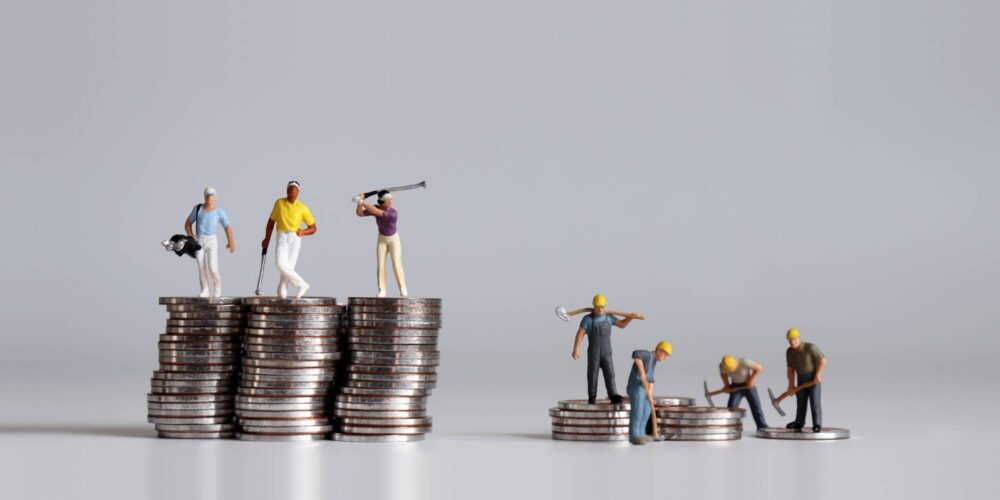
So it is not simply that some individuals are richer than others. A relatively small owning class controls much of the land, workplaces, finance and productive resources upon which society depends. Most people do not control those resources and depend principally upon selling their ability to work for wages. Power comes from controlling resources others require.
This concentrated ownership gives the capitalist class a disproportionate capacity to determine how society’s resources are used: where investment goes, what is built, which enterprises expand or close, and where employment is created or withdrawn. The freedom attached to property can therefore shape the conditions under which others exercise their freedom.
Housing demonstrates this very clearly. A home has a use value: somewhere to live. Under capitalism it can also have an exchange value: it can be bought, sold, rented and accumulated as an asset. These functions can coexist, including for an owner-occupier, but they can conflict when housing is organised principally as a commodity from which a financial return is expected.
A society may urgently need affordable housing while land remains undeveloped, homes stand vacant, or investment flows towards housing offering the greatest return. At the level of society, declaring housing a right has little material force while much of the land and housing development is controlled by private owners and investors, with decisions about what gets built and when shaped by expected financial return. Access then depends largely upon what households can pay, while supply is shaped by profitability rather than social need.
Private landlords, developers and investment funds already exercise considerable control over housing and land. If the right to housing is to be more than words, that control must be subordinated to the social need for secure and affordable homes.
The same contradiction appears wherever essential needs are organised as commodities. Healthcare, energy and land can meet human needs while also serving as sources of private profit and accumulated wealth. Capitalism gives particular freedoms a structural advantage because ownership carries control over resources upon which others depend.
The hierarchy also appears internationally. The Palestinian right to self-determination has been overwhelmingly reaffirmed by the United Nations, and Ireland formally recognised the State of Palestine in 2024. Yet recognition has not been matched by collective measures capable of altering the balance of power, ending Israel’s assault on Gaza or stopping the genocide.
Israel’s claims to security have repeatedly been given greater practical weight by the dominant imperialist powers than Palestinian life, freedom and national self-determination. Rights recognised by the majority can still be overridden when military, economic and diplomatic power lies elsewhere.
Recognising that rights and freedoms do not carry equal weight within existing relations of power does not diminish individual freedom. Freedom of speech, association, political organisation, privacy and trade-union activity are real gains that working people have fought to win and defend.
But freedom is more than what the law allows us to do. Capitalism emphasises what people are formally free to do: enter contracts, purchase property or accumulate wealth. Less attention is given to what people are materially free from: poverty, debt, insecure housing, being forced to migrate by poverty, war or economic necessity, loss of income, or dependence upon privately controlled essential services.
These freedoms are connected. Freedom from poverty, insecurity and economic compulsion expands the freedom to act: to refuse degrading work, participate in political life, organise collectively and make meaningful choices. Material freedom creates the conditions in which more people can exercise individual liberty.
A communist approach seeks to organise essential resources around social need rather than private return. This can be summed up as rights before commodities. In practice, that means giving society democratic control over essential resources so that their use is determined by need rather than financial return.
Ireland’s struggle against domestic water charges showed what this can mean. Right2Water brought together trade unions, community groups and political organisations in mass opposition to the charging regime. The claim that water should be treated as a right rather than a commodity mattered because an organised movement stood behind it. That movement helped force the state to retreat from domestic water charges.
Declaring something a right is therefore not enough. Calling housing a right does not build homes; calling healthcare a right does not provide doctors or hospital beds. Social rights become material when society possesses the resources, institutions and social power required to guarantee them.
Rights before commodities means changing the order of priority: housing people before extracting profit from housing; meeting medical need before private return; meeting society’s energy needs before treating energy primarily as a source of profit.
Capitalist democracy proclaims political equality while leaving the economic power of capital largely untouched. Workers may possess the same formal political rights, yet the owners of capital retain the power to decide what is produced, where investment goes, who is employed and under what conditions. Political democracy coexists with the rule of capital over labour.
That contradiction is not sustained by individual prejudice or hypocrisy alone. The recurring priority given to property, profit and accumulation is reproduced through the institutions of capitalist society itself. Law, the state, political institutions and dominant ideas operate within these relations of power and help make them durable.
The next article examines how this hierarchy is reproduced and made to appear normal, neutral and democratic: the machinery of power.