

In May of this year, the Minister for Public Expenditure, Infrastructure, Public Service Reform and Digitalisation, Jack Chambers, TD, published details of an enhanced expenditure control and escalation process to curb what was described as out-of-control spending. It was stated by the Minister that spending was already over the 6% targeted by the Coalition. Chambers said that “there is a need for a strengthened expenditure control environment and renewed focus on fiscal discipline … departments should ensure that they pursue efficiencies and reforms to identify savings.” In response to Dáil questioning, he further stated that the Government remains open to talks through their Officials but conditioned these talks with the following context:
“Since 2020, the public service pay bill has increased by €12 billion, reaching €34 billion in 2026, an increase of 55%. As well as providing for increases in pay rates, this investment has supported substantial growth in the public service workforce, with employment now exceeding 420,000, an increase of more than 70,000 employees since 2020 … any agreement will have to be balanced, affordable and capable of being accommodated in the context of other expenditure priorities within the fiscal framework.”
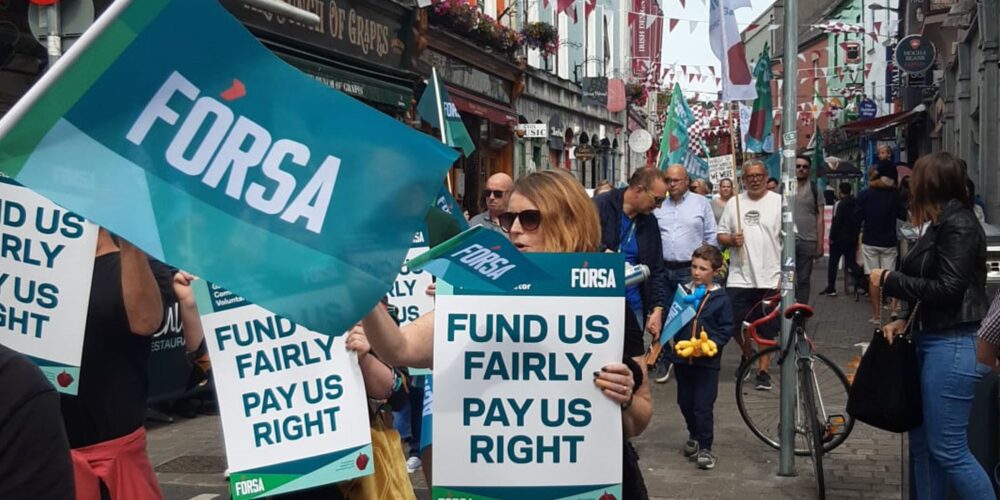
In contrast to this, Forsa General Secretary, Kevin Callinan, has demanded that a bridging pay increase be awarded for July to December 2026, while a further multi-year deal would have to have a formula linking pay increases to inflation, so as to cost-of-living-proof the deal. This would provide security to public sector workers that, should inflation continue to rise post-agreement, their future increases would not be eroded. Callinan stated that:
“We’re arguing that at the outset we should develop a formula linked to the movement in prices if there’s to be a multi-annual agreement. That it should be a formula linked to prices over a few years.
“Our experience, and I think it’s the experience of workers across the economy in general, is that the losses that were suffered as a result of inflation in 2021, 2022 and into 2023 have only really been made good in headline pay figures by now.
“It’s taken that long to catch up. We need a much tighter way where workers can maintain their living standards.”
The contrast in these two positions is the reason why hundreds of thousands of public sector workers across the State are now balloting for industrial action, and it remains to be seen whether a negotiated agreement can be reached ahead of the Budget. The State has repeatedly and clearly prioritised the immediate needs of business in addressing some of their rising costs, and so will not want to signal large pay increases to the rest of the economy.
The lesson from the fuel protests for trade union leaders was clear. Disruption is needed and necessary. Industrial peace has been taken for granted by the Government. The movement needs to flex its industrial muscle and remind the Government of the power of organised workers. The challenge is that, after decades of passivity and demobilisation, can this be achieved? Communist Party members across the public sector unions are working to deliver these necessary ballots for industrial action as Step 1.