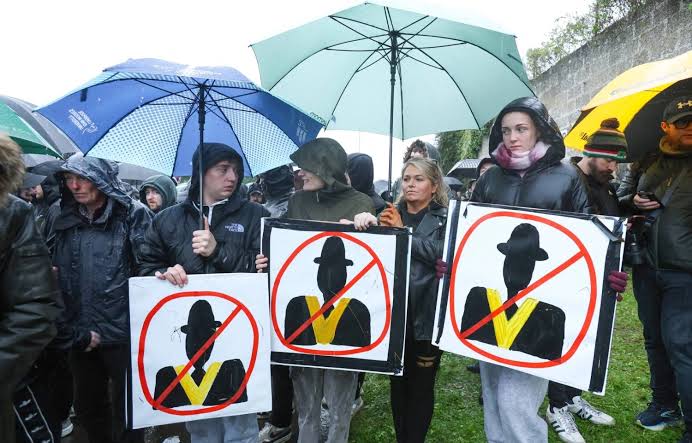


“There are decades where nothing happens, and there are weeks where decades happen.” A quote attributed to V. I. Lenin might also be applied to recent events in the Six Counties. The two-week Drumcree standoff has had a large impact on the day-to-day political situation in the north. Not only that, but it also has ramifications for the very future of the north’s political entity. By refusing to force an Orange parade through the nationalist Garvaghy Road, the PSNI has delivered an ominous message to unionism: a long-standing understanding relating to the balance of power has ended.
The setback suffered by the loyal order was particularly significant in an area which for over two centuries has been the very heartland of Orangism. Portadown’s Garvaghy Road is, after all, a mere six miles from the actual cottage in which the Order was founded in 1795. An organisation designed not only to suppress the Catholic population but to counter the influence of republicanism seeking to unite Protestant, Catholic and Dissenter.
For two centuries after its foundation, the Order, through the unscrupulous use of force and widespread employment of strategic discriminatory practices, acted as a cross-class organisation committed to maintaining sectarian supremacy and the union with Britain. Moreover, throughout those two centuries, Orangism largely succeeded in achieving its objective – doing so to such an extent that the Six Counties gained the sobriquet “the Orange state”.
Confident, therefore, in its entitlement to the unstinting support of the state and its police force, the Portadown district of the Order sought to march through the predominantly nationalist Garvaghy Road. While the Order undoubtedly anticipated some degree of resistance to its planned walk, the response – not only by local residents but by people from across Ireland – took many by surprise. On one occasion, several thousand gathered to demonstrate solidarity with the residents. Astonishingly too, a letter of support signed by almost 2,000 people from a Protestant background was read out by a former police officer.
Notwithstanding the fact that the Parades Commission had granted permission for the march and that its determination was subsequently upheld by the judiciary, the PSNI refused to repeat the practice of the RUC and beat residents off a street where they lived. Adding to this change of direction by those in power was the decision to ban the march by Chris Bryant, the British cabinet minister and Secretary of State for Northern Ireland.
So, after two centuries of exerting hegemony over the wider unionist community and the northern state, it would appear that over the course of a fortnight this was no longer the case. Not only was the Orange Order in disarray, but, seemingly, political unionism was in a similar position.
All three main unionist parties felt obliged to insist on the “right” of the local lodge to march along the Garvaghy Road. All three also spoke of their outrage at those elected members of the Stormont Assembly who assisted residents in blocking the march. Nevertheless, their responses differed significantly, ranging from meekly calling for the MLAs who protested to be fined to demands that the DUP withdraw from the Assembly. Significantly, the DUP itself is divided on this issue, with its prominent MP Carla Lockhart at odds with party leader Gavin Robinson over whether or not to bring down Stormont. Ms Lockhart is not alone in the party, with Assembly members Jonathan Buckley and Brian Kingston recently joining an Orange parade to protest against the decision by Secretary of State Bryant to ban the march.
Elsewhere, the extreme hardline Traditional Unionist Voice (TUV) party of Jim Allister is exploiting its rival’s difficulties. By openly supporting the Lockhart call to collapse the Assembly, the TUV has every likelihood of capturing seats from the DUP in the upcoming local government and Assembly elections next May.
The likely outcome of a fractured unionism is the return of a Sinn Féin First Minister in the aftermath of the above-mentioned May Assembly election. Moreover, the party is apparently determined to strengthen its team in Stormont, as it has selected three of its most talented members to run in the upcoming contest.
All of which gives rise to several questions. What is happening in the north, and are these occurrences of real significance? To begin, several important facts have to be identified.
In the first instance, unionism is no longer the monolith it once was, as major differences in approach were evident in relation to the Drumcree event. Moreover, there has emerged a significant section of the unionist community who no longer actively support any of the political parties and remained impassive during the Portadown standoff. Interestingly too, there was an absence of loyalist paramilitaries.
There was then the very clear evidence of multi-party support for the Garvaghy Road Residents Coalition, with only Fianna Fáil and Fine Gael refusing to send a spokesperson to the huge rally of support. Importantly, there was no display of triumphalism in the aftermath of the decision to ban the Orange parade.
Lastly is the fact that the state and its forces decided not to antagonise the north’s non-unionist constituency, as they opted not to deploy their physical might to enforce a court order. That in itself is a major acknowledgement of the changing circumstances on the ground in the Six Counties.
All of which begs the question: why? Why this dramatic change in response to a challenge to “law and order in the King’s realm”? One could speculate, but in the absence of concrete evidence, better not. All the same, it has to be said that the times they are a-changing in the north – and hopefully in a positive direction.
Truly there are indeed: decades where nothing happens, and weeks where decades happen.