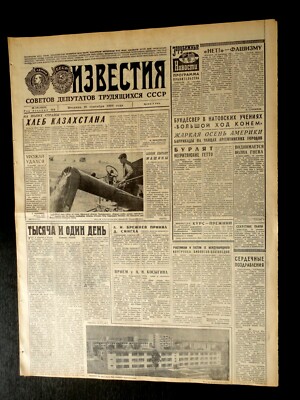
Vikentiy Matveyev (1923–1997), celebrated foreign correspondent of the Soviet newspaper Izvestiya and a historian, was among the first Soviet journalists to visit Ireland. Here, we reproduce entries from his journal documenting his visits in 1955 and 1961.
3 September 1955
I was fortunate enough – yes, indeed! – to spend a week behind the ‘green curtain’, which still firmly separates Ireland from contact with Soviet people at all levels, from the official level downwards. I did not coin the term myself; it was the Irish writer Peadar O’Donnell who presented me with a copy of his book in Dublin, inscribed: ‘To the first Soviet journalist to penetrate the Green Curtain’. I owe this ‘penetration’ to… astronomy. At the end of August, the International Astronomical Congress took place in Dublin. The editorial team had tasked me with covering the congress for the newspaper. The Irish Embassy in London could not refuse me a visa.
The surprises began at Dublin Airport. I was asked neither for my passport nor where I was from. The same thing happened when I was leaving Ireland. Instead, I was subjected to a thorough interrogation by a health inspector, concerned that foot-and-mouth disease – a scourge of livestock – might be brought into Ireland. The customs officer twirled a couple of bottles of ‘Stolichnaya’ in his hands and asked whether it was as good as the local whiskey. I was in the presence of a connoisseur of strong drink, as are most Irish people.
Another, and the main, surprise was how easy it was to interact with the Irish compared with in England, with the exception, of course, of the clergy; for it is precisely the local Catholic Church’s categorical rejection of everything associated with the ‘godless Soviets’ that explains the Dublin authorities’ avoidance of any contact with us.
Mr O’Donnell’s visit to my hotel came as a most pleasant surprise. Although of advanced age, he was remarkably energetic and immediately spoke of the purpose of the meeting: to try, with my help, to facilitate the establishment of diplomatic relations between Ireland and our country. The fact is that the prosperity of County Donegal, on the western tip of Ireland, depends on the fishing industry, and O’Donnell sees the Soviet Union as a promising market for fish products in exchange for imports of our timber into Ireland. This business factor, he said, would help break through the barriers to communication with the Soviet Union erected by the Catholic Church. He asked whether he could count on continuing our acquaintance in London, where he often visits. Of course! I said that in my reports on Ireland in Izvestiya, I would certainly raise the issue that interested him.
O’Donnell, with his fame among the Irish, helped me to meet a wide variety of people on the ‘Emerald Isle’. Not only was there no ‘Iron Curtain’ whatsoever, but I felt considerably freer in Ireland than in England.
Together with our astronomers, we managed to attend official receptions, where none of the local dignitaries shied away from speaking with a Soviet journalist. This included participants in Ireland’s national liberation struggle of 1916–1922, which we had supported at the time. People here still remember that. At one reception, an elderly Irishman introduced me to a man of his own age and said: ‘We were in the same prison cell forty years ago.’
‘Fair play, what a recommendation’, remarked another Irishman.
‘The very best we could have!’ replied his friend.
It was not uncommon during meetings in Dublin to hear talk of what was referred to as the ‘bleeding wound’ – the partition of the island, and the six counties in the north of the island that form part of the United Kingdom of Great Britain. I got the impression that some of the Irish people who spoke in this way, particularly the younger ones, would like to see our country as a source of support for their sentiments. However, this was not stated explicitly.
8 May 1961
I have returned from my second trip to Ireland – a ‘hassle-free’ one as far as visas were concerned, even though diplomatic relations have not yet been established, though this is, it seems, just around the corner. My stay there coincided with Gagarin’s space flight. Children and newspaper sellers were running through the streets of Dublin, shouting his name, each in their own way. Not a single Catholic prelate dared to excommunicate the ‘stranger in the heavens’. I quickly made new acquaintances and rekindled something of a friendship with Peadar O’Donnell. An interview on Irish radio was broadcast that very same day. Articles about my stay appeared in the newspapers. This time I managed to see the country beyond the capital. Peadar put me in his well-worn ‘Volkswagen’, and we set off north-west, to County Donegal – the writer’s homeland. There used to be a train service; now you can only get there by car. A deserted motorway. The only thing to watch out for was sheep darting across the road. The village of Dunkineely. Peadar’s house is not far from the wild cliffs where the waves of the Atlantic crash.
‘The nearest parish in the West,’ jokes O’Donnell, ‘is in New York…’
The local population relies heavily on fishing, but even that is in decline. We need large markets. Peadar remains a passionate advocate for developing trade links with our country, and now few of his compatriots see him as anything short of the ‘Antichrist’.
Ireland’s second-largest city is Cork, where the bishop has just, for some reason, launched a tirade against the Communists, apparently frightened by the resonance of Gagarin’s feat, whose name he prudently failed to mention. I travelled to Cork by rail in a half-empty carriage, passing overgrown, deserted stations. In Cork Cathedral, I committed a double sin: I lied in the visitors’ book about who I was and where I was from, and repeated the deception when the bell-ringer in the belfry offered to let me ring the bell, asking where I was from. I claimed to be Dutch. Just imagine what would have happened if the city’s bishop had found out about an ‘atheist communist’ ringing the bell from the belfry!
After Cork came the little town of Killarney, celebrated in Irish poetry. A pack of hotel agents pounced on me, but I chose a modest abode on the very outskirts of the town, where wild ducks took flight from under my feet. I checked into the hotel, making no secret of my affiliation. The woman behind the counter joked: ‘I thought Russians wore horns!’
An elderly Irishman standing nearby remarked:
‘I knew that was propaganda. You’re not at all like what they write about you in the papers…’
The longer I stayed in the country, the more I was struck by its vibrant cultural life, with its festivals of song, poetry, drama and dance. And, without exaggeration, the warmest impression I took away from my encounters there came from my conversation with Seán Ó Riada, the conductor of one of the orchestras, who tracked me down and invited me to his home, where his wife and I sat talking from midnight until three in the morning after Ó Riada’s concert. Seán spoke of many things that went beyond the scope of ordinary conversation. It was clear how deeply he was moved by Ireland’s long and troubled history.
‘The most difficult period in our history,’ he recounted, ‘coincided, not by chance, with the disappearance from the country of the harp – the national instrument, which was widespread in the 17th and 18th centuries.’ By the 19th century, the impoverishment of the nation as a result of Britain’s inhumane policies had reached such a degree that even wealthy families could not afford the luxury of a harp. It was replaced by a simple violin and a cheap horn. If the harp was regarded by the English as an instrument of rebellion, then the use of our native Gaelic language was equated with rebellion itself. A special decree was issued against the use of this language. Our native language unites us, and we want to rely on ourselves, to feel our own strength!