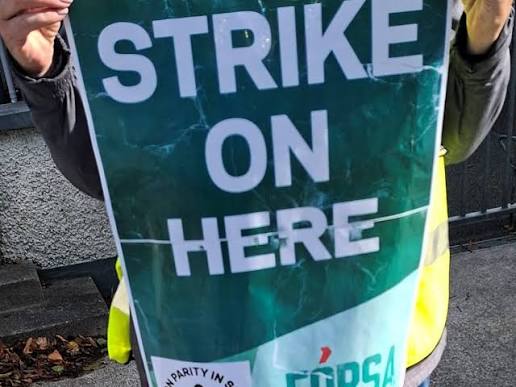


Ireland is approaching a significant confrontation between organised labour and the State. The public service pay agreement expired at the end of June, without a successor agreement or formal negotiations. Since then, unions representing workers across healthcare, education, local government, the civil service and State agencies have balloted their members for industrial action. Fórsa members voted 96.6% in favour, while INMO members recorded more than 99% support; INTO members have likewise voted overwhelmingly for action.
No doubt, in the coming weeks the established media will do their usual work of seeding disunity between public and private sector workers, highlighting the supposedly cushy nature of public sector employment in contrast to the “real” working class in the private sector. This is a classic tactic; as if the public sector does not have a substantial role to play in the conflict over the distribution of socially produced wealth and over the conditions under which the working class reproduces itself.
The public servant sells their labour-power to the State. The teacher, nurse, council worker, civil servant and administrator may perform different functions, but all depend upon wages for their livelihood. At the same time, their labour produces and maintains services upon which the entire economy depends. Hospitals must function, schools must open, infrastructure must be maintained and public administration must operate. Capital depends upon this social infrastructure even when the labour maintaining it does not directly generate private profit.
This creates a fundamental contradiction. Society requires public services, yet the capitalist State is under continual pressure to contain the cost of providing them. Workers are consequently asked to deliver more, absorb staff shortages and organisational changes, and accept the erosion of their real purchasing power while being sold lines by sleazy government ministers that the budget “can’t do everything for everyone” while handing over the State’s income to private industry and offering nothing to workers.
The argument for organised labour is simple: that public-service pay has fallen behind living costs. Fórsa says pay has lagged prices by as much as 5%, while September CSO figures cited by the union put annual inflation at 3.7% against average pay improvements of roughly 1.5% during 2026. The Government, ever wary of open conflict, is stalling; Minister Jack Chambers has argued that the current balloting process is delaying an eventual agreement.
The significance of the present movement therefore lies not simply in its immediate demands but in its potential to unite workers whose workplaces or roles are normally separated from one another. Coordinated action transforms individual grievances into collective power. Fórsa and SIPTU members are due to begin work-to-rule and related actions on 30 September, while the ICTU Public Services Committee has announced coordinated national strike action for 14 October.
For socialists, this is precisely the importance of trade-union struggle. A worker acting alone possesses little bargaining power; workers acting collectively demonstrate that production and administration depend upon their labour. The strike makes visible a fact normally concealed by the everyday operation of society: the people who keep society functioning possess collective power over whether it functions at all.
Economic struggle must be understood politically. A pay settlement can improve workers’ immediate conditions without changing the underlying structure that produces exploitation and inequality, kicking the problem down the road for another number of years. But the contradictions are only ever waylaid, never solved. The task for socialists, then, is therefore not to simply wage the struggles of organised labour, but to connect them to the broader struggle over who controls the wealth and institutions of society.
The emerging public-sector dispute demonstrates that question with unusual clarity. The issue is not merely what workers are paid. It is who decides the value of their labour, who determines the priorities of public expenditure, and ultimately whose interests the State is organised to serve.
The coming weeks will therefore be important not simply for public-sector workers, but for the development of class consciousness and collective organisation across Ireland.