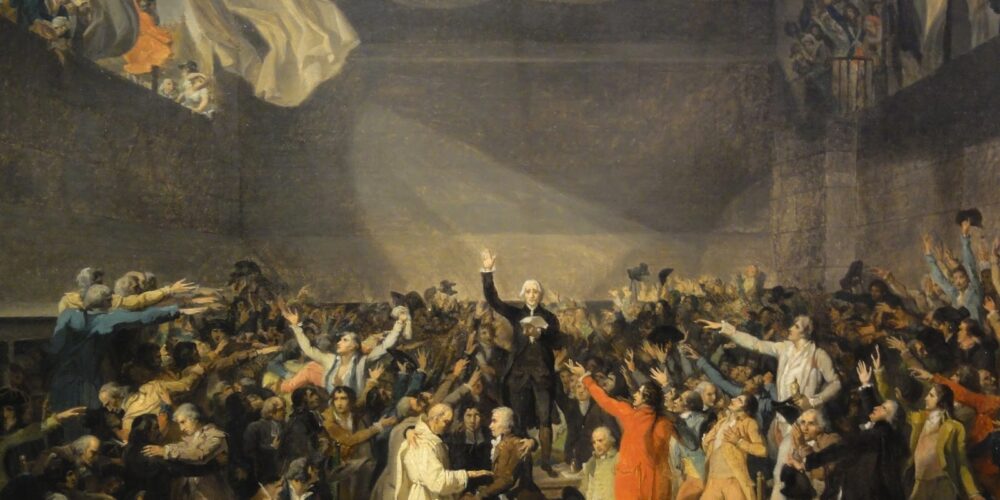


Supporters of bourgeois liberal democracy claim that the bourgeois state exists to defend the interests of all its citizens and is therefore neutral on political and economic issues. The state claims that its legitimacy is based on the will of the people as expressed in elections for its supreme legislative body and that, once elected, each parliament is sovereign; that is, it is the supreme law- and policy-making body in the state until the following election. A sitting parliament is legally free, within the provisions of the state’s Constitution, to repeal any decision made by an earlier parliament, and it can also enact any legislation it wishes. Is it possible, therefore, to use bourgeois democracy to “legislate capitalism out of existence”?
Marxism shows us that the state – its politics, its laws, its courts and its police – is structured to protect capitalist private property and maintain the rule of the capitalist class. That does not mean that we see the state, its legislature and legal institutions as direct puppets of the capitalist class. Politics and law have relative autonomy within the bourgeois state and are areas where the working class can make gains. However, the media, the dominant culture and the education system reinforce and propagate capitalist ideology, and during elections these ideological tools, as well as the financial resources of the capitalist class, will be used against any political threat to capitalist rule.
The election of an anti-capitalist majority to a bourgeois parliament will not automatically lead to the end of capitalist rule. The bourgeoisie has at its disposal “things stronger than parliamentary majorities”.¹ When Bonar Law made that statement, he had in mind using the military against the government. Even without the use of force, a progressive government which accepted the limits of bourgeois democracy would be forced to run the state through the existing state apparatus, with economic power still in the hands of the capitalist class. It would also come under attack from the “markets” – that is, the financial power of international capital – to ensure compliance with capitalism.
We are not in a revolutionary situation, but even the possibility of social democratic reforms through parliamentary methods has become increasingly unlikely. The claim by bourgeois theorists that a sitting parliament is sovereign within its state is bogus. Former German finance minister Schäuble made this explicit when he said, “elections cannot be allowed to change economic policy”.² Successive Irish governments have ignored the demands of the overwhelming majority of the Irish people to end its economic links with apartheid Israel because they claim that the Dáil does not have the legal authority to do so. Of course, they do not state it as clearly as that; instead they refer to EU versus national competence, etc.
Housing and homelessness have become major issues throughout the EU/NATO bloc. But as Leilani Farha, former UN special rapporteur on adequate housing, stated: “decisions about housing have been removed from democratic control and handed to financial actors”.³
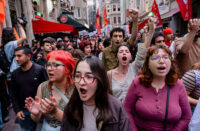
The failure or refusal of governments throughout the EU/NATO bloc to respond to the needs and demands of the people is exposing the limits of bourgeois democracy. Is it the beginning of a crisis of legitimacy for bourgeois democracy? There has been an upsurge in protest movements, stretching from India to Ireland, demanding government action on Palestine, education, energy prices, housing and the cost of living. The various campaigns have focused on specific government policies or called for a change of government. This does not challenge the root cause of their concerns, which is the capitalist system, in the same way that the Luddites focused on the machines which took their jobs rather than the capitalist who owned the machines.
Protest movements which seek reform within the existing capitalist system are not an existential threat to the dictatorship of the bourgeoisie. However, they can help raise class consciousness if the revolutionary left is strong enough, ideologically and organisationally, to ensure they are not channelled into the sterile confines of parliamentary politics.
References:
- Andrew Bonar Law, Conservative Party leader, speaking against the Third Home Rule Bill, 1912. [Full source and page reference required.]
- Yanis Varoufakis, Adults in the Room: My Battle with Europe’s Deep Establishment. London: Bodley Head, 2017. [Please confirm edition and supply page reference.]
- The Guardian, 19 October 2026. [Please verify the date – see query 8 – and supply the article title, author and page/reference details.]