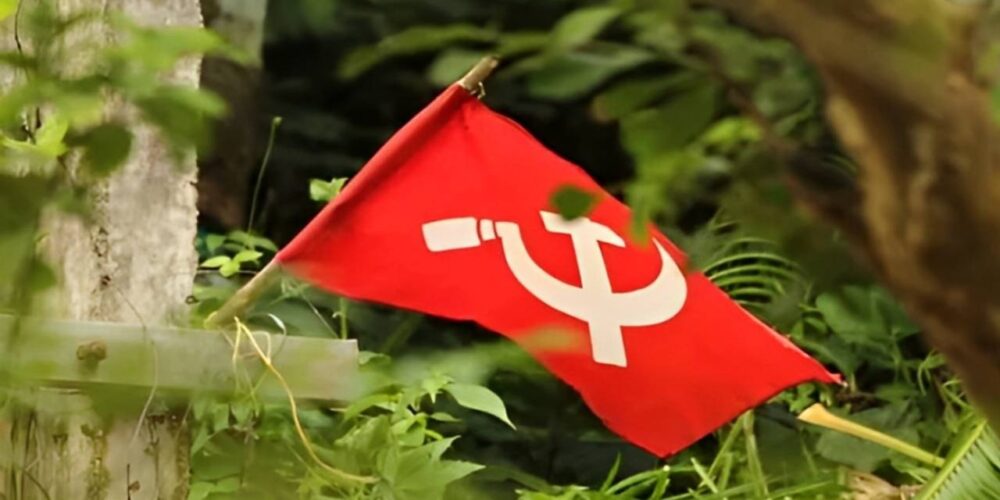



More than three years ago, I reviewed Bresnihan and Millner’s book All We Want Is the Earth: Land, Labour and Movements Beyond Environmentalism [socialistvoice.ie/2023/09/environmentalism-capitalism-and-vibes/] for Socialist Voice. In that review I noted that between their excellent analysis and contrasting of “the co-opted ‘First World’ environmentalist language picked up by corporations and states” and “community organising in the ‘Third World’, coinciding with anti-colonial and anti-capitalist movements rising after the Second World War”, there was “a gap that might need filling in another book: the ‘Second World’”. There [were] no references to environmental movements in the socialist states, or to how the planned economy and post-revolution reconstruction of socialist states dealt with environmental issues. The missing piece of the puzzle now comes in the form of Communism, the Highest Stage of Ecology by Guillaume Suing.
Carefully translated and edited by Henry Hakamäki and Salvatore Engel-Di Mauro, Suing’s book takes a Marxist-Leninist perspective on environmental struggles, questions of development, class and state. Suing sets off on a journey across the socialist and capitalist world to dispel myths about the relationship between communism and the environment, as well as to address the futile efforts of Western environmentalism under capitalism from a materialist standpoint.
Quite often, to dispel a myth about the supposed inherent tendency of socialist development to harm the environment, it is enough for Suing to hold up a mirror and show that the implied tendencies are actually those of capitalism. He, however, rarely stops at that first step. From the pages of Communism, the Highest Stage of Ecology, we learn about environmental protection efforts in Cuba and the Soviet Union, based on science and integrated into the planning process.
Throughout his argument, Suing insists on the dialectical method, allowing for a nuanced, consistently materialist analysis contextualising developments in the conditions of the time and place under consideration. The intensity of the revisionist and anti-communist arguments and their pervasiveness in the public sphere sometimes lead Suing into a less critical and more passionate argument. This is a common trait in anti-revisionist writing.
A significant part of the book is dedicated to the dialectics of nature, applied to questions of biology and, in particular, genetics. The context for this study is, of course, the infamous “Lysenko affair”, the controversy surrounding the experimental and theoretical efforts of the Soviet agronomist and biologist Trofim Lysenko, and their effect on Soviet agriculture and science, as well as international scientific discourse. Suing explained his writing task: “The aim is not to re-establish a ‘cult of personality’ around Lysenko. He hardly lends himself to this, given the numerous theoretical errors he propagated in the final years of his career, and the visibly unsympathetic character his opponents have had to complain about. It’s more a question of reopening a scientific and ecological debate that was too quickly dismissed for political reasons, at the height of the Cold War between two irreconcilable blocs.” (pp. 113–114) Suing’s reopening is not without faults, but for a reader interested in genetics, biology, philosophy of science or indeed dialectical materialism in scientific practice, it is an important contribution. Personally, I would find the analysis of Lewontin and Levins in The Dialectical Biologist (Harvard University Press, 1985) and that of Helena Sheehan in Marxism and the Philosophy of Science (Humanities Press International, 1985) better grounded in the tradition of Engels and the dialectical method.
Writing about history, science and dialectical materialism, Suing keeps the present moment and important lessons for Marxist-Leninist cadres in mind: Communism, the Highest Stage of Ecology is not a nostalgic treatise or a theoretical exercise. It is an anti-imperialist, materialist analysis of our world.
Like many other Iskra Books editions, Communism, the Highest Stage of Ecology (Guillaume Suing, Iskra Books, 2025) is available from Connolly Books, Temple Bar, Dublin 2.