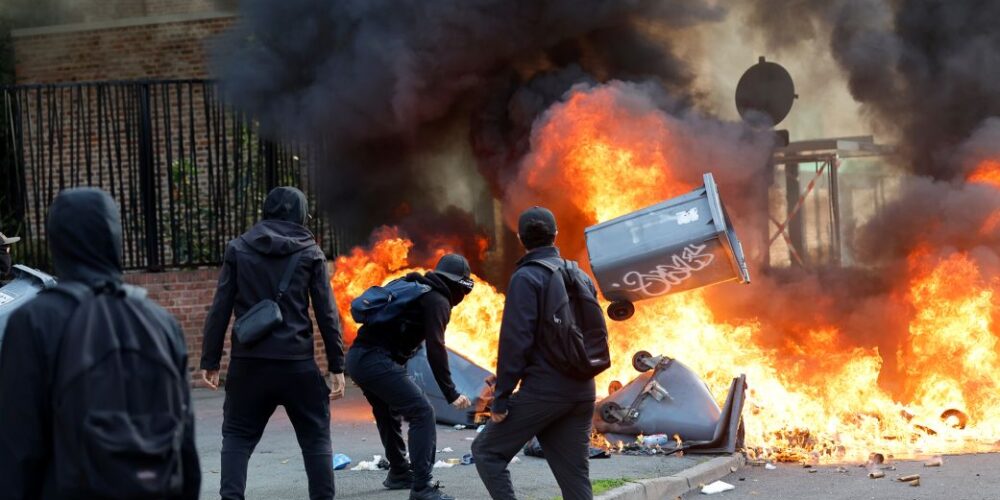

Over the past few days, friends in Dublin have been messaging me to ask if I’m okay after the protests in Paris. I understand why they might have felt like they should worry about me. I’m a Communist Party member living in the suburbs of Paris, and TV channels all over the world are showing nothing but looting and rioting.
What I see is something else: a revolt unfolding in front of us. So of course it is not quiet, and it is not always peaceful, but it was bound to happen. Anger had been building for years over fuel prices, taxes and the decay of our public services.
So the question is not whether there is violence. It is whose violence we are shown, whose we are not, and whose interests that serves. There are three kinds at play here: the violence of capital, of the revolt, and of the state that defends capital. Only one is on the front pages.
The first violence is the oldest and the least visible. It is the violence of a system built on exploiting those who have only their labour to sell. It never calls itself violence; we call it a wage, a rent, a price or a budget line. But it kills.
In 2023, 38 workers under the age of 25 died on the job in France. About seven million people say they do not have enough to eat; among 18-24-year-olds, the figure is one in four. This summer’s heatwaves left nearly 8,000 excess deaths, according to Santé publique France.
It all comes down to choices about who pays and who receives. Public services are the social wage of the working class, so every cut is a wage cut.
We are told France has no money. Yet last year a Senate inquiry, with the Communist Fabien Gay as rapporteur, found that companies received at least €211 billion in public aid in 2023, with almost no conditions attached. Too often, that money was pocketed, then used to close factories, relocate or lay off workers.
Meanwhile, money is always found for the military: €64 billion is promised for 2027, double the 2017 level. The country is preparing for war, and we already hear talk about a “war economy”. No need to say that it won’t be the children of the bourgeoisie who are sent to fight Russian troops.
And when the left proposed asking the very rich to contribute, the answer was no. Last autumn, the National Assembly voted down the Zucman tax, a 2% minimum annual levy on fortunes above €100 million that would raise an estimated €15 to €20 billion a year. From the “centre” to the far right, the bourgeoisie came together to make sure that law wouldn’t pass.
The 2026 budget cuts around 4,000 teaching posts, and for the first time defence has overtaken education as the state’s largest item of spending. Teachers are not replaced, classes grow, and Parcoursup, the selective admissions platform, offered about 10,000 fewer places this year, according to a teachers’ union. Meanwhile, €10 to €12 billion of public money a year goes to private schools. And this summer a union survey found classrooms averaging 32°C.
This generation of high-schoolers has grown up in La France à Macron, where unchecked capitalism has deepened inequality and where their parents were met with police violence for defending the retirement age of 62.
So when students at the Lycée Saint-Exupéry in Créteil, in the Paris suburbs, began blockading their school in September to sound the alarm about their conditions, we can’t really say we were surprised.
It spread within days: by the end of September, about one in ten high schools had been blockaded or targeted, according to the Interior Minister. Working-class students everywhere rose up with clear demands and a clear method: replacement of absent teachers, smaller classes, renovated buildings and, above all, the ability to study in the same conditions as children in rich neighbourhoods.
What happened on 17 October was plain class struggle. Teachers, public- and private-sector workers, students and the yellow vests marched together against a “cost-of-living crisis” that is really the crisis of late capitalism. Up to 800,000 people took to the streets.
Marx wrote that force is the midwife of every old society pregnant with a new one. This is the second kind of violence, the revolutionary kind. The bourgeois are afraid of it because it shows that the working class, when organised and conscious of its own domination, can overturn their rule. A revolution is never quiet and rarely peaceful: the history of France is built on such moments, from 1789 to the Commune of 1871.
We should not romanticise it. At least 3,000 shops were damaged or looted, and their employees are now on partial unemployment. Spontaneous anger is a symptom of the contradictions of capitalism, not yet a strategy against it.
In a capitalist society the state’s job is to protect the interests of capital and its order. When that order is challenged, the state steps in. This is the third kind of violence.
On 17 October, access to the authorised march was blocked, pushing law-abiding demonstrators into undeclared marches, and tear gas was fired in the morning, hours before the main demonstration set off.
A 17-year-old boy lost a hand to a police grenade in Saint-Étienne, a teenage girl lost the sight of an eye in Mulhouse, and another teenager lost his vision in Tours. Only after teenagers were injured did the Interior Minister suspend stun grenades at high-school protests.
Then came the curfews: from 19 October, people were (and still are) barred from the streets of parts of Paris, Lyon, Lille and Nice after 11pm. Gabriel Attal, Macron’s former prime minister and a presidential hopeful, wants the power to block certain social media during riots.
This is a failure of Macron’s government and another step away from democracy. First came our right to choose our own government: the left came first in the 2024 elections, and Macron appointed a prime minister from the right-wing Republican Party. Then our right to protest, with banned routes and demonstrations. Now our freedom of movement.
It is no accident that the violence put on show is the kind that can be blamed on the young, on workers, on immigrants. It fits the far-right narrative, and Donald Trump was quick to blame immigration for the fires in France.
The class that owns the economy also shapes the story we are told about it. That is why images of burning bins and looted shops travelled across the world within hours. The first violence has no images; the third is reported as an afterthought; and the second becomes a spectacle used to justify more of the third.
Now far fewer people are talking about the cost of living, the shortage of teachers, the spread of poverty and a climate changing so fast that the children of the working class have very little to hope for.
Anger alone is not enough. It becomes a force only when people understand what they have in common: that the teacher, the nurse, the student and the worker are on the same side, and that their problems come from the same source. This is the role of the Communist Party: to help working people see their own class condition, to show that none of us can win alone, and to unite us into one organised movement. The anger is already there. Our job is to give it awareness, unity and direction.