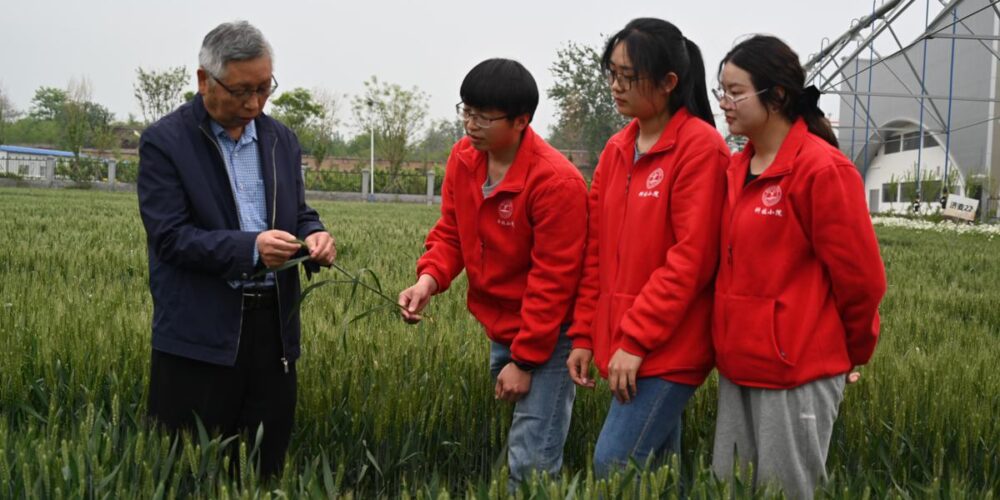


Early on a Sunday morning in October, a group of professors gathered at the School of
Marxism at Peking University. It was for a day of labour organised by the CPC party
branches in the school. We boarded a bus and set out for a farm where we dug the soil to
harvest root vegetables. We later made dumplings while roasting vegetables in a brick oven
and ate together. At the end of the day, we had a party meeting.
As one of the speakers at this meeting, I spoke of the significance of the event itself in terms
of mental and manual labour and how left movements, especially here in China, have
addressed this.
As we have evolved, there has been an ever-greater separation between mental and manual
labour. This social division of labour was necessary to advance, but it has intensified under
capitalism, making it possible for people to consume lavishly at an ever-greater distance
from the process that produces what they consume.
When I first came to Beijing, a German scholar would regularly sit across from me at
breakfast. Since I was teaching in the School of Marxism, he would amuse himself by airing
his liberal, half-baked arguments against Marxism. One day, he argued that Marxism was
obsolete “because production isn’t so important anymore”.
Seriously? How did he believe the building in which we were sitting came to be there? How
did he think the amazing food we were eating came to be grown, transported, cooked and
laid out before us?
This was symptomatic. He said it out loud, but so many live in this vast disconnection
between production and consumption.
The truth is that there has been so much production, and never have such people depended
so heavily on production while being so oblivious of it as a material reality and as a labour
process. The intellectual and cultural life of capitalist society has become increasingly
unmoored.
The gap between mental and manual labour has bred theories and projects driven by market
logic and yet distanced from the realities of material production. Ever more sophisticated
resurgences of idealism are born of the conceit that consciousness and will alone make the
world go round. Consciousness and will are vital, but we make history not in conditions of
our own making.
Many theories, such as postmodernism, are born of individual consciousness severed from
the natural and social matrix of its existence. Many intellectuals imagine that they can
determine the world without being determined by it.
In the revolutionary years here in China, there was a radical challenge to the inherited social
division of labour, to elitist forms of knowledge production, to the traditional division of mental
and manual labour. Students and teachers were sent to farms and factories, while workers,
peasants and soldiers entered universities. Curricula were redesigned to serve the new
social order.
The Cultural Revolution intensified the process. It asked radical questions about the most
fundamental presuppositions of knowledge production, especially about the class character
of knowledge, and shifted epistemic authority to the masses.
However, it went wild and the education system broke down. Coercion and fear overtook
debate and persuasion. Honest intellectuals were denounced and humiliated. There was a
striking lack of clear epistemological, ethical and legal criteria for condemnation and
retribution.
This movement both embodied a radical vision of knowledge production and subverted it in a
tumultuous churn of confusion and chaos. There are complex historiographical issues.
Abroad, and even here in China, the perspective of “scar literature” prevails. The scars are
there and terrible things happened, but this was more than an ultra-leftist faction on a
rampage, all sorted when the Gang of Four were put on trial. The same could be said of the
Soviet 20th Party Congress blaming all that happened during the purges on a Stalinist cult of
personality. These were complex, turbulent and tragic movements.
The reaction against the Cultural Revolution brought about its opposite. China opened up to
capitalism not only in its economy but also in culture and knowledge. Universities integrated
into global networks and norms. Marxism was not renounced, but it was marginalised, and
much teaching and research proceeded without reference to Marxism. The distance
between mental and manual labour increased, as did competition, hierarchy and
commodification in intellectual and cultural production.
Since 2012, there has been a rebalancing. There has been a revival of Marxism, both from
above and below, and a degree of repoliticisation of culture and knowledge, while retaining
respect for expertise and global integration. There is still a big gap between mental and
manual labour.
Even though it was just a small and symbolic gesture, I think it important that we harvested
vegetables on this day. It would be good for all intellectuals to participate occasionally in
industrial and agricultural production and to show such respect for manual labour. I was
proud to be part of it, just as I was many years ago when I was at the International Lenin
School in Moscow and was sent to a Soviet factory for the Leninist subbotnik, a day of
voluntary labour.
On a larger scale, we need to find ways to reconnect what has been disconnected, to have
both the necessary sophistication and specialisation to advance knowledge while striving for
integrality, for an ability to apprehend and appreciate the whole.