

It is 1890. While Britain is aggressively expanding its global empire, its domestic industries are increasingly dominated by mechanised production and growing concentration of capital, and the industrial proletariat is increasingly alienated from the products of its labour. In The Commonweal, a utopia describes London in 2102: the Thames is clean, work is a pleasure, and “profit” and “alienation” are forgotten. Its author is the socialist William Morris. Its title: News from Nowhere.
- L. Morton described News from Nowhere as “the first utopia that is not utopian”—rooted in historical development and class struggle.
Morris was born in 1834 into a wealthy family.
In 1883 Morris joined the Democratic Federation. He lectured, sold socialist newspapers, and poured his money into the cause. “Apart from the desire to produce beautiful things,” he wrote, “the leading passion of my life has been and is hatred of modern civilisation.”
A Dream of John Ball
Morris’s first major socialist work, A Dream of John Ball, appeared serially in The Commonweal from November 1886 to January 1887. A Victorian socialist awakens in a medieval village on the eve of the Peasants’ Revolt of 1381. He meets Will Green, a free peasant, and declares himself “No one’s man.” Green replies that this is “not the custom of England,” but that one day it might be.
John Ball’s central sermon is: “Fellowship is heaven, and lack of fellowship is hell.” The narrator predicts that the revolt will fail and describes the wage slavery and industrial capitalism that will follow. Morris summarises the dialectic: “men fight and lose the battle, and the thing they fought for comes about in spite of their defeat.”
The tale exposes a contradiction in Morris’s literary practice. Its peasants are active revolutionary subjects, unlike the working class in The Pilgrims of Hope, where Morris struggled to portray contemporary workers as bearers of revolutionary energy. Thompson sees this as a historical as well as literary limitation.
News from Nowhere: The Dream of the Future
While A Dream of John Ball looks to the past for hope, News from Nowhere imagines the future concretely. A Victorian socialist awakens after a meeting in Hammersmith in a transformed world: the Thames is clean, factories have disappeared, and bridges are works of art. Dick, the ferryman, rejects the narrator’s money as a “troublesome and roundabout custom.”
Work is newly organised: the road-menders “laughed and talked merrily together.” Production is for use, inferior goods disappear, and labour becomes creative activity. Morris’s utopia dissolves the separation between work and life: “work is the highest bliss!”
Yet the revolution was not peaceful. It included class conflict, a general strike, the massacre at Trafalgar Square, and civil war. The new society emerges through historical struggle. On the journey to Kelmscott, the landscape appears freed from bourgeois profit-seeking, but the narrator cannot stay. Ellen’s “mournful look” reminds him that he belongs to another time.
After Nowhere, Morris did not return to contemporary class struggles on anything like the same scale; his later prose works lead instead into mythical worlds. “How the Change Came” remains his extended depiction of revolution as a movement of the masses.
Socialism
Morris rejected Hyndman’s authoritarianism, anarchism, and parliamentarianism. He saw reforms such as the eight-hour day as “useless” if intended to replace revolution. Engels respected his socialist commitment but criticised his political judgment, particularly his indulgence toward anarchists in the Socialist League.
Morris opposed Bellamy’s utopia, Looking Backward, which he saw as “state communism”—”a huge national centralisation” in which no one feels responsible. For Morris, communism meant decentralisation and the dissolution of the State. Art was not a luxury but an essential expression and instrument of human happiness. Where Bellamy imagined a perfected Boston, Morris imagined a decentralised fellowship in which work is “the highest bliss” and town and country are reconciled. Without “pleasure in the work itself,” he argued, there could be no communism.
In How I Became a Socialist (1894), Morris recalls becoming a critic of civilisation through history and art. He read Marx only later and struggled through the “pure economics” of Capital. His conviction grew from the ugliness and injustice of Victorian society and the insight that another society was possible. He remained filled with “a deep love of the earth and the life on it.”
Artistic Practice
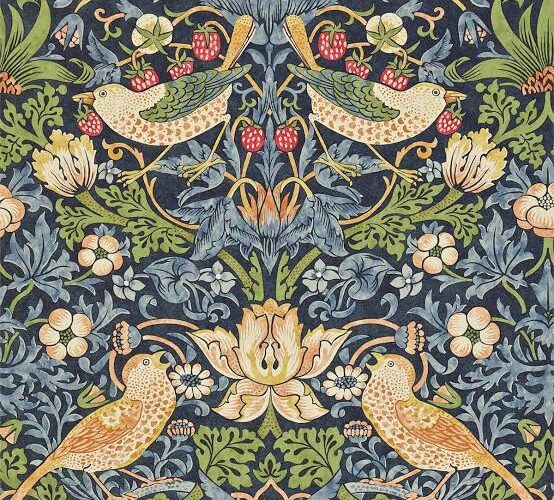
For Morris, the workshop was a laboratory of socialist practice. Thompson describes Morris & Co. as an attempt to “make pleasurable and creative labour.” At Merton Abbey, Morris raised wages, replaced time-work with piece-work where possible, allotted gardens to craftsmen, and blurred the distinction between designer and executor. His organic designs expressed his stand against utilitarianism and industry’s stunting of growth. He trained apprentices on the assumption that “any intelligent lad had the makings of an artist and craftsman in him.” The Firm was a “practical experiment” in socialist labour, conducted within capitalism and against it.
Morris’s “deep love of the earth and the life on it” pervades his entire work. In A Dream of John Ball, community and freedom emerge through struggle; in News from Nowhere, they become the foundations of a society where work brings joy and things are made with care. His critique of “waste and greed” gives this vision an ecological dimension. Both works ask under what conditions human beings can work freely, live communally, and find joy in the beauty and usefulness of their world—and how such a society can be realised.