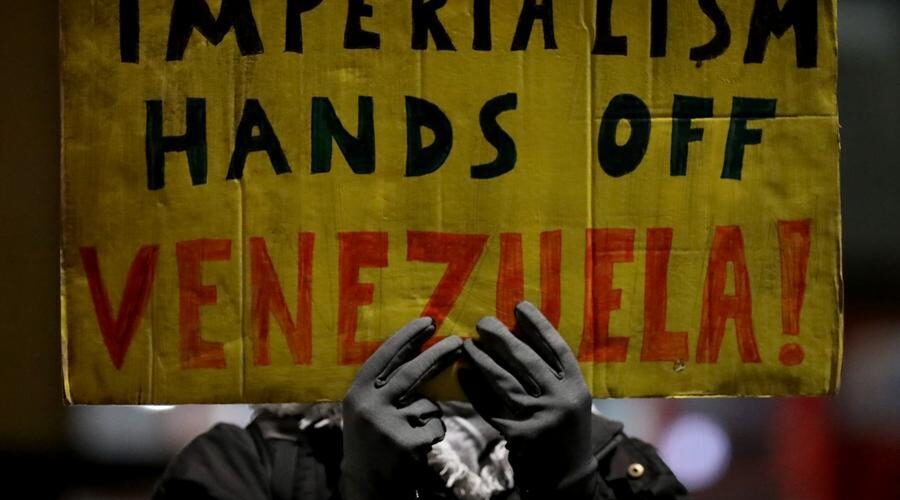


January 3, 2026, marked a turning point in Venezuela’s contemporary political history. The U.S. military intervention, the bombings of national territory, and the kidnapping of Nicolás Maduro and Cilia Flores constituted an open violation of sovereignty and gave way to a new balance of power, in which the United States began to exercise a leading role in fundamental decisions regarding Venezuelan political and economic life.
But it would be a mistake to interpret these events as the beginning of the crisis. January 3 represents the culmination of a prolonged process of economic, political, and institutional deterioration and, at the same time, the beginning of a new phase: the establishment of a regime of tutelage.
A Crisis That Had Been Brewing
Since 2013, the model of accumulation based on oil revenues had been increasingly exhausted. The drop in crude oil prices beginning in 2014 coincided with declining production, deteriorating productive capacity, and greater financing difficulties.
Added to this were unilateral U.S. coercive measures. Beginning in 2017, Washington imposed financial sanctions, and in January 2019, it directly sanctioned PDVSA, restricting oil financing and marketing. These measures deepened a crisis that was already underway.
Faced with this crisis, Nicolás Maduro’s government did not transform the structures of economic dependence but instead implemented austerity measures whose cost fell on workers through wage cuts, precarious working conditions, and the weakening of collective bargaining.
At the same time, the government leadership used the sanctions as justification for opaque and discretionary management of oil resources.
Maduro then sought room to manoeuvre through his relations with China, Russia, Iran, and Turkey. For the PCV, these relations reflected inter-imperialist contradictions but did not signify a break from dependence: they were used to ensure the survival of the PSUV leadership.
At the same time, the closure of democratic spaces progressed through the erosion of institutional autonomy, the judicialisation of politics, restrictions on social and labour organisations, intervention in political parties, and electoral limitations.
July 28, 2024, marked a decisive moment in that process. The proclamation of Nicolás Maduro as the winner of the presidential election—without the publication of results broken down by polling centre and polling station—triggered a profound crisis of legitimacy. The subsequent repression and arrest of thousands of workers and students further closed off the institutional path.
January 3 and Foreign Intervention
U.S. policy toward Venezuela must be understood within the context of its regional strategy. Washington’s new National Security Strategy reaffirmed the Monroe Doctrine and the need to prevent the presence of extra-regional powers in Latin America. Venezuela occupies a central position due to its energy and mineral resources.
The military operation on January 3 and the abduction of Maduro and Cilia Flores constituted an open violation of Venezuelan sovereignty. No internal crisis can justify a foreign power using force to decide who governs a country.
Following the intervention, Washington pushed a “plan” to supposedly “stabilise” the country and pave the way for an eventual political transition. In practice, however, the new scenario combines political-military tutelage with economic control. Meanwhile, the triumvirate—composed of Delcy Rodríguez, Jorge Rodríguez, and Diosdado Cabello—ensures internal political control.
Oil is at the core of this economic tutelage. The reform of the Hydrocarbons Laws expands private participation, modifies the conditions for state intervention, incorporates international arbitration mechanisms, and reduces controls over contracts. At the same time, oil revenues are administered through mechanisms under U.S. jurisdiction.
The Working Class Continues to Pay the Price
While favourable conditions are offered to transnational capital, workers continue to bear the brunt of the crisis. Wages and pensions remain frozen; labour reform proposals driven by business leaders are moving forward, and the dismantling of social benefits is being promoted.
Sixty-eight percent of households live in poverty, and 32 percent in extreme poverty. Only 19 percent receive water daily, and 39 percent face daily power outages lasting several hours.
Regaining Sovereignty
The situation following January 3 requires overcoming two false dilemmas: subordination to Washington and the continuation of an authoritarian model that used anti-imperialist rhetoric to preserve power.
The PCV is working alongside political and social organisations to build a democratic, popular, and sovereign alternative aimed at restoring the Constitution, confronting plunder, and reclaiming social and political rights.
The task is to restore the Venezuelan people’s ability to decide their present and future, to confront all forms of paternalism, and to place the nation’s wealth at the service of those who produce it.