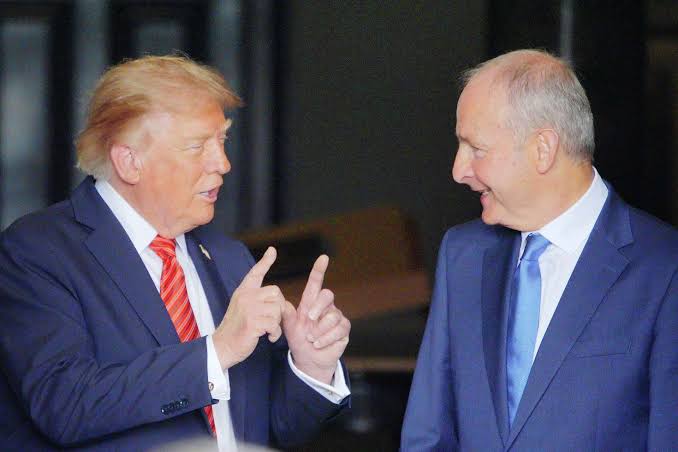



During his recent visit to Ireland, Donald Trump behaved much as expected. Unwilling to share the limelight, he stole attention from Shane Lowry, winner of the Irish Open, by announcing a lifting of tariffs on Irish whiskey exports to the USA. This populist gesture in Doonbeg was, however, superseded by repeatedly voicing support for Irish reunification. While the former gesture was widely welcomed, the latter call caused considerable discomfort among a number of political parties and senior politicians. Trump’s long-term admirers in the DUP were upset and deeply embarrassed by the president’s pronouncement. Nor was discomfort confined to northern unionists. The neo-Redmondite Taoiseach, Micheál Martin, appeared equally discommoded by the comments. Rather than address the issue directly, the Fianna Fáil leader opted instead to distract attention from Donald’s words by attacking Sinn Féin.
Elsewhere there was an acknowledgment that Trump’s intervention had certainly put the issue back on the table, for a time at least. This came in the aftermath of a blunt dismissal by Britain’s Prime Minister, Andy Burnham, of any possibility of constitutional change.
What, if anything, therefore, was behind this intervention in what is generally deemed as something beyond the remit of a US politician, even one who is the president? Trump is of course well known for his unpredictable, often ill-considered outbursts. This was offered as one possible reason for his surprising stance. Elsewhere, other commentators speculated that he was attempting to influence Irish American voters in the upcoming mid-term elections in the US.
There is, though, another plausible explanation. That is, the US deep state intervening through their president to ensure the future direction of events in Ireland. Seems far-fetched? Well, let’s consider the facts.
Notwithstanding the Fianna Fáil leader’s resistance to contemplate an end to partition, there is an inexorable momentum in that direction. A hapless, incompetent, non-performing six-county administration is incapable of generating support for that failed political entity. How long can the partitioned statelet survive in light of changing demographics and a lack of confidence among many members of the unionist community? Anyone doubting that this is widely understood in the corridors of power need only read a recent article in the arch-conservative, pro-establishment British newspaper, The Telegraph.[1]
In a lengthy piece by Lily Shanagher under the headline “Generation Kneecap’s plan to break up the UK and reshape Ireland”, she reports that in a study conducted by Queen’s University and Ulster University, a majority of all those under 35 years in the north favour reunification. These facts are neither missed nor misread by the US embassy in Dublin and reported back to Washington. Reunification over the coming decades is seemingly inevitable and, in their view, this may pose a risk to the United States’ imperial interests.
Capitalism is being challenged through its own contradictions and working people in the West are experiencing ever increasing hardship. In spite of threats from fascism, there appears to be a growth of left-leaning movements, as evidenced by Die Linke in Berlin and Zohran Mamdani in New York. Not enormous, admittedly, but indicative of a potential for change, especially when taken together with the encouraging example offered by the People’s Republic of China.
So, how does Ireland fit into this scenario? While there may be no imminent threat of a revolutionary upsurge in this country, the potential for such is always present. The enormous support for Palestine is, alone, a disturbing factor for Washington. Why, it may be asked, would a country with no obvious relationship to the Middle East demonstrate that depth of support? The answer lies in a deep-seated hostility to imperialism (in any of its manifestations) as a result of our traumatic history. There is also the evidence provided by the Catherine Connolly election campaign of a possible united front among left-leaning elements in Irish society.
Taken together with the above-mentioned leftward movements in Europe and New York, coupled with their obsessing over China’s exemplar economy, the US deep state might well believe it has cause for concern. A campaign for Irish reunification could generate the conditions for the realisation of James Connolly’s workers’ republic. For them, there is then the nightmare of a socialist state in Western Europe, or Cuba in the North Atlantic, as the British military once suggested.
So along comes the US president and emphasises his desire to see an end to partition. As a consequence, many supporters of a united Ireland may well view this development as something to be welcomed. And, moreover, under no circumstances should this advantage be imperilled by opposition to America’s agenda or its policies.
Whether or not this was the reason for Trump’s pronouncements is a matter for speculation. What is more certain is that his statements may possibly detrimentally influence the opinion of a section of Irish society that might otherwise follow a more progressive course, now and into the future.
Therein lies a challenge for the Irish left, in that the case for a workers’ republic has to be made without concession to compromise. The future must be socialism, not Yankee-led barbarism.
Notes
[1] Lily Shanagher, “Generation Kneecap’s plan to break up the UK and reshape Ireland”, The Telegraph, 18 September 2026. https://www.telegraph.co.uk/world-news/2026/09/18/generation-kneecap-ireland-plan-to-break-up-britain/