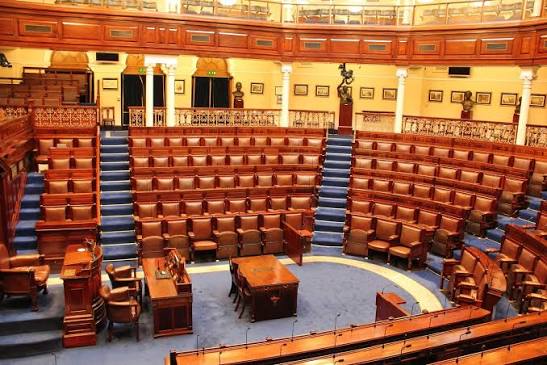



This is the third in a five-part series on the politics of power. Earlier articles asked what makes rights real and why some carry greater weight. This article examines the State and institutions through which those power relations are reproduced.
One of the clearest moments when political power appears to change is an election. Ministers lose office, parties that have governed for years can be removed, and a new government may arrive promising a very different direction, and so there is still a belief that changes in government matter, that our representative democracy can still effect change, can make things better. Governments make choices that affect people’s lives positively and negatively, and political struggle can force changes that powerful interests would rather prevent. Yet for all the visible change at the top, once the new ministers take their seats the deeper structures of power remain largely where they were the day before. The courts, civil service, State departments, police and legal structures remain, while ownership of land, workplaces, finance and productive resources remains largely intact.
This is why government and the State cannot be treated as the same thing. A government is the temporary political administration of the State; the State is the more permanent machinery through which laws are enforced, property relations regulated, society administered and coercive power exercised.
The State does not stand above the class relations of society as a neutral referee. It developed within a society divided into classes and, taken as a whole, protects the general conditions of capitalist class rule, giving political and legal form to a social order based upon private ownership, wage labour and capital accumulation. This does not mean every judge, civil servant or politician consciously acts on behalf of capital; the State can regulate particular interests while preserving the wider conditions in which capitalist ownership continues. Class struggle is more complicated than two uniform camps facing one another. Workers do not automatically act with a developed class consciousness, capitalist ideas extend beyond those who own capital, and small business owners, professionals, managers and other middle layers can be pulled in different political directions. But the capitalist class enters this struggle with the enormous advantage that comes from ownership of productive wealth, which is both the source of its economic power and the basis upon which that power is reproduced. It therefore has a direct material interest in defending the mode of production from which its wealth and position arise, while the potential power of working people rests principally on their collective capacity to organise.
A transport system offers a useful way of thinking about the relationship between a government and this longer-lived State structure. A driver can choose a destination, change route or even break the rules, but the roads, regulations and means of enforcement already exist before the journey begins. Governments can likewise expand public services or privatise them, strengthen labour rights or weaken them, but they operate through institutions and laws that pre-date them. Yet the transport system itself is not fixed: roads and routes are rebuilt around changing patterns of settlement, trade and social priorities, just as class struggle has shaped the institutions of the State. Working people have forced trade-union protections and democratic gains into law, improving conditions while strengthening the forces capable of winning more. Reform within the existing State, however, does not by itself change the mode of production. Governments can push its institutions in a different direction without displacing the ownership and class relations on which that State rests; changing a route is not the same as redesigning the transport system.
The State is therefore both a mechanism of class rule and a terrain of class struggle, where working people organise within it and against it to impose demands and expand what is considered possible.
Law is where these relations of power become practical in everyday life. Private property does not protect itself: ownership is recognised in law, contracts can be enforced through the courts, and ultimately the State has the authority to uphold those claims. At the same time, working people have fought to place limits on what owners can do through employment rights, tenant protections and other democratic gains. In the Twenty-Six Counties, Article 43 of the Constitution reflects this tension by recognising private property while allowing its exercise to be restricted according to social justice and the common good. The rules can therefore change, sometimes significantly, while the underlying property relation remains.
That order could not survive through law and force alone. It also requires consent, and concentrated wealth and ownership give the capitalist class a considerable advantage in shaping the institutions and industries through which ideas and culture circulate. This does not mean that every journalist, teacher, artist or cultural institution simply repeats the ideas of capital. There are always voices challenging the prevailing view, sometimes forcefully, but they generally do so within a broader establishment culture in which private ownership, profit and the existing organisation of production are seldom questioned at their roots. These assumptions recur across political debate, media, education and culture until they can appear less like one way of organising society and more like ordinary common sense. Private investment can then appear as normal economic activity while public direction of investment is treated as political interference; a company closing a workplace can be presented as responding to market conditions while workers resisting that closure are accused of disruption. Capitalism does not always have to defend itself explicitly when alternatives can instead be dismissed as impossible, unrealistic or condemned through the claim that history has already proved them failures. Anti-communism can perform this function by reducing very different socialist experiences to a single warning against organising society on different terms.
Consent is never complete, and the same institutions can become places where dominant ideas are challenged. When consent and routine administration are no longer enough, however, the coercive side of the State remains. Courts can enforce orders, property claims can be backed by State authority, industrial action can be restricted by law, and police and other coercive institutions can be used when existing authority is directly challenged. The power arising from economic ownership is therefore carried through State institutions, given force through law, sustained where possible through consent and backed ultimately by coercion, with each relation contested through class struggle.
This is why winning a government and changing the mode of production are not the same thing. Reforms can improve conditions and build organisation, but demands can eventually come into conflict with the ownership and class relations embedded within the existing State. Returning to the transport analogy, transformation cannot ultimately mean choosing an ever more radical route through the same network; the network itself, and eventually the way movement is organised, must become subject to change. In social terms this means moving beyond who administers the existing State towards the deeper questions of which class holds power, who owns and controls productive resources, and around what social needs production is organised.
Even this account remains incomplete because the State does not exist inside a sealed national economy. Capital, finance and production cross borders, while states operate within international markets, treaties, institutions and unequal power relations. To understand the full machinery of capitalist power, we therefore have to move beyond the national State and examine its international organisation through imperialism and dependency.