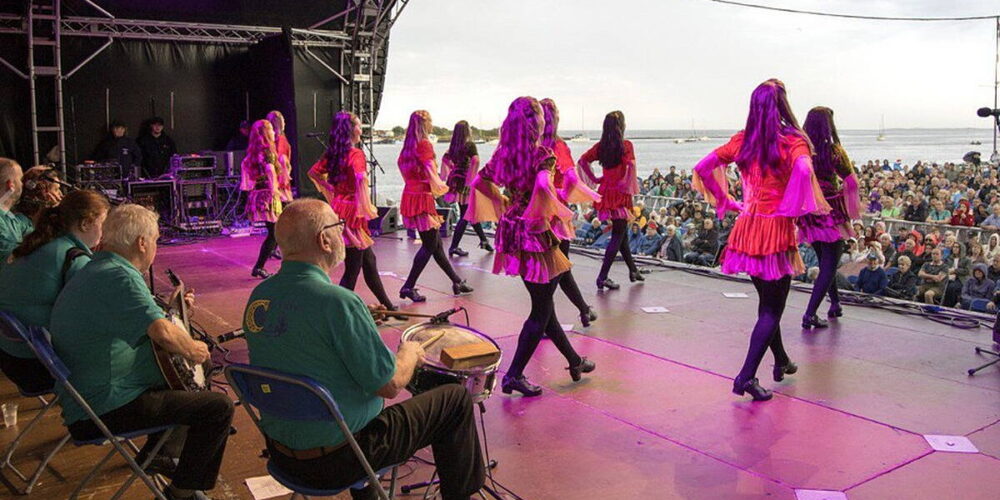
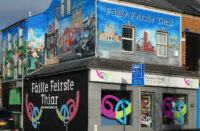
I Mí Lúnasa, Béal Feirste will host Fleadh Cheoil na hÉireann, the world’s largest traditional music festival. It is not the first time the Fleadh has been held in the north – Derry welcomed it in 2013 as part of the ‘UK City of Culture’ circus – but its arrival in the 6 Counties’ largest city is still a significant cultural moment. On one level, it is to be welcomed. An Fleadh brings musicians, singers, dancers, storytellers and communities together in a celebration of Irish traditional culture that transcends partition. It offers space for working-class art to flourish in the streets, pubs, community halls and clubs, far from the sterile halls of the establishment.
Yet, for the left, a festival of this scale in partitioned Belfast cannot be viewed in isolation. An Fleadh arrives at a moment when governance in the 6 Counties is almost universally ridiculed. While the ribbons are tied and the stages erected, the underlying reality of the north remains one of institutional collapse, unmet need, and political paralysis.
Neoliberalism’s tune: privatisation, austerity, and apathy
An Fleadh is not the cause of this dysfunction, nor are its organisers to blame. Ceol traidisiúnta has always been a resource of the oppressed, a means of memory and resistance. But the use of An Fleadh by political and business elites – from Stormont’s inert executive to the Belfast Chamber of Commerce – is a different matter. For them, An Fleadh is a branding exercise: a neoliberal “experience economy” event designed to generate footfall, hotel bookings, and tourist revenue, while doing absolutely nothing to challenge the austerity and privatisation that have gutted the north’s public services.
This is the same neoliberal logic that has seen voter turnout in the 6 Counties slump to record lows. In the 2022 Assembly election, turnout fell to 54% – a steady decline from the 70% of the 1998 Good Friday referendum. Why would working-class communities turn out for a political system that offers them nothing? An Fleadh offers a feel-good alternative to engaging with a bankrupt political class.
Declining turnout, rising despair
The collapse of voter participation is a direct symptom of the north’s political decay. Stormont has not agreed a multi-year budget; the health service is on its knees; the PSNI is riddled with institutional misogyny; Lough Neagh chokes on algae while water bills rise. Into this vacuum, the Fleadh arrives as a welcome diversion. It is easier to sell music lessons and trad sessions than to explain why 400,000 people in the 6 Counties rely on antidepressants just to get through the day.
The northern political establishment does not want an engaged, militant working class. It wants a passive audience – consumers of culture, not shapers of politics. They want to seduce us with music, singing and dance – while the real business of extracting wealth, cutting services, and ignoring the poor continues behind the scenes.
Unionist obstruction and a dysfunctional executive
An Fleadh is also being wielded as a symbol of a “shared future” and “cross-community normality” by a Stormont administration that has abandoned any pretence of productive governance. In its stead we get smiling, symbolic photo ops with English royals and Stormont Ministers. Since Sinn Féin became the largest party in 2022, unionism – particularly the DUP, now increasingly outflanked by the far right TUV – has resisted every initiative that might grant nationalists a modicum of leverage. The Assembly cannot agree a budget. The Executive meets but does not act. Casement Park, the A5 dual carriageway, the 2 tier healthcare system, the cost of capitalism crisis and Lough Neagh stand out as some of the most epic failures. Blame continues to be diverted to the colonial overlords in London.
Stormont is not a power-sharing government; it is a power-sharing corpse. Into the grave of devolution, An Fleadh descends as a bouquet of flowers – pleasant to smell, but powerless to raise the dead. A festival, no matter how large in scale and how well-received by the populace, will not heal the wounds inflicted by empire.
Let us welcome the musicians and artists to our streets. Fáilte roimh na ceoltóirí, fáilte roimh na hamhránaithe. Let us enjoy the sessions. But let us do so with clear eyes. Fleadh Cheoil na hÉireann i mBéal Feirste is window dressing – a cultural festival that the political and economic establishment will use to distract from its own failure. The real tune the north needs is one of collective working-class action and a fight for reunification on socialist terms.
Beidh ceol againn – ach beidh réabhlóid againn fosta.