


For decades the housing question in Ireland has been framed in narrow and increasingly sterile terms. On one side stands the market, presented as the mechanism through which supply and demand will balance if given sufficient freedom. On the other stands the traditional social democratic response, calling for increased public or social housing to correct its worst excesses. Both approaches accept, to different degrees, the assumption that housing is a commodity governed by price. What neither fully confronts is whether the crisis itself reflects a failure of the system, or the way it is meant to operate.
From a socialist perspective, this is where the problem begins. Housing is not simply another commodity. It is a basic condition of life, a social necessity. Marx’s distinction between use value and exchange value is particularly sharp here. A home has a use value as shelter, security, and the material basis of family life. Under capitalism, however, this use value is subordinated to exchange value. Housing becomes an asset, a store of wealth, a vehicle for speculation, and a source of profit.
The Irish housing crisis is not an accident. Nor is it a crisis for those who own and profit from land and property; for them, it has been a period of rising values and increased returns. It is the logical outcome of a system in which land, construction, finance, and rent are organised around accumulation. Developers build where profit is highest, not where need is greatest. Land is hoarded and traded. Banks extract decades of interest through mortgage debt. Rents rise because the market permits it. Access to housing is determined not by need, but by purchasing power. In this sense, there is no crisis for the system itself. What is experienced as crisis by those locked out is, for those who own and control housing, an opportunity for increased accumulation. The contradiction is not a failure, but a normal feature of the system: hardship for the many, profit for the few.
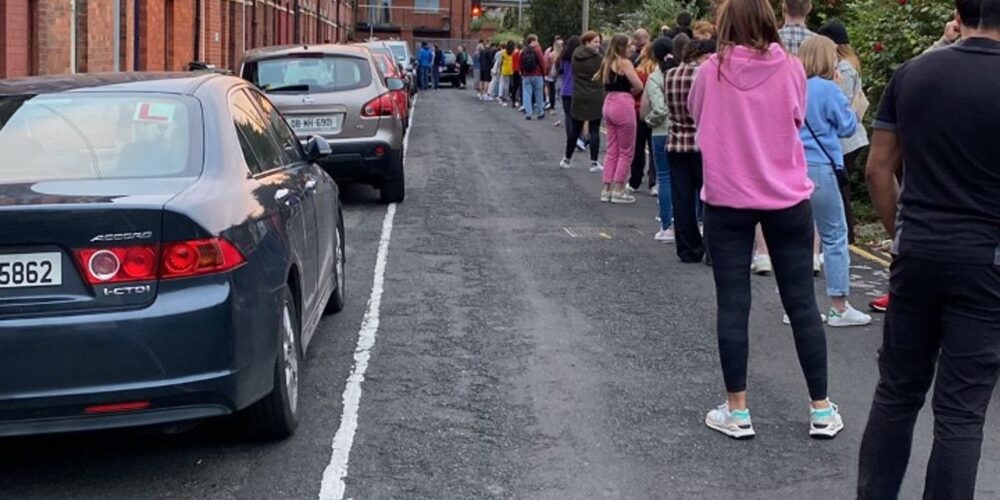
Nowhere is this more visible than in the experience of renters. For a growing section of the working class, housing is defined by insecurity, high costs, and lack of control. Rents absorb an ever-increasing share of income, often at unsustainable levels. Tenure is fragile, subject to eviction or sale. The ability to plan a life or remain in a community is undermined. This is not marginal, but the clearest expression of a system in which housing exists as a revenue stream.
At the same time, the pressures facing renters are not separate from those facing so-called homeowners. The same system that extracts rent also extracts interest. Mortgages stretching over decades transfer income to financial institutions, often exceeding the original value of the home. Ownership, in this sense, is partial and conditional. Both renters and mortgage holders are subject to a system they do not control. The difference lies in form rather than substance.
This distinction also cuts across the idea of a “squeezed middle”. Class is often reduced to income, but those dependent on wages remain tied to the same structures of housing, credit, and employment. The divide between renter and homeowner is not a class divide, but a difference between paying for housing through rent or through debt.
This logic extends into the very shape of our towns and cities. New developments are characterised by smaller units, reduced green space, and fewer amenities – not as a matter of design, but of return on investment. Every site is pushed to maximise yield. Planning decisions are subordinated to land values. In city centres, land that could sustain communities is redirected toward higher-yield uses such as hotels and short-term accommodation.
Recent controversies, from threats to spaces like The Cobblestone Pub to disputes linked to Yamamori, reflect ongoing pressure to prioritise tourism and short-term returns over long-term residential life. More broadly, across Dublin, planning increasingly favours hotels, student accommodation, and short-term letting over permanent housing, particularly in central locations. This raises prices and displaces residents, transforming cities into spaces of consumption rather than places to live.
The consequences are lived daily. Workers are pushed further from where they work, leading to long commutes, congestion, and the erosion of time. Hours that could be spent with family or in rest are absorbed into the reproduction of labour. For working-class people, the housing crisis is therefore also a crisis of time and wellbeing.
For those involved in housing campaigns, this poses a strategic question. Can the crisis be resolved through reform, or do these measures run up against the limits of a system in which housing remains a commodity? Experience suggests the latter. Rent caps are circumvented, supply is restricted, and capital adapts to maintain returns. Reforms are necessary, but continually eroded where underlying relations remain unchanged.
The traditional socialist response has been to remove housing from the market through large-scale public provision. This remains essential, particularly in Ireland where the state has retreated from direct building. But the political reality is more complex. The desire for homeownership runs deep, especially within the working class. For many families, the home is the only form of security – the only asset that can be passed on, the only buffer against insecurity.
This reflects not a commitment to the market, but a lack of alternatives. Where pensions are weak, services uneven, and wages insecure, housing is forced to carry the burden of security. The family home becomes a substitute for a functioning social system.
This raises a broader question. Is the goal the universalisation of state ownership, or the decommodification of housing as a system? These are not the same. The central issue is not ownership in the narrow legal sense, but whether housing can cease to function as a source of profit and accumulation.
This does not require the state to own every dwelling. The decisive question is whether housing can function as capital. A system in which land, planning, finance, and price are socially controlled can allow secure household possession, protected from eviction, speculation, and arbitrary price increases, without permitting accumulation or extraction. In such conditions, the home can exist as personal property, protected for use rather than profit.
This brings the housing question back to a principle embedded in Irish political thought. The Proclamation of 1916 asserted the right of the people of Ireland to the ownership of Ireland, and the Democratic Programme of the First Dáil declared that the nation’s resources exist to serve the people. These pointed toward a social order in which land could not be monopolised for private gain while the majority struggled for basic necessities.
In this light, the housing crisis is not a policy failure, but the outcome of a system working as designed. What is experienced as crisis by those locked out is, for those who own and profit from land, a condition of rising values and accumulation. This is a contradiction within the system itself: housing as a human need cannot be reconciled with housing as a vehicle for profit. As long as land is treated as a commodity, that democratic promise remains unfulfilled.
This requires confronting the question of land. As long as land can be hoarded, traded, and used to extract rising values, housing policy remains constrained. Land value taxation offers one mechanism, but more fundamentally it points towards the need for social control over land itself.
A socialist housing system would be defined by democratic control over land, planning, construction, and price. It would determine what gets built, where, and for whom, based on social need rather than private return. Construction could be led by public, cooperative, and non-profit actors. Prices could be linked to income, bringing housing costs down to a small proportion of earnings.
Such an approach would transform planning. Housing would be developed as part of a wider social infrastructure, with transport, green space, schools, and services built in. The aim would not be to maximise units per acre, but quality of life. This is not simply planning, but democratic planning – the conscious organisation of housing around social need.
It also forces a deeper reflection. Why has housing become the primary form of security for working-class families? Weak pensions, insecure work, and the commodification of essential services push households towards private assets as a means of survival.
A socialist approach would seek to reverse this, building collective forms of security so that the home no longer substitutes for social provision. Within such a system, public ownership and democratic planning would form the foundation of housing provision. On that basis, different forms of housing could emerge – public rental, cooperative models, and forms of secure household possession not subject to speculation – suited to rural, suburban, and urban life, but all organised around need rather than profit.
The debate, then, is not between state and private housing. The question is whether housing will continue to be organised for profit, or reorganised around need. These questions are not abstract. They are lived daily by renters, mortgage holders, and workers facing high costs, long commutes, and insecurity. The real issue is not whether people should own their homes. It is whether capital should own the housing system and, in turn, shape the conditions under which that ownership exists.