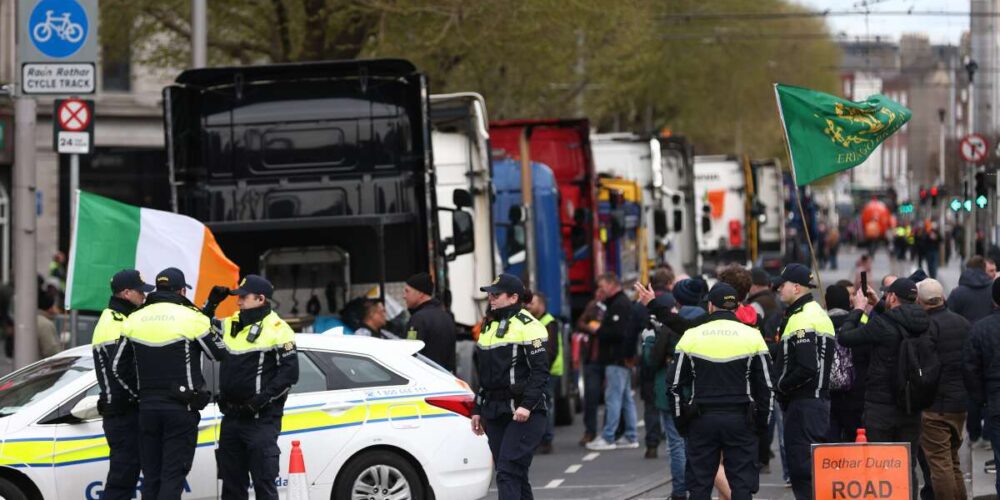

It would be entirely understandable if our readers were to take a measure of enjoyment from the latest spat embroiling Fianna Fáil and its leader, Micheál Martin. Castigated from within and outside the party for his handling of the fuel protests, questions were bound to be raised about his leadership. Coming little more than six months after the Jim Gavin debacle during the presidential election campaign, even his closest allies were concerned for the party’s image and future.
Nevertheless, and notwithstanding the reasonable reaction to seeing a deeply conservative political institution in bother, it remains necessary to reflect soberly on the entirety of the situation surrounding the protests. Although the cost-of-living crisis generated a degree of empathy for the disruption (and discomfort for the coalition) from the less well-off and hard-pressed working people, the genesis of the conflict was neither labour-led nor inspired.
As the Marxist scholar Professor Helena Sheehan pointed out last month on her Facebook page[1], the protests demonstrated the “…disproportionate power of those who own heavy vehicles…”. And, moreover, the state’s habit of making “…constant concessions to those who embrace market forces when going their way and demand that the state compensate them when they have losses or even problems…”.
In relation to the first count, it is indisputable that the owners of vehicles costing well in excess of €100,000 can hardly be considered as proletarian. Admittedly, not every protester was the possessor of such expensive machinery but were, nevertheless, for the most part in business as distinct from being waged employees.
Hardly surprising, therefore, that so many of the Dáil’s pro-business deputies in the coalition expressed sympathy for the plight of the ‘very decent’ people protesting while critical of their blockading of ports and oil depots. In fact it was this sympathy for the protesters that caused such turmoil for the Taoiseach and his ministers from many within the ruling coalition.
All things considered, the outcome of the protests demonstrated the nature and make-up of the 26-county Irish state. Faced with a rebellious cohort of some of those who normally wholeheartedly support the privilege-granting status quo, the government conceded to their demands. Of note was the fact that the price reductions were largely confined to petrol and diesel, with little done to alleviate the plight of low-income households depending on kerosene for home heating.
In short, the existing politico-economic system is designed only for the wellbeing of the more prosperous class. Furthermore, the free-market promoting coalition government is determined to ensure this remains the case. Any doubt as to the veracity of this need only be dispelled by reflecting on the message delivered recently in the government’s Spring Economic Forecast[2].
While the Department said that a general government surplus of €9.2bn is in prospect, there is no commitment to radically transform society in favour of workers or the less well-off. Speaking at the launch of the report, Minister for Public Expenditure Jack Chambers emphasised this point when he said: “…There is a need for strong cost controls across Departments to enable continuing delivery of commitments in the Programme for Government…”
A Programme for Government that fails to include provision of public housing, a national health service free and accessible to all, a package to offset the cost-of-living crisis, not to mention planning for a sustainable economy into the future.
There is a risk in all of this that those who forced their agenda on a government fundamentally sympathetic to their demands if not their tactics may be encouraged to exert pressure in the future if they feel the need to do so. There is, currently, a real risk that events in the Strait of Hormuz may lead to an economic recession if not a 1930s-like depression.
Were this to come about, would the coalition government divert funds away from granting relief to those ‘decent’ owners of heavy road-blocking machinery and instead direct it towards support for the working class? Only the wilfully naive would believe the latter.
There is a need that a strong signal be delivered to all in authority making it clear such an outcome will not be tolerated. Only one group currently has the wherewithal to carry this out, and that is the trade union movement. Encouragingly, after a meeting last month of the Labour Employer Economic Forum (LEEF), which brings together trade unions, employers, and government representatives, ICTU General Secretary Owen Reidy said: “…Our message to the Government today was clear: stop caving in to business demands at the expense of workers’ living standards.”[3]
It is very important that every section of left-wing opinion in Ireland demonstrates its backing for the stance adopted by the ICTU and endeavours to ensure that they have the support necessary to make good on their warning to government.