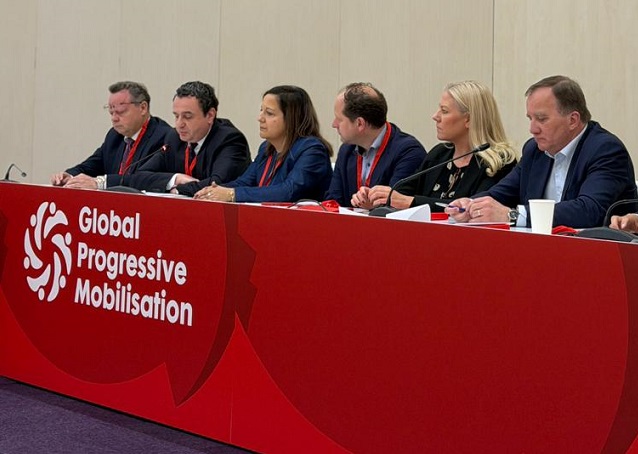



The Global Progressive Mobilization Conference was held in Barcelona on April 17–18, 2026, under the patronage of Spanish Prime Minister Pedro Sánchez and with the participation of Stefan Löfven, signalling a European effort to reposition the progressive current internationally. More than four thousand participants from around forty countries attended, including leaders such as Luiz Inácio Lula da Silva and the presidents of South Africa, Mexico, and Colombia, alongside European political elites. The organisation of the conference by the Socialist International and the Progressive Alliance reflects coordinated efforts to revive joint progressive action.
On the Palestinian side, the Fatah movement participated with a delegation headed by Mohammad Shtayyeh, alongside the Palestinian Popular Struggle Front led by Ahmad Majdalani, as well as Ahmad Tibi and Samir Ben Said. This reflects an attempt to integrate the Palestinian voice into progressive networks of influence. The conference forms part of growing global progressive mobilisation aimed at constructing an alternative discourse that combines social justice with transnational democracy, in response to the rise of populist right-wing currents and the policies of Donald Trump.
Objectives, Contexts, and Transformations
The conference represents an effort to rebuild the progressive current on more cohesive foundations by moving beyond dialogue toward establishing transnational coordination that unites like-minded forces into an effective international bloc. This responds to the rise of nationalism and populism, prompting the development of an alternative discourse capable of addressing social transformations and restoring trust in democratic institutions.
It also reflects an awareness of the shift toward a more complex multipolar international system, encouraging expanded cross-continental partnerships. Its convening is linked to the accumulation of global crises—such as climate change, economic inequality, and conflicts—which necessitate broader international coordination. Organising forces aim to transform theoretical coordination into effective political action through alliances and practical programmes that enhance their credibility and presence.
The conference further emphasises strengthening the electoral presence of progressive parties and redefining globalisation in a way that balances economic openness with social justice. At the same time, issues of human rights, democracy, and migration are central to the agenda, alongside calls to reform the global economic system. Finally, peace and security are redefined within a comprehensive framework that includes economic and social stability, reflecting a broader understanding of global threats.
Conference Agendas
The conference agendas reflect an attempt to formulate a comprehensive framework for addressing structural crises, focusing on social justice and reducing economic disparities amid rising inequality, which has contributed to the rise of populism and calls for reconsidering wealth distribution models. Climate change also occupies a central position as a political and economic challenge requiring international coordination, with an emphasis on linking sustainability and development.
Human rights and democracy are highlighted in light of declining democratic standards, alongside migration and asylum as contentious issues requiring a balance between humanitarian obligations and domestic pressures. Economically, there are increasing calls to reform the global system and address structural imbalances between the Global North and South. Within this context, peace and international security are framed comprehensively to include economic and social stability, not merely the absence of conflict.
Palestinian Participation and Its Significance
Palestinian participation in progressive conferences indicates a shift from treating the issue as an isolated political file to framing it within global justice and human rights discourse, emphasising inequality and rights rather than solely geopolitics. The two-state solution remains a broadly accepted reference point, though not necessarily a definitive resolution.
However, this framing faces internal divergences within the progressive camp, particularly regarding Israeli policies and approaches to the conflict. While it enhances the international visibility of the Palestinian issue, it also places it among competing global priorities such as climate and migration.
In this context, participation becomes a tool for reinserting the issue into international agendas, expanding outreach, and building alliances that may translate into political support within international institutions. It also reflects a shift toward transnational networks as instruments of influence and links the Palestinian issue to broader themes such as social justice, strengthening its position within progressive discourse.
At the same time, official participation enhances Palestinian diplomatic presence and reinforces the legitimacy of its representation within decision-making spheres, with the involvement of political figures contributing to amplifying Palestinian and Arab voices in the long term.
Conclusion
Overall, the conference appears as a strategic political and intellectual platform rather than a direct executive mechanism for producing binding policies. It aims to facilitate dialogue and consensus-building among progressive forces to reposition them globally, particularly in response to the rise of the right.
Although multiple international issues, including the Palestinian question, are addressed, they are framed within a broader context rather than as central topics.
The conference also represents the culmination of an accumulative process of international coordination led by figures such as Pedro Sánchez and Stefan Löfven, supported by progressive organisations, aiming to establish sustainable cooperation beyond episodic events. Its significance lies not only in immediate outcomes but in its capacity to build networks of influence that may shape future international policies and positions.
Within this framework, Palestinian participation extends beyond symbolism, serving as a mechanism to strengthen presence within influential circles and to shape their positions on the Palestinian issue. Consequently, the conference can be seen as part of a broader trajectory of reconfiguring alliances and discourses at the international level.