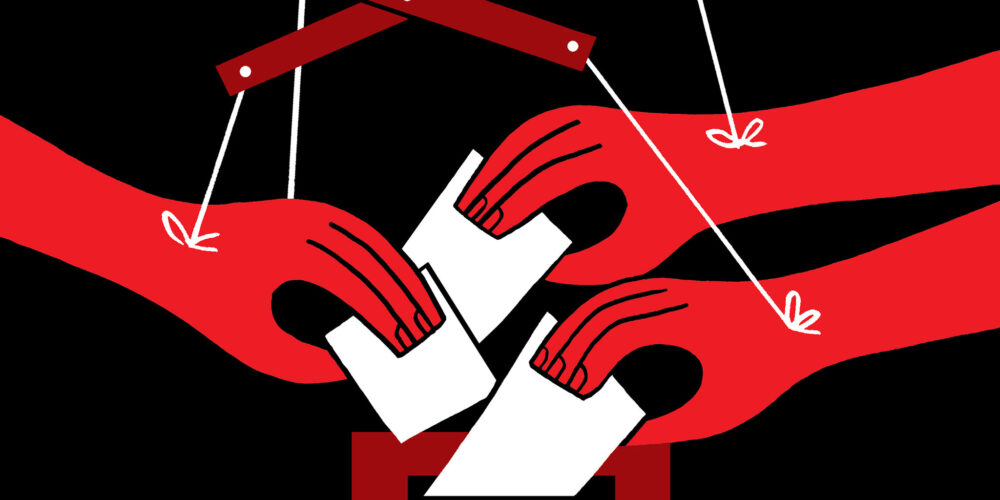

In many bourgeois liberal democracies, analysts have become anxious about the “crisis of democracy” – i.e. the loss of support for the traditional parties. Some commentators look outside the system and blame interference by Russian and Chinese state agencies. More realistic defenders of bourgeois democracy locate the crisis within the system itself.[1] Deneen, who is very much on the conservative side in politics, claims that it is liberalism in politics and the economy which has undermined the pillars of liberal democracy. Acemoglu also blames late-stage capitalism, in particular the loss of well-paid, unionised manufacturing jobs for non-graduates. While both are critical of some of the consequences of late-stage capitalism on society, they are not anti-capitalist.
Is there a crisis in bourgeois democracy? The bourgeoisie have a narrow definition of democracy. The people vote once every few years and they then have no further role in the process. If the people give the “wrong” result, for example when the Irish people rejected the Nice and Lisbon Treaties, and when the Romanians voted for an anti-EU candidate in their Presidential election, the result is rejected. In our case we had to vote again; in Romania the vote was annulled and the candidate disqualified from the re-run election.
There is a contradiction between capitalism and democracy. The tension between democracy and capitalism has existed since the emergence of the capitalist state. When the bourgeoisie was a revolutionary class and mobilised to overthrow the feudal state, their cry was Liberty, not Democracy. Their concept of liberty meant that formally all the citizens of the state were equal. The capitalist is free to own property and exploit the labour power of workers. The worker is legally free to refuse to sell his labour-power to the capitalist, but economically he has no choice. Such was the fear of the capitalists that the poor might seek more than formal declarations of equality; the right to vote was restricted to property owners. The right to vote was won as the result of struggle against the capitalist state.
Democracy has always been limited under capitalism. Once a government has been formed it becomes, in the words of former British Law Lord Hailsham, an “elective dictatorship”. This can be seen clearly in the attempts by the Irish government to get rid of the Triple Lock on the deployment of Irish troops abroad, even though this was not in their election manifesto. Once an election is over there is no further role for the electorate.
From the end of the Second World War, capitalism sought to buy off the possibility of socialist revolution by means of the welfare state. The belief that electoral politics could bring about progressive change and tame capitalism created a stable political environment. By the 1980s advanced capitalist economies began to dismantle the welfare state as their capitalists began to export manufacturing jobs. Following the overthrow of Socialism in the USSR and Eastern Europe, this process accelerated as the capitalist class believed they had buried socialism as an alternative and therefore the social democratic model of capitalism and the welfare state could be dismantled.
The crisis is the result of the failure of electoral politics to respond to the needs and demands of the people. The needs of capitalism have always trumped democratic demands. People demand housing, well-paid work, affordable energy and safe communities. Government policy is that the market will provide these. Irrespective of who is elected, the situation doesn’t change. That’s the crisis of democracy.
The task of the revolutionary left is to highlight the reality of bourgeois liberal democracy and build the class consciousness and confidence of the working class to go beyond bourgeois liberal democracy and take state power into their own hands. Real politics take place not in parliaments but, as Marx said, in “the rude external world”.[2]
References
[1] See for example, “Why Liberalism Failed” by Patrick J. Deneen and “What Happened to Liberal Democracy? Remaking a Politics of Shared Prosperity” by Daron Acemoglu.
[2] Marx. The 18th Brumaire of Louis Napoleon.