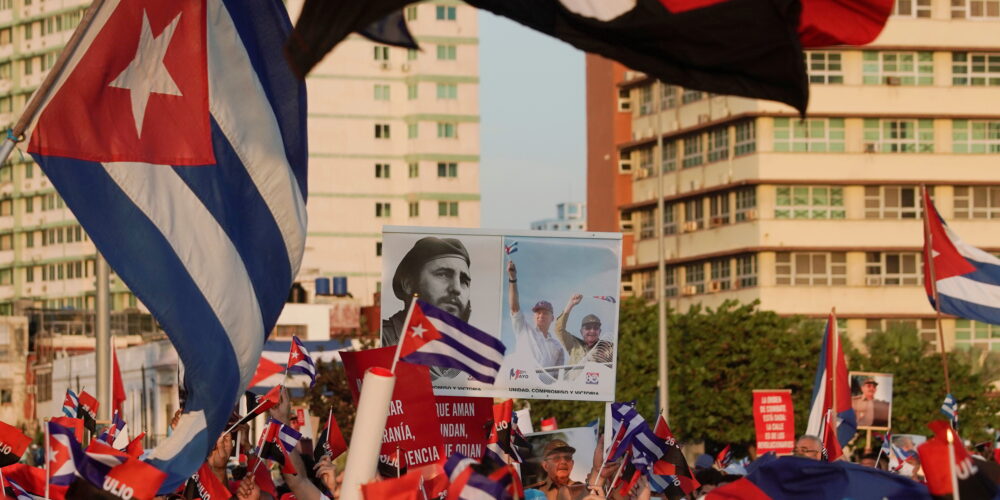

Last month, the Communist Party of Ireland commemorated the 1953 revolutionary assault by El Movimiento 26 de Julio on the Moncada Barracks in Santiago de Cuba with a solidarity vigil on Ha’penny Bridge, Dublin and a Cuban Film Festival in the New Theatre, Temple Bar. Moncada was not merely a military action – it was, as Fidel Castro later declared, “a cry of thought”, the spark that would ultimately liberate Cuba from the grip of US-backed tyranny and set it on the path to socialism.[1] As the Communist Party of Ireland recalls that historic act of revolutionary courage, we stand solidly with the Caribbean island that has defied the most powerful empire in human history for nearly seven decades.
Today, that revolution faces its most sustained assault yet: the economic, commercial and financial blockade imposed by the United States – a blockade that has intensified rather than relented, and which the Cuban Foreign Minister, Bruno Rodríguez Parrilla, has rightly condemned as a “multidimensional, unconventional war”. Between March 2025 and February 2026 alone, the blockade cost Cuba a record $8 billion – a 7% increase on the previous year – bringing cumulative losses since 1959 to an astonishing $178.7 billion.[2] These are not abstract figures. They represent hospitals unable to operate, schools without electricity, and a population enduring nationwide blackouts as Washington orchestrates what Rodríguez has called an “energy siege … equivalent to a naval blockade, which is an act of war”.[3]
The blockade did not emerge from a vacuum. It is the instrument of a US imperial project in Latin America that stretches back to the Monroe Doctrine of 1823 – the declaration that the Western Hemisphere was the exclusive sphere of US influence. That project has been revived with a vengeance under the so-called “Trump Corollary”, which asserts the right to dominate the hemisphere “politically, economically, commercially, and militarily”.[4] From the overthrow of Jacobo Árbenz in Guatemala in 1954, to the backing of Pinochet’s coup in Chile in 1973, to the kidnapping of Venezuela’s President Nicolas Maduro and Cilia Flores in 2026, to the systematic subversion of left-wing governments across the continent, Washington has consistently treated Latin America as a backyard to be controlled, not a region of sovereign nations to be respected.
For communists, this renewed aggression is no mystery. US imperialism is driven by the internal contradictions of a declining hegemon. The National Security Strategy of 2025 makes explicit what was once implicit: the United States seeks to control critical supply chains, secure access to energy and mineral resources, and prevent any “hostile foreign incursions” – by which it means the growing influence of the People’s Republic of China and other BRICS powers – in its traditional backyard.[5] The empire is lashing out, and the people of Cuba are in the crosshairs precisely because they represent an alternative – a socialist alternative – that Washington cannot tolerate.
Yet despite this siege, Cuba has achieved what no capitalist country in the region can claim. Free, universal healthcare and education; a life expectancy rivaling that of developed nations; medical internationalism that has sent doctors to the poorest corners of the globe; and a revolutionary consciousness that refuses to be broken. These are the fruits of socialism – the “original sin” for which successive US governments have never forgiven the Cuban people. In the face of impossible odds, Cuba has maintained its commitment to internationalism, offering solidarity to the oppressed while receiving precious little in return.
The world, however, is not silent. On 7th July 2026, the UN General Assembly voted overwhelmingly – 136 in favour, 9 against, 30 abstentions – to hold an urgent debate on the necessity of ending the US embargo.[6] This followed the twenty-third consecutive annual resolution condemning the blockade, which passed with 188 votes in favour and only 2 against (the United States and Israel). Vietnam, speaking on behalf of ASEAN, the Non-Aligned Movement and the G77 plus China, underscored that “for nearly seven decades, the blockade has severely impacted the development and daily life of the Cuban people”.[7] China’s UN representative noted that “Cuba has suffered accumulated losses of more than $170 billion … while hospitals, schools, water supply systems, grain storage facilities and other infrastructure related to people’s livelihood have come under severe pressure”. Even the UN Secretary-General, António Guterres, has expressed grave concern over the humanitarian situation, and the UN has been “involved in efforts to get fuel into Cuba for humanitarian purposes”.[8]
In July 2026, the Communist Party of Ireland organised a popular Cuban Film Festival at the New Theatre, showcasing the richness of Cuban culture and the resilience of its people through the lens of its revolutionary cinema. Such events are vital – they remind us that Cuba is not merely a cause to be debated in abstract, but a living, breathing nation of human beings whose daily lives are shaped by the brutality of the blockade. They also provide a space to educate, to organise, and to build the broadest possible movement against US imperialism.
But resolutions, debates, and cultural events, however welcome, are not enough. The blockade continues. The energy siege intensifies. The people of Cuba endure. It falls to us – communists, socialists, trade unionists and all people of conscience – to translate solidarity into concrete political action. We must demand that the Irish government break with the US-led axis of coercion and speak out unequivocally against the blockade. We must support the campaign to remove Cuba from the US State Sponsors of Terrorism list – a grotesque slander that serves only to justify further aggression. We must build links with Cuban trade unions, cultural organisations, and civil society, ensuring that the people of Cuba know they do not stand alone.
The Cuban people’s struggle is our struggle. Their endurance is a victory for all humanity against imperialism, exploitation, and war. As Cuba’s foreign minister reminded the world: “Cuba is not a threat. Cuba is the nation that is under threat”.[9] Let us ensure that threat is met not with silence, but with the full force of international working-class solidarity.
¡Cuba sí, bloqueo no!
[1] Fidel Castro, History Will Absolve Me (defence speech, 16th October 1953).
[2] Cuba’s Foreign Ministry Report on the Impact of the US Blockade, March 2026; cumulative figures cited by Cuban government to the UN, July 2026.
[3] Bruno Rodríguez Parrilla, address to the UN General Assembly, 7th July 2026.
[4] US National Security Strategy 2025 (declassified sections on Latin America), cited in The Intercept, May 2026.
[5] Ibid.
[6] UN General Assembly Resolution, 7th July 2026; vote outcome reported by Reuters and UN press release, 7th July 2026.
[7] Vietnamese UN Representative, statement to the UN General Assembly, 7th July 2026.
[8] UN Secretary-General António Guterres, quoted in The Guardian, 10th July 2026.
[9] Bruno Rodríguez Parrilla, address to the UN General Assembly, 7th July 2026.