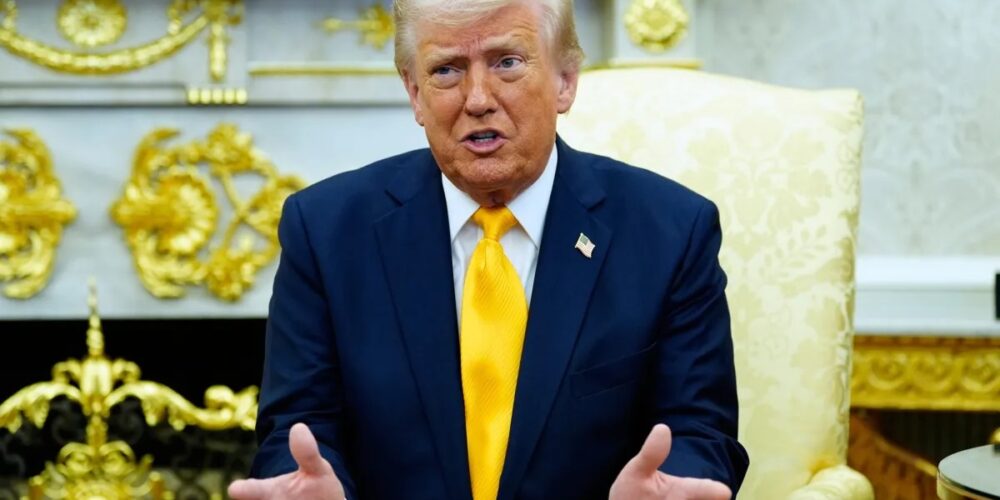


A question for our readers. Is the Trump presidency an aberration in an otherwise properly functioning governmental structure, or is this bizarre regime symptomatic of a deeper malaise? Let us examine the situation.
Donald Trump is an obnoxious, unscrupulous, vainglorious, unprincipled thug. He is also a convicted felon who, as president, has used that position to greatly enlarge his personal wealth. Since returning to the White House in 2025, he has used executive orders to introduce a plethora of tariffs that have caused turmoil not only in states traditionally viewed as out of favour with Washington but among long-term allies as well. Coupled with his threat to annex countries that are members of NATO, he has destabilised what, for long, was a solidly united bloc of leading capitalist countries.
Moreover, and in contradiction to his election campaign promise not to embark on foreign wars, he has launched several military operations. Most recently, he has decided to attack Iran. An unwise option as it turned out, resulting in his popularity falling due to the inflationary impact of rising oil prices. Consequently, there is an opinion growing in some quarters that as his influence declines, his presidency will be viewed as an aberration never to be repeated.
Whatever about the Trump style of running the office being a bizarre, one-off phenomenon, the essence of the US presidency and its dictatorial use of economic power backed by flagrant use of military might will not change voluntarily. While Donald Trump may well pass into history as a boorish anomaly, he is not an aberration in terms of the United States’ exercise of power.
In reality, while the Trumpian delivery is theatrical to the point of ludicrousness, his underlying theme of ‘Make America Great Again’ (MAGA) is something that the US ruling class wholeheartedly endorses. The reason is simply that the American Century is no more and the empire is in decline. A condition brought about largely through its adoption of neo-liberal economic policies at the beginning of the 1980s.
A policy found necessary by the US bourgeoisie in what might be described as an example of the inherent contradictions within capitalism. Three decades after the end of the Second World War and the Western bloc’s compromise with its working class in order to offset the attraction of Soviet-style socialism, the capitalist order was feeling threatened by the increasing power of labour. Drawing on the theories of the Chicago School of Economics led by Milton Friedman, the government of Ronald Reagan (and that of Margaret Thatcher) embarked on a mission to crush organised labour.
Utilising a strategy of ostensibly promoting the supremacy of free market capitalism, no consideration of how this impacted on employment or working-class living standards was to be tolerated. In practice, this meant that the state not only refused to consider any input from organised labour but actively worked to break trade union bargaining power.
Consequently, big business found it politically possible to move its manufacturing plants from the USA and relocate abroad in order to take advantage of lower labour costs. (A similar process was also underway in Thatcher’s Britain.) Over time, deindustrialisation led to what became known as the ‘Rust Belt’ across the Midwest and Great Lakes, accompanied inevitably by mass unemployment.
As Lenin had identified in his classic work Imperialism, the Highest Stage of Capitalism, the export of capital replaced the export of manufactured commodities. For several decades thereafter, the US financial sector benefitted as central government paid little attention to the hardship being endured by many working-class Americans.
By the same token, the US ruling class was initially indifferent to the outworking of facilitating the transfer of much of its manufacturing base abroad. Eventually, though, they came to realise that by doing so other countries, particularly China, had built a viable indigenous manufacturing base. Further concern was created by the fact that the People’s Republic had used its enormous sophisticated educational structures to enhance manufacturing processes once controlled solely by the USA.
This has resulted in China’s manufacturing sector now being significantly greater than that of the US. In the mid-1980s, China’s share of global manufacturing stood at less than 5 per cent, in contrast to the US share of approximately 27 per cent. Current figures show that China’s share stands at nearly 30 per cent while the US has declined to just over 17 per cent. Moreover, the PRC is leading global markets in crucial fields, among which are green energy, electronics, heavy industry and industrial automation tools.
Faced with the prospect of being comprehensively outperformed economically by what is deemed as Communist China, the US ruling capitalist class along with its Deep State are reacting despotically. This is evidenced by the fact that Trump was allowed leeway that would not have been tolerated if opposed by the embedded establishment. Between his abuse of office to self-enrich, his criminal conviction and the distinct likelihood of incriminating material in the Epstein files, there were ample grounds for impeachment if so desired.
There can only be one conclusion, and that is, regardless of his style, Trump is allowed, even encouraged, to launch a programme of measures compatible with the interests of the empire.
In short, to answer the question with which we opened: Donald Trump is undoubtedly a boorish charlatan, but he is not in any way an aberration in terms of the methodology, practices and strategy of the Yankee empire. Therein lies the dangerous malaise at the heart of that system.
Reference
¹ Felix Richter, ‘China’s Rise to Manufacturing Dominance’, Statista, https://tinyurl.com/34ptcexr.