
Football is the global language of ordinary people. It is played on any suitable surface (and many unsuitable surfaces) by working people in every corner of the world. But the World Cup stands above this mass, democratic experience, a political and economic spectacle, a plaything of FIFA, multinational corporations, broadcasters and political elites, in a word, the ruling class. The contradictions were visible from the opening match.
FIFA touted the tournament as its ‘most inclusive’ ever. Yet for thousands of supporters, journalists and workers, particularly from the Global South, entry to the United States proved anything but inclusive. Restrictive visa policies and heightened immigration enforcement prevented many fans from attending, undermining the FIFA Foundation’s rhetoric that ‘football knows no borders’. If football knew no borders, we would have been spared the absurd spectacle of the Iranian national team being refused entry to the United States except for the days of their fixtures, forcing them to be based in Mexico for the duration of the tournament. An outrageously obvious act of sabotage against a political enemy of the United States which undoubtedly contributed to their exit in the group stage.
As with Olympic Games throughout the 20th and 21st centuries, host cities invested billions in infrastructure, security and promotional campaigns while homelessness and housing crises continued, unaddressed. In several cities including Atlanta and Toronto, homeless encampments were cleared from tourist areas in the run-up to the tournament, exposing the priorities of urban development under capitalism: poverty is a structural necessity, not to be solved, merely to be hidden from view. All this while the oily Gianni Infantino and the FIFA elite jet around the world on private planes.
This pattern is hardly new.
From Brazil in 2014 to Qatar in 2022, mega-events have repeatedly transferred public wealth into private hands. The 2026 tournament followed the same model. FIFA is expected to generate record revenues, while global sponsors from banks and airlines to sportswear giants and technology companies enjoyed unparalleled exposure. Ordinary working people, however, bore the financial burden in their taxes, from stadium upgrades, policing, transport projects, and security operations. Those members of the public who wished to attend the games faced steep ticketing prices, with upper-deck seats costing in the thousands of dollars. Further intrusions into the game by a spirit of rank commercialism were plain to see in the risible hydration breaks, a transparent effort to introduce additional advertising opportunities into the most-watched sporting fixtures in the world, the parade of celebrities shown in the crowd, and the almost hilariously crass introduction of the ‘half-time show’ where the world-bestriding United States celebrated itself as a bastion of ‘love’.
The expansion to 48 teams undoubtedly created new opportunities for smaller footballing nations. Countries such as Cape Verde, Curaçao and DR Congo captured the imagination of supporters worldwide, demonstrating that football’s talent is far more widely distributed than the sport’s wealth.
The tournament also illustrated how sport continues to serve political purposes.
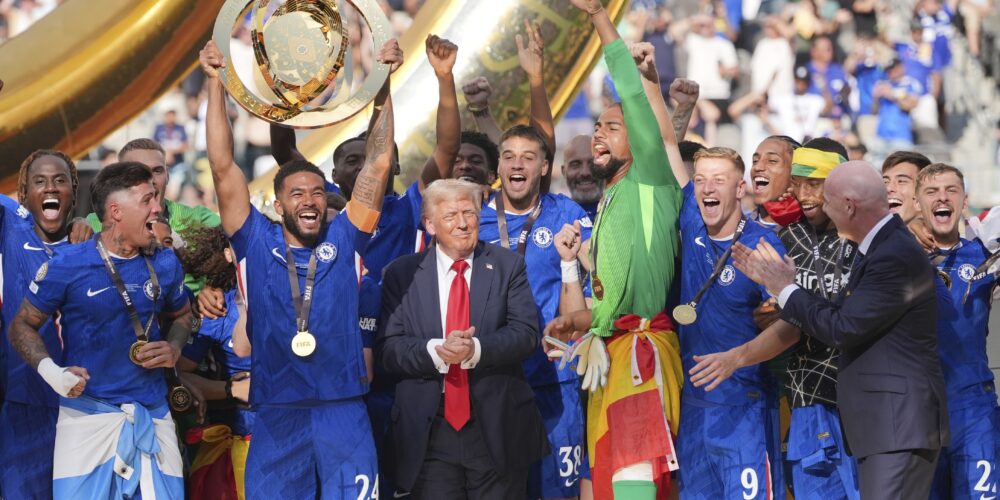
Governments eagerly associated themselves with football’s popularity, wrapping themselves in the language of unity and diversity while pursuing policies that deepen various crises at home. The World Cup provided an opportunity for political leaders to showcase national prestige, distract from domestic crises and promote an image of stability and prosperity. Hilariously, in the United States itself, the ruling class is shackled to the world-historic tastelessness and obliviousness of noted cartoonish simpleton Donald Trump, whose refusal to clear the stage during Spain’s trophy presentation despite Infantino’s pleas added a tragicomic air to this sportswashing effort.
None of this diminishes the genuine joy in the game experienced by supporters.
Football belongs to the global working class. It is a treasure trove of collective happiness that resists even the most ham-fisted attempts at co-option by the rulers of this world. But the contradiction remains. Capitalism is extraordinarily adept at commodifying collective culture. The universal game is transformed into one of the world’s most profitable entertainment industries. Every goal, every shirt, every television audience and every social media interaction becomes another source of profit extraction. In light of this, we can neither reject football as trivial nor romanticise the game as it currently exists. Instead, we must reclaim the democratic spirit that made football the world’s game in the first place.
Imagine a sporting culture where public investment prioritised community cultivation over corporate hospitality; where workers building stadiums enjoyed strong protections and living wages; where broadcasting served the public rather than private monopolies; and where supporters, not billionaires and marketing executives, shape the future of the sport.
The 2026 World Cup demonstrated both football’s extraordinary capacity to unite humanity and capitalism’s remarkable ability to commercialise that unity. The task before us is not to abandon the beautiful game but to struggle for a society in which its immense social value is no longer subordinated to private profit.
Football must be the people’s game, not the ruling class’s spectacle.