
At the threshold of the imperialist era, when the Enlightenment’s promises gave way to war, repression, and new forms of domination, contradiction — the irreconcilable tension between hope and terror — became central to art. A new aesthetics of terror emerged — an existential response to an age that shattered traditional meaning and exposed individuals to unprecedented violence. Francisco de Goya (1746–1828) stands as one of its decisive figures.
Rising from modest origins to become court painter to Charles IV, Goya gained intimate knowledge of the structures of power he would later critique. His cycle The Disasters of War (1810–1820), created in response to the Spanish War of Independence, transcends mere documentation. It confronts a society already destabilised by political stagnation, economic fragility, and social division. War appears as the culmination of a deeper crisis.
In these etchings, Goya merges documentary precision with existential intensity. Violence is systematically de-heroised. Breaking with the conventions of history painting, he presents terror as the direct result of human action. The horrors of war are neither glorified nor allegorically softened; they are shown with unflinching immediacy.
Plate 1, “Dark Forebodings”, establishes the tone. A kneeling figure gazes upward as shadowy, monstrous forms gather in a turbulent sky. The aquatint’s blurred darkness suggests an advancing black fog, a premonition of the atrocities to come. The image externalises psychological dread: fear, anxiety, and impending doom become visible. Like Christ in Gethsemane, the figure embodies existential abandonment and the human desire to escape approaching horror.
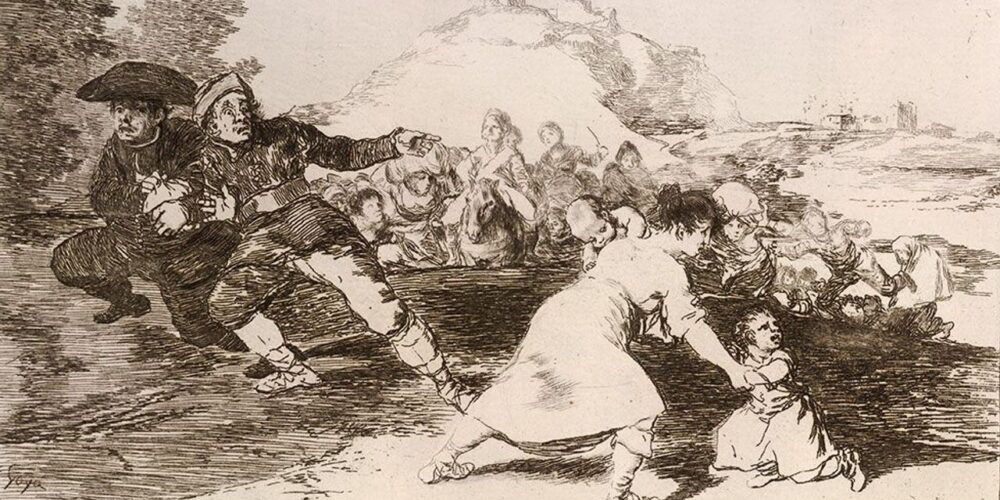
Terror is both historical and psychological. Subsequent plates depict escalating brutality. In “With or Without Reason”, peasants resist French soldiers; in “The Same”, they retaliate with equal ferocity. Goya refuses moral simplification: violence dehumanises perpetrators and victims alike. Scenes of rape, mutilation, execution, and slaughter reveal a spiral of brutality in which humanity itself seems to dissolve.
Yet Goya’s concern is not limited to external violence. Terror also appears as psychological shock and existential condition. Gestures and glances draw viewers into the moral vortex of events. In Plates 44 and 45 (“I saw it”), the assertion of eyewitness testimony collapses distance between artist and observer. Plate 26 (“One cannot watch”) intensifies this strategy: figures kneel around a veiled mother and child, begging for mercy from soldiers who remain outside the pictorial space. The scene does not merely depict violence; it captures existential shock.
From Plate 48 onward, the focus shifts to the Madrid famine. Plate 55 centres on a skeletal group arranged in a downward, earthbound triangle around a dead woman — likely a mother. Their physical proximity suggests solidarity, yet their unity lies in shared annihilation. Opposed to them stands a second triangle formed by a well-dressed woman turning away toward a distant French figure. Her illuminated form contrasts with the shadowed, starving group. The title, “The worst thing is to beg”, underscores the erosion not only of material sustenance but of dignity and communal cohesion. Goya visualises social disintegration itself.
This trajectory culminates in Plate 69, “Nothing”. A decaying body inscribes the word Nada, becoming both witness and victim. In earlier versions, an allegory of reason confronted darkness; in the final state, the light is nearly extinguished. Justice’s scales lie overturned. The aftermath of war has not brought renewal but restoration and repression. Terror condenses into nihilism: a world stripped of meaning.
At this point, the cycle shifts from documentation to political allegory. Goya exposes the systemic violence of the Restoration. In Plate 74, a wolf enthroned as judge blames “wretched humanity” for its suffering, while a monk assists him. Hypocrisy and clerical complicity are laid bare. The promise of liberal reform, briefly embodied in the Constitution of Cádiz (1812), is crushed by reactionary forces.
Yet the series does not end in accusation. From the negation of “Nothing”, Goya develops a utopian counter-vision. In Plate 79, “Truth has died”, Truth — identified with liberal reform — is buried by clergy. Yet even in death she radiates light. Plate 80, “Will she rise again?”, shows her as a luminous apparition terrifying her adversaries. Resurrection is conceived politically, not theologically.
The final plate, “This is the truth”, offers a radiant conclusion. Unlike the preceding dark aquatints, a luminous figure of Truth stands firmly on the earth, dressed like a peasant woman. Beside her, an elderly farmer holds agricultural tools; before them lie a full basket and a lamb — symbols of labour, fertility, and renewal. Truth is bound to productive life in solidarity. The scorched ground of famine is replaced by substance and weight. Here, truth emerges from shared work and community. The composition remains grounded, natural, and horizontal: hope is earthly, not transcendent.
In The Disasters of War, Goya establishes an aesthetics of terror that refuses reconciliation. Hope and despair, liberation and renewed servitude, documentation and vision stand unresolved. Terror is neither aestheticised nor neutralised; contradiction itself becomes the organising principle. Yet hope persists as fragile possibility.
Goya thus appears as a precursor of modern art. His fusion of radical realism and symbolic condensation resonates in the works of Otto Dix, Pablo Picasso, Käthe Kollwitz, and others who confronted the violence of modernity. Born of his time’s contradictions, Goya’s art continues to speak to ours. In times of terror, it suggests, art must not console — it must render truth visible.