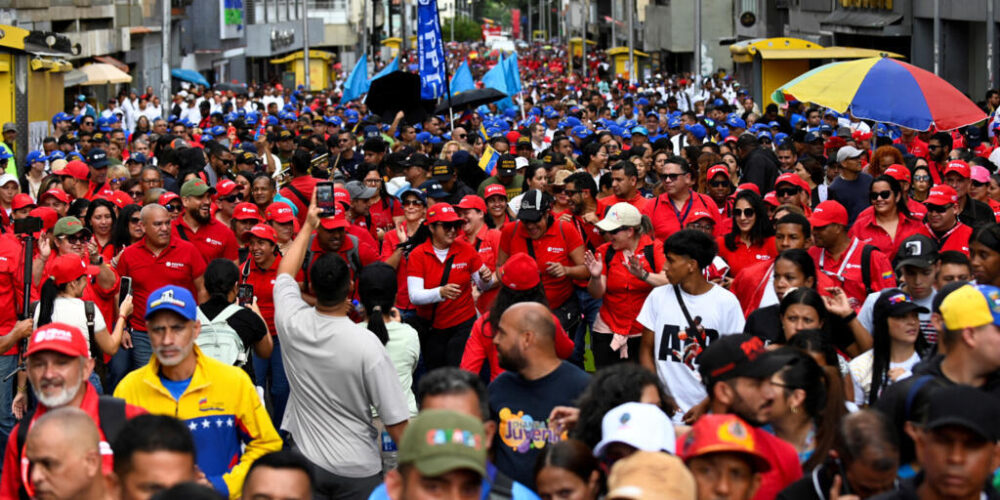

Events surrounding the kidnapping of Venezuelan President Nicolás Maduro and Cilia Adela Flores de Maduro on 3 January by the US continue to cause confusion and division on the Left worldwide as people try to understand what happened.
Many questions have certainly been raised by the events that unfolded on 3 January in Caracas. Much of the focus centred on the very limited response from the Venezuelan military. How were the US able to penetrate Venezuelan airspace so easily and kidnap the president? In the ensuing defence of the president, 32 Cuban military volunteers died in the battle alongside a significant number of both Venezuelan civilian and military personnel.
Western intelligence agencies, using their easy access to Western media outlets, have been attempting to exploit the ensuing confusion to further isolate Venezuela’s interim president, Delcy Rodríguez, with unrelenting leaks from “sources”—mostly unidentified individuals presented as being “well informed” or “close” to events, with very little concrete evidence presented. This is all part of the ideological conditioning and the manufacturing of consent regarding how working people should understand events from a Western imperialist perspective, clearly presenting it as impossible to defeat or escape the clutches of imperialism in order to encourage defeatism and passivity.
While trying to figure out what really took place in Caracas in early January, there are many rabbit holes Western intelligence agencies would like working people to go down. The very fact that Venezuela’s interim president, Delcy Rodríguez, may be going to Washington sometime in February is not an indication of anything substantive at this point. People should not mistake diplomacy for selling out.
Venezuela is in a bad and weak position at this time after decades of sanctions and the seizure of state assets and sovereign wealth funds by the US, which has had a significant impact upon working people. Workers need to remember that sanctions are about hurting working people and the poor, to break the people’s capacity to resist imperialism. Currently, Venezuela has few cards to play and too few allies in the region or even globally.
At this moment in time, the ownership of the huge oil reserves rests with the Venezuelan government. Revenues have almost dried up, thereby heavily impacting the Bolivarian social programmes that have benefited workers, peasants, and the poor. If the government can begin to get the oil revenues flowing, the critical question then becomes what it is used for and who benefits.
A number of questions flow from possible engagement with the US: will it ease the sanctions and blockade pressures? Will it create more space to manoeuvre in order to allow possible movement forward? Building and sustaining radical economic, social, and political change, as the Bolivarian process is in Venezuela, is extremely complex and challenging given the hostile environment in which this struggle takes place.
Experience globally and nationally shows that capitalism-imperialism will not cede ground without a fight. Over the course of the Bolivarian process, there was a confused mix of liberation theology, Catholic social teaching, and the ideological confusion created by the wishy-washy “21st Century Socialism” peddled by Western leftist academics who wanted to ignore the historical experience of building socialism in the 20th century—building socialism without taking state power.
The future of the Bolivarian process in Venezuela will depend upon the mobilisation of the working class. Critical questions include whether they will be able or willing to maintain the same social, economic, and political relationship with Cuba. This is where international solidarity can play a key role: to show the working class of Venezuela they have support globally, that Cuba does not stand alone.
The balance of forces is not on our side currently. At this time, national material self-interest dominates the world view of many countries, not any great anti-imperialist vision, as when the Soviet Union was a strong material force in world politics and events. Taking a step back in order to create space to move forwards does not necessarily mean the abandonment of struggle. Now is not the time for absolutes but for strategic thinking, recognising where the balance of forces lies. What we wish and what is possible are two different things.
Those who believe in and struggle for radical change need to see what lessons we can learn from events in Venezuela and other Latin American radical processes. We need to try and promote the lessons to be learned:
- A revolutionary ideology is needed to secure and build a revolution.
- State power is not neutral.
- The working class needs to be at the centre of economic and political power.
- The ownership and control of capital is a critical question.
- The owners of capital should not be allowed a foothold in economic and political life to undermine the revolutionary process.
- Radical change cannot be brought about within an electoral cycle.
- Ultra-leftism is a cul-de-sac; there is no pure revolution, nor one without contradictions.
- National sovereignty and independence are class questions: in whose hands they are wielded and whom they serve.
Going down conspiracy rabbit holes constructed by the state’s ideological apparatus is of little value; it only allows them to decide what happened and how it happened. It disempowers us and is a victory for anti-working-class forces.