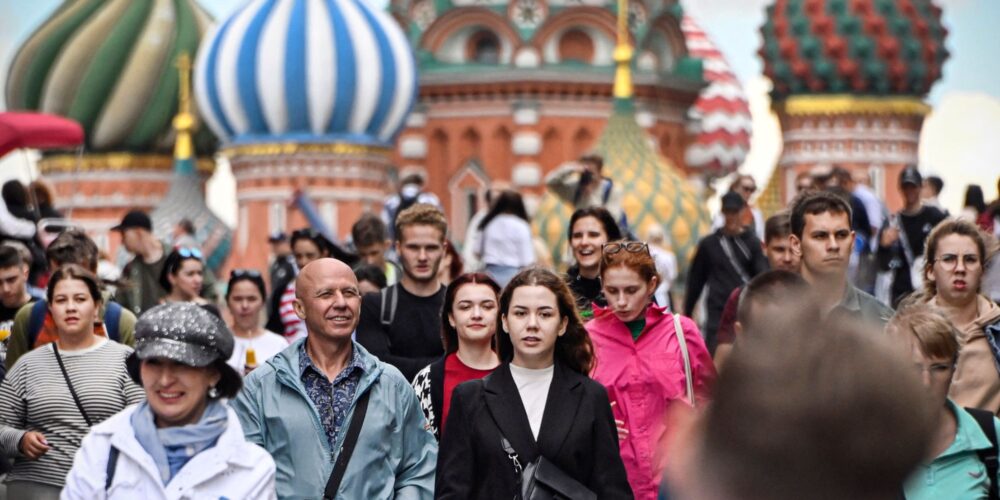
St Petersburg (Leningrad), 2026 – If you are considering visiting Russia, let’s cut through the Western media noise: I would genuinely recommend travelling. It is rewarding, eye-opening and surprisingly easy, with one genuine headache: Western bank cards.
Before we left, we secured our visa online in under five days – a painless process, with payment easily routed through third-party international banks. Flights and hotels were also booked online using our standard Western bank cards. However, Visa and Mastercard are useless inside Russia (thanks to sanctions). Russians use Chinese-linked UnionPay debit cards issued by Russian banks for international travel – accepted everywhere except the EU, US, Britain and Israel. Western travellers can easily access rubles through banks and currency exchange offices.
We met our old pal, Ilya Klemyonov, from the Communists of Russia party, at their new premises in Leningrad. In an ironic twist of globalisation, the office sits literally next door to an Irish pub called ‘The Irishman’. While the Russian comrades enjoyed their sto gram (100 ml of vodka), we stuck to water for our political debrief with Ilya and the General Secretary, Sergey Malinkovich, a native Leningrader.
Asked about the drone attacks, both men reflected the locals’ remarkably relaxed attitude: ‘The Siege of Leningrad is carved into the city’s soul. Drones? They pale in comparison.’
Sergey pulled out his phone to show us a photo of his grandmother – a machine-gunner defending the city against Nazi warplanes. Many people we met proudly showed photos of relatives who perished in or survived that 900-day genocide. The memory remains raw and utterly genuine. The same WWII slogan – ‘This is our cause’ – now appears on billboards again today in relation to the Ukrainian conflict.
According to Ilya, the population has rallied around Putin. Their view, shared by almost everyone we met, is that the war in Ukraine is in fact a war against the West as a whole and a continuation of the Great Patriotic War, in which their grandparents and great-grandparents fought in the 1940s. Since the West appears unwilling to negotiate, many believe a larger confrontation is almost inevitable. The ghost of 1939 has returned.
Reflecting on Putin’s 26 years in power, Ilya described a mixed record. The state has reclaimed strategic sectors plundered by oligarchs in the 1990s, with oil, gas and the arms industry now firmly state-owned. The nationalisation of key industries, he argued, is among the greatest threats to Western powers, even though the wider system remains capitalist. German and Chinese cars are everywhere alongside Ladas. We saw no obvious poverty, though Ilya noted his party works for the poorer sections of society, without dwelling on economic hardship. Our comrades claimed the conflict involving Iran has recently strengthened the ruble. We also noticed Iranian fruit and vegetables filling supermarket shelves.
As Western sanctions took hold and international brands exited in 2022, Putin did not simply let them leave. In March that year, he declared Russia would seek ‘legal solutions’ to seize the assets of departing companies. A list of 59 foreign firms – including Apple, Ikea, Microsoft, Shell and McDonald’s – was identified for possible nationalisation. Under the legal mechanism, foreign-owned businesses (with at least 25 per cent foreign ownership) that ceased operations could have external managers appointed, their assets auctioned, and ownership effectively transferred to Russian hands.
The most symbolic case was McDonald’s. After 30 years in Russia, the chain sold its 850 restaurants in May 2022. They reopened the following month under a Russian owner as Vkusno – i tochka (‘Tasty – full stop’). For the Russians we spoke to, this was not a loss but sovereignty: domestic control replaced foreign ownership. The state stepped in to protect jobs and prevent what the ruling United Russia party called ‘premeditated bankruptcy’. What mattered was that Russia was no longer beholden to Western corporate blackmail. The prevailing sentiment was one of support for the government, with the state seen as a shield against Western domination.
We also raised the issue of labour. Mass migration from former Soviet republics (Uzbekistan, Tajikistan, Kyrgyzstan) provides cheap labour for construction and services. However, these workers lack social protection. The official trade unions are largely integrated into the state system: active in major factories but virtually absent from small and medium-sized private enterprises. Ilya explained that the Communists of Russia fill this gap, working with those facing exploitation and discrimination, including migrants.
One of the party’s key but underreported roles is informing regional and local government about grassroots problems. In effect, they perform work the trade unions should be doing, acting as a safety valve for social grievances. With 500 elected deputies across regional and municipal governments, they maintain a genuine campaigning presence.
Travel to Russia proved a fascinating insight into a society that has weathered manifold crises over the past 40 years. Not least was the replacement of a thriving socialist society with a catastrophic, avaricious capitalism dictated and exploited by the West and its ally, a subservient Russian oligarchy.
Russia’s economic stabilisation in the early years of this century faced aggressive NATO encirclement and imperialist demonisation. Moscow’s concerns were disdainfully rejected, culminating in a US-financed coup in neighbouring Ukraine. The goal: NATO missiles on Russia’s border, only minutes from Moscow. This belligerence prompted Russian push-back, leading to immense sanctions and today’s proxy war, as imperial capital dreams of Balkanising and seizing the jewels of this resource-filled land. Today, Russia has embraced state capitalism and rallied around a deeply historical wartime mentality. It is worth witnessing.
The payment difficulties of travelling to Russia are real, but surmountable. The people are resilient and exceptionally friendly, and the history is palpable.