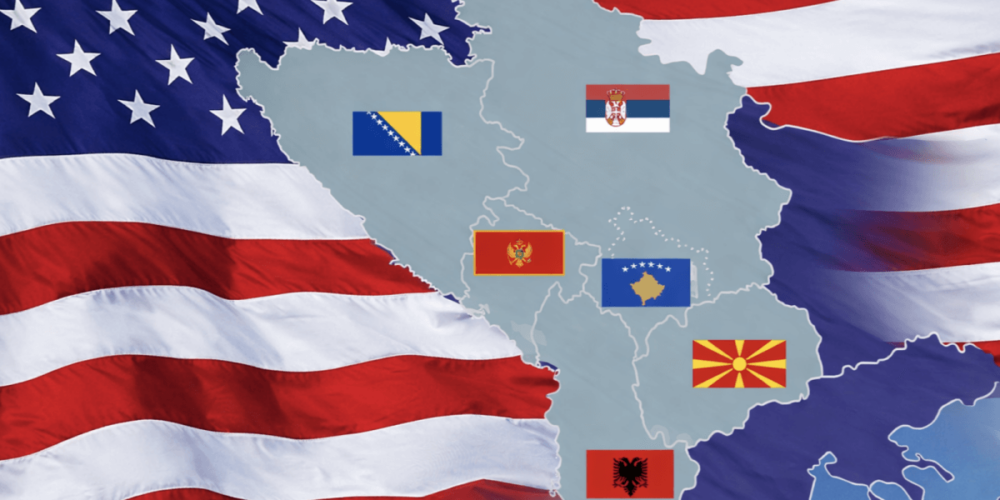

The latest event in the series of Connolly Conversations, public meetings on current topics held in Connolly Books in Dublin, focused on the developments in the Western Balkans. This term, rather popular in geostrategic parlance of the European Union, denotes the still-not-EU territories in the Balkans. While the protests in Albania have been the most common reference to the current geopolitics of the Western Balkans in our media, this meeting turned the discussion to the complexity of energy supply in the Balkans, and the political landscape left after Bill Clinton’s deadly peace campaign. The long shadow of Pax Clinton in places like Bosnia and Herzegovina mirrors the situation in the North of Ireland.
Bosnia and Herzegovina, 30 years after the Dayton Peace Accords, remains in a constitutional stalemate, with the power sharing in the Bosnian consociational arrangement being open to manipulation and exploitation. In addition to the complex asymmetric structure of representation, Bosnia and Herzegovina has a foreign administrator in the form of the High Representative. The High Representative has a wide range of powers, including imposing and annulling laws without parliamentary procedure. This law-making power is consistently a point of contention, and these days it has the attention of international geopolitical analysts with the new energy infrastructure plans in the region.
The United States has sustained continuous pressure in the Western Balkans to lock them into their own fossil fuel economy and establish a scheme of dependency. Not unlike the decade of pressure on Ireland to establish a liquefied natural gas (LNG) terminal and bring in US gas through maritime routes, the idea of the so-called Southern Interconnection in Croatia and Bosnia is to bring US gas into the Adriatic Sea and then distribute it across the Balkans via a network of pipelines, countering Russian gas imports in the area.
The infrastructure is yet to be built, and the representatives of US interests in the region belong to the well-known set of usual suspects: for example, the tiny company trusted with the project on the American side is led by the brother of Michael Flynn, former state security advisor of US President Donald Trump. On the Bosnian side, the controversial Israeli businessman Amir Gross Kabiri has repeatedly implied involvement in the project. One major issue in the way of this major advancement of the US energy industry is the legal framework in Bosnia and Herzegovina. The current laws regulating the use of state assets require the state to have full control of infrastructure built on state land; unsurprisingly, this is unacceptable for the US. The law needs to be changed, and the US will support only a new High Representative (the previous High Representative resigned earlier in the year) who is ready to make this intervention on their behalf.
The explicit demand of the US administration in this regard has replaced decades of veiled, gloved diplomacy of “peace”, “values”, “anti-corruption”. The EU finds itself in opposition to the US pressure, but not without its own interests in energy, mineral extraction, military and political influence. Characteristically for the Balkans, EU expansion in the region always went hand-in-hand with that of NATO, referring to the process as “Euro-Atlantic integrations”. This process continues, and it is hard to see the news of Montenegro joining the EU outside the geostrategic plan of securing the Adriatic coast, countering Russian and Chinese influence, and solidifying economic and military strategic assets. The fast-tracking of Bulgaria and Romania two decades ago into the EU and NATO was no different.