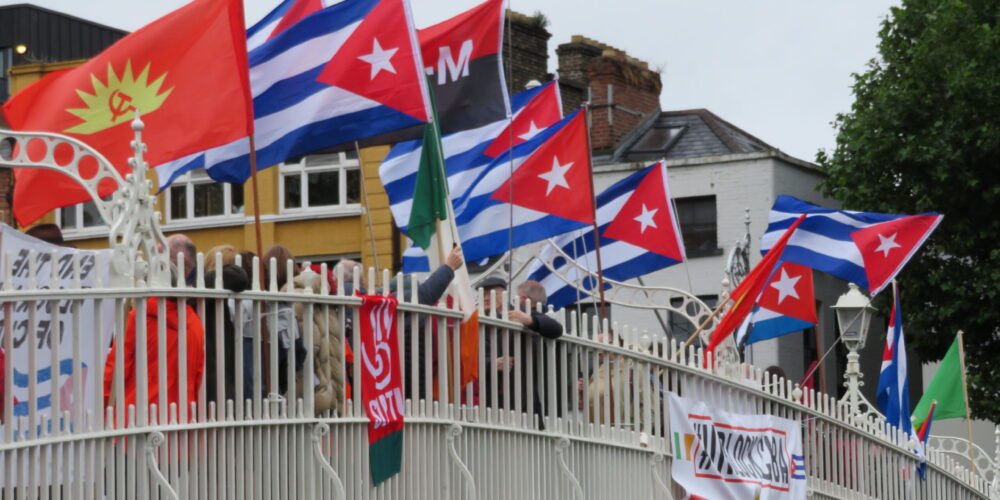

At the end of June, the Communist Party of Ireland had the privilege of hosting an intimate morning event with Elizabeth Ribalta from the Cuban Institute of Friendship with the Peoples (ICAP), during her travels around Ireland and the UK.
The event happened just days after Cuban president Miguel Díaz-Canel announced swathes of the economy would be opened up to foreign and private investment, as the state attempts to tackle the impacts of the tightening US blockade.
Below are excerpts from our discussion, shortened for brevity.
Question: First, what is ICAP, for people who aren’t familiar?
Elizabeth: The Cuban Institute of Friendship with the Peoples was founded in 1960, one year after the revolution. The US government started trying to isolate Cuba from the world, so our objective was to link people of other countries with Cuba. From the beginning we defended just causes around the world—independence processes in Africa, Asia, Latin America. We received refugees from the dictatorship in Chile. We started receiving solidarity brigades who came to participate in building the new society.
Q: What’s actually happening on the ground?
E: This is a very well-designed manoeuvre of US policy. They describe Cuba as a “state sponsor of terrorism”, inventing excuses like Chinese military bases or phantom drone attacks—all not true. They say Cuba is a failed state needing humanitarian intervention. Then they suffocate every source of income, cutting all opportunity to trade, to buy equipment, medicines, food, technology.
Since we don’t receive oil, power cuts are up to 20 hours daily. Imagine waking up with no electricity, no breakfast, walking long distances to work or school. Eighty percent of water pumping is paralysed. Hospitals operate on generators with minimal diesel. Surgical waiting lists exceed 100,000 patients—more than 11,000 are children. Infant mortality has risen to 9.9 [per 1,000 live births], when years ago it was just 4. This is something Cubans are suffering every day.
Q: Some European leftists feel recent economic changes are a betrayal of the revolution. What do you say?
E: We know our friends sometimes idealise the revolution. They don’t see we are in a process of constructing a new society—you cannot cut yourself from the international system we live in. We are making mistakes. We go two steps forward and one step back. We are not China, we are not Vietnam—it is a very different scenario. People need to maintain faith with the Cuban revolution because its success is also the success of other peoples around the world.
Q: The European Parliament recently passed a resolution calling for sanctions on Cuba. What’s happening there?
E: Now we are in a very adverse scenario in the EU because the majority of parliamentarians are from the right wing. The left are the minority. That gives the counterrevolution spaces to give them all this misinformation about Cuba—just the point of view of mercenary people who go to the parliament to sabotage the dialogue between Cuba and the European Union. It is very sad that European governments have pledged to US policy and what Trump says. These countries have their own self-determination and sovereignty, but it seems like they don’t have it.
Q: What should Irish activists prioritise?
E: The call for solidarity is urgent—this is a genocide. They are not using bombs yet, but they could be. The solidarity movement must be more active than ever: visible public manifestations, motions, declarations, letters to MPs and European parliamentarians. We need you to keep denouncing this policy, because if it’s not visible, they will continue lying.
We really appreciate the aid—solar panels for polyclinics, maternity homes, schools. Food, powdered milk, beans, rice. But also, go to Cuba. You need to see with your own eyes what is really happening, and this is a way to support Cuba economically. I know there are obstacles, but it is necessary to go.