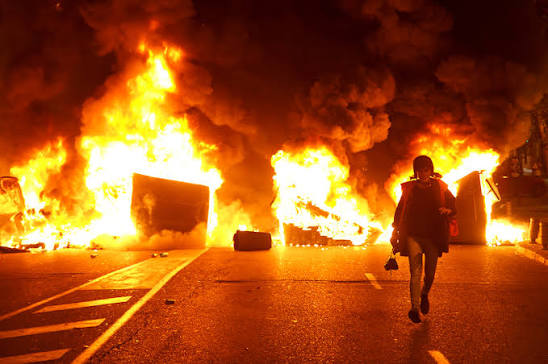


Rioting, violence, racist attacks, attacks on homes, forcing people out of communities, thuggery, attacks on workers took place over a few nights from 9 June, largely concentrated in Belfast and in loyalist-dominated areas. Thanks to decent people, across all communities, and organised opposition, it did not spread much or last long. However, the threat remains, has never gone away and is not new.
Firstly, it is important to wish the victim of the shocking knife attack well in what is likely to be a very difficult, both physical and psychological, recovery, and also to note the intervention that saved his life; those who intervened will also, no doubt, suffer trauma as a result and need support.
This piece for Socialist Voice is not focused on the horrific incident, victim, perpetrator or hero but instead on the racist loyalist violence that opportunistically occurred in response. At the time, there was lots of reporting, media hype, opinions, statements, demos and counter-demos but very little analysis that placed the violence in its actual historical context. The ‘commentary’ all round from both the mainstream media and ‘left’ groups was often poor and merely parroted narratives from other countries, virtually ignoring the time, place and context of where this happened.
Reading pieces at the time, one could have mistaken this event for happening in the US or Britain, such was the lazy journalism, cut-and-paste sloganeering from the left, liberal pronouncements and general lack of specific historic and political context and content. A piece in the Irish Times, and one in RTÉ, managed to write about the violence without mentioning loyalism once! The pieces pontificated about the ongoing rise of the far right like it’s new, as if Ireland has not had organised reactionary right-wing armed loyalist paramilitary organisations for decades, and in other forms for centuries, committing racist, sectarian pogroms and genocide against the native population – murdering, stealing land, homes and forcing people out of their communities. We’ll just conveniently forget the legacy of settler colonialism specifically, and colonialism more generally, on our island and instead import a liberal take on the far right from elsewhere.
A pogrom is broadly defined as a violent and targeted attack directed against a specific ethnic, religious, or national group. Sadly, this is not new to Ireland nor is it ancient history. Yes, it occurred in an organised systematic way in the 1600s and 1700s but also in the 1920s, 1960s and 1970s, as well as sporadically through the 1980s and into the 1990s. Targeted attacks by planters, and then their descendants/political heirs, against natives and later more generally against Catholics, new Irish and migrants. Organised, armed, violent, reactionary, right-wing (arguably neo-fascist) and racist paramilitary structures exist in Ireland as an active construct and agent of British colonialism here. They are not new. They are not a social media invention, although this amplifies. They are not a Trump/Farage/Musk construct, although this presents tactical alliance opportunities (including with 26-county free-state right-wing nationalists), money, profile and audience.
These groups that were behind the scenes orchestrating and directing the violence are the most reactionary elements of British imperialism with a strong connection to British state agencies. It is impossible to believe that the British State did not know what was happening, even if there was a degree of opportune spontaneity to the attacks. Given the direction of travel toward a United Ireland, this was more likely an opportunistic moment to remind people of their organisation and violence and to continue the division of the working class. We have a fragile tactical political truce, but loyalist paramilitary structures that are racist and reactionary have not disbanded or disappeared. Workers do have genuine grievances, especially with regard to housing supply and immigration realities often ignored by ‘the left’, but be under no illusions: these reactionary forces, the boot boys of imperialism in Ireland, offer nothing but further division, continuing low wages, insufficient housing and general misery.