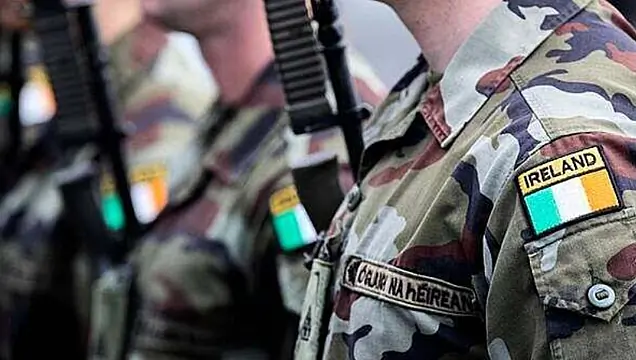



In Preparation for the EU Presidency
Ireland will hold the EU presidency from 1st July until 31st December 2026. In advance of this, the government has taken steps to further integrate Ireland into EU and NATO military structures, while churning out the usual refrain that none of this affects ‘our policy of military neutrality’.
Maritime Security Strategy
On 25th February, Minister for Foreign Affairs Helen McEntee launched the state’s first ever Maritime Security Strategy 2026 – 2030.
The strategy claims to be ‘in line with Ireland’s policy of military neutrality … [which] is characterised by non-membership of military alliances or mutual defence arrangements’. It then sets out how Ireland will embrace military alliances and mutual defence arrangements with the Joint Expeditionary Force (JEF), NATO, the EU, Britain and France. This would appear to violate even the government’s narrow definition of neutrality, which doesn’t align with international law.
The JEF is a British led outfit comprising NATO’s northern European members. Ireland now seeks to access a ‘JEF+’ arrangement. Meanwhile it will also enhance its partnership with NATO, in place since 1999, maximising ‘opportunities … through the Individually Tailored Partnership Programme’.
The Strategy also foresees collaboration with EU Defence Capability Development Initiatives including positioning Ireland as a host or partner ‘in an EU regional monitoring hub for Critical Undersea Infrastructure’.
The government will host ‘a maritime security conference during Ireland’s Presidency of the Council of the EU’.
Bilateral agreements will be drawn up with Britain and France, both nuclear powers, permitting them to patrol Irish waters. The government announced plans to advance legislation in this regard ahead of the EU Presidency. But without any mention of a sunset clause, it is likely that these and other arrangements introduced under the pretext of providing security during the presidency will outlive it and be normalised.
The Strategy seeks to develop ‘forward operating bases’, which may see ports transformed into military bases in the same way that Shannon Airport has become a de facto US military base.
The document doesn’t reference any maritime security attacks, with the exception of Nord Stream, which occurred in the heart of ‘NATO territory’. It also fails to mention that undersea infrastructure is damaged regularly, with about 200 incidents occurring annually, none of which are from sabotage. A Washington Post article concurred – it is ‘accidents, not Russian sabotage, behind undersea cable damage’.
Nevertheless, Ireland will now invest vast sums to prevent hypothetical threats, while failing to address actual urgent matters including housing, health care and climate crisis.
A €2 billion arms deal
In recent months details have emerged of an unprecedented arms deal that could see the state ‘purchase up to €2 billion of military equipment from France’.
Though figures vary across reportage, French arms company KNDS, looks set to earn between €600 and €800 million for up to 400 combat vehicles.
KNDS is a member of the Irish Defence and Security Association, a self described ‘industry group’ that lobbies the government. This deal may be the fruit of those efforts.
Why is the government amassing combat ready vehicles at a rate of one per 20 soldiers? Is it expecting a land invasion? Or are they for use in conflicts overseas as part of EU and NATO led missions? Future participation in such missions would appear to be a foregone conclusion considering the current direction of travel coupled with plans to abolish the Triple Lock.
Or will these vehicles be used in future confrontations against those who revolt against the capitalist system? Will the government turn the guns on its own people? It’s worth recalling how quickly it announced that the army would be deployed to curb the fuel protests. The climate wasn’t ripe for it then but it may be in the future.
Or will these vehicles, at best, be left to gather dust in the Curragh, signifying a colossal waste of public money?
Whatever their eventual use, there is little question that the deal constitutes a combination of arms trade opportunism and a weak government that has folded under pressure from war mongering elites in Brussels, London and Washington.
The vehicles at the centre of the deal will rely on AI systems to decide what constitutes a target and will point the gun turret at it. In theory they will also be able to open fire using AI without a human in the loop.
Procurement of military equipment that can autonomously open fire should be a matter of public debate. Yet the normalisation of references to AI and militarism in public discourse means that when the government seeks to acquire what are essentially killer robots, barely an eyebrow is raised.
Other equipment making up the €2 billion deal includes €500 million in military radar, €300 million in aircraft, €100 million in communication equipment, €60 million in sonar and €1 million for a ‘NATO proof’ room.
If the government gets its way, Ireland will be unrecognisable by the end of the EU presidency. NATO ships will patrol our waters, Irish troops will be free to deploy on EU and NATO missions, and the state will be in possession of military equipment that will allow for its seamless integration into NATO military structures. No doubt we’ll continue to be told that ‘none of this will affect our policy of military neutrality’.