


A recent article in the Belfast Telegraph informed its readers that 400,000 people in the 6-counties – that is, 26.5% of the area’s population – were using antidepressants.[1] In other words, does this mean that three out of every four residents of that dysfunctional political entity are able to get through the day without resorting to the same?
Hardly a week passes without yet another report of system failure. There is an endless list of defective organs of governance. Health, infrastructure, education, policing – all are either underperforming or actually malfunctioning. In the past few months, there has been a series of failures within the local administration that bears evidence to its incompetence and downright inadequacy.
Nothing better illustrates the hopeless nature of the 6-county body politic than its repeated failure to provide anything resembling adequate and acceptable policing. A source of division and dispute since partition, the sorry tale continues. Not only is there the ongoing obstruction in its dealings with legacy issues, but in other areas of what may be defined as civil policing, the PSNI is found to be woefully inadequate.
After decades of biased, political policing, there might have been an expectation, in what is supposed to be a new era, that there would be some improvement. Any such hope was dashed after a report last month examining how the force dealt with the murder of a young woman, Katie Simpson, in 2020. In spite of the fact that her boyfriend had several convictions for physically abusing previous partners, and despite concerns raised by medical staff, investigating detectives initially dismissed Katie’s death as suicide.
Worse still, an acquaintance of both the victim and her killer had conveyed his suspicions to police in the local station within days of her death. Not only was this not followed up, but, sinisterly, the killer was let know about this report. Eventually, but only after much pressure, a murder charge was brought. Before the trial got under way, the accused took his own life.
So, adding to its many other failings, a subsequent review commissioned by the north’s Department of Justice found “institutional misogyny”[2] and “systemic failures” within the PSNI.
Let us then look at what passes for the north’s health service. A recent editorial in the Belfast-based Irish News[3] delivered a damning but accurate assessment of the state of the service: “Thousands of people are waiting years for operations, appointments and treatments that would be delivered far more quickly elsewhere.” An accusation supported by figures from the Northern Ireland Audit Office, which reveals that “51% of those on NI waiting lists were waiting over 52 weeks for assessment or treatment compared to 5.4% in England.” Further evidence of malfunction, if needed, was again provided by the Audit Office last month, reporting that only 29.5% of patients started treatment within 62 days of an urgent red-flag referral.[4]
Nor does the tale of despair and decline end there.
Ulster University, the north’s biggest third-level institution, announced in April that it is to make around 450 staff redundant. This in an area in dire need of academic input to stem the debilitating brain drain.
Lough Neagh, the largest freshwater lake in these islands, supplying approximately 40% of the north’s population with drinking water, is heavily polluted with green algae. An asset that once also provided employment for several hundred families fishing its rich waters is no longer fit for purpose, as its eel population is devastated by pollutants.
We could continue – for example, with the extraordinary level of suicides, the disproportionately high per capita levels of violence against women, or the failure to build a much-needed motorway to upgrade the dangerous A5. The Assembly cannot agree a multi-year budget, ensuring little progress is possible.
However, enough said. The picture should be clear.
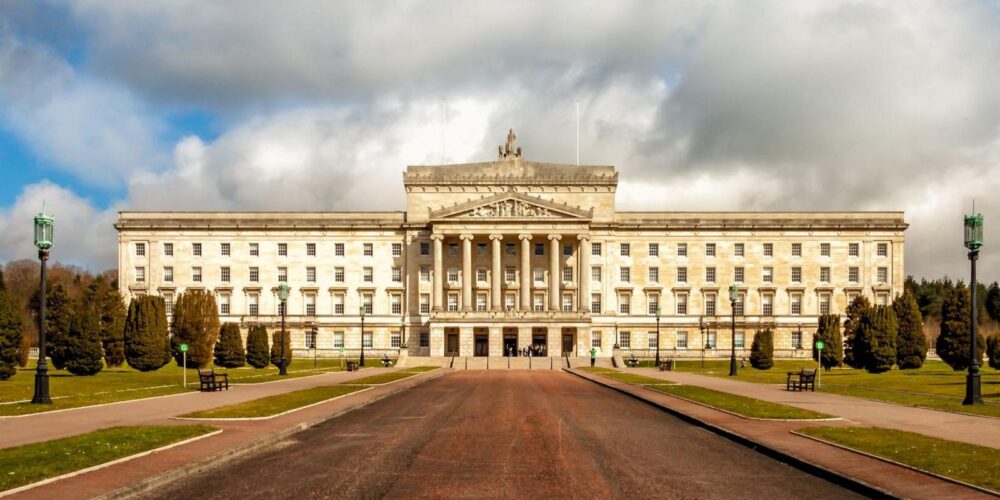
Presiding over this omnishambles is the incompetent, dysfunctional local devolved administration sitting inertly in Stormont. Since 2022, when Sinn Féin won the largest number of seats in the Assembly, unionism of all shades has been deeply disconcerted. Fearing being outmanoeuvred by the still more reactionary TUV, the DUP has resisted every initiative that might appear to indicate Sinn Féin having a modicum of leverage in the north. Now the Ulster Unionists have joined in the conflict by threatening to deselect any so-called moderate MLAs hoping to contest next year’s Assembly elections.
As a consequence of unionist obduracy and absolute refusal to share power productively, governance in the 6-counties is virtually moribund.
It is difficult to see how this administrative deadlock can be resolved this side of re-unification. In the meantime, the 6-counties remain in a pitiful state of disrepair. Even Charles Windsor experienced the downside of the place on his recent visit, when falling victim to the droppings of a treasonous seagull.
Little surprise that so many in the area resort to antidepressants.
Footnotes (as in original, formatted for clarity):
[1] “It’s no surprise 400,000 people here are on antidepressants – political failure has left this place in a terrible state…” Gail Walker, Belfast Telegraph, May 23rd, 2026.
[2] “Katie Simpson’s death exposes ‘institutional misogyny’ in PSNI…” 5 May 2026, Kelly Bonner and Brendan Hughes, BBC News NI.
[3] The Irish News, editorial, 21/05/2026.
[4] https://www.itv.com/news/utv/2026-04-23/ni-probably-worst-in-western-europe-for-cancer-wait-times