
Ireland is experiencing an inflationary slowdown. Forecasts point to growth falling from expectations of near 3% to now 1.6% for 2026. Higher energy prices, alongside the decline in last year’s exports surge, feed that dynamic. Inflation is likely to register at least 3.3% in 2026.
There are already signs of sectoral weakness: the services purchasing managers’ index, a useful measure of capitalist sentiment, slipped into contraction territory for the first time in over five years.
So-called “consumer sentiment” has fallen for two months in a row, as the working class face a squeeze from energy and service-price rises, with real disposable income growth, the Central Bank has recently reported, likely to be weaker than expected. Things are not much better in the North, with expected growth of just 0.7% in 2026.
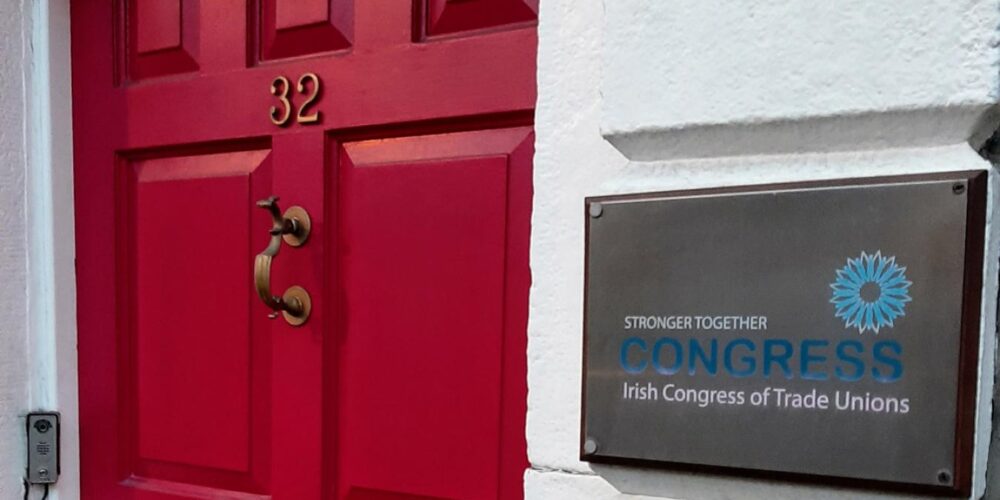
The Irish Congress of Trade Unions has pushed a cost-of-living line. They have said workers should not bear the brunt of the crisis. True. However, their approach is largely institutional: lobbying, meetings, policy proposals. Not bad, but not enough. Of course, the ICTU has to hold together very different unions, sectors, political instincts and bargaining calendars. It is not itself a strike machine. That aside, the challenge for the labour movement remains: how can we turn real economic grievances into organised workplace power?
How will workers compel the state and employers to shift the burden? SIPTU’s National Executive Council points in one direction: declaring recently that they will support workers in pay talks across both private and public sectors, including industrial action where necessary to protect pay and living standards. A general bargaining line across the union is surely better than localised and isolated pay disputes. But could it be bolstered by thinking further around coordinated action with a cross-sector timetable?
In the North, we have seen sharp sectoral interventions, but not yet a unified labour-movement campaign capable of turning these cost-of-living grievances into a general political demand. In transport, Unite has criticised the Minister for Infrastructure’s unfunded fare freeze, thereby throwing further into relief the contradictions of the fiscal crisis of the Executive in robbing Peter to pay Paul. Measures that superficially look pro-citizen can become anti-worker and anti-service if the state does not adequately fund them.
A fare freeze without additional funding risks being paid for through cuts, workloads or deterioration in public transport provision. The recent NIPSA complaint about unpaid pay awards for civil servants speaks further to the much-commented-on dysfunction in Stormont. The delay in pay for 25,000 NIPSA civil servants is not a mere payroll inconvenience; it reflects the way public-sector workers in the North are made to wait at the end of a long chain of budget controls, departmental approvals and fiscal constraint. In a cost-of-living crisis, the delayed implementation of an agreed award becomes a real cut in living standards, even if arrears are eventually paid.
North and South, the challenge – and necessity – is moving from fragmented defensive disputes to coordinated class bargaining. This is not pie in the sky, for there is potential to learn from abroad. From Germany, we might learn from the discipline of pattern bargaining; from Belgium, the principle that wages must be protected automatically against inflation via indexation; from Spain, the value of coordinated national wage norms; from France, the importance of visible social mobilisation; and even from North American strike waves, the UAW art of targeted escalation.
Can we combine these into an Irish strategy? Win benchmarks, generalise them, protect real wages, organise sectors and make the cost-of-living crisis a question of workplace power? That is a strategy of power, not simply petition.