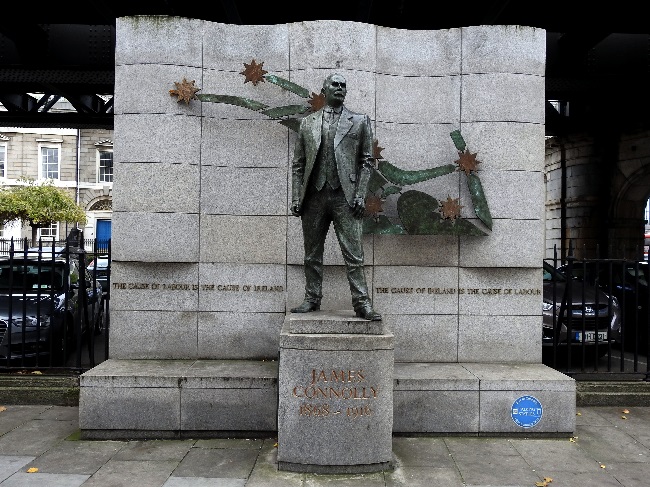


The annual festival to commemorate the execution of James Connolly on 12th May 1916 will this year feature readings of a short story and a play which have been attributed to the revolutionary socialist and writer and were only discovered in recent years.
The short story entitled ‘The Agitator’s Wife’ was found in 2018 by researchers in a journal archived in Warwick University Library. It was first published in the Labour Prophet, a Christian Socialist journal, in February 1894 when Connolly was a trade union and political activist in Scotland.
The fictional story, found by researchers at Glasgow University, describes how the wife of a trade union organiser took over the running of a strike by dock workers when her husband and child fell seriously ill.
In her 1935 memoir, Portrait of a Rebel Father, Nora Connolly O’Brien wrote of a conversation between her father and mother when the family lived in New York in the first decade of the 1900s during which they referred to ‘The Agitator’s Wife’.
Nora Connolly wrote:
They were living in New York. “It seems to be our fate, James,” said mama when they were packing, “never to spend five years in any one place….What’s the use of building up a home when you know that it’s bound to be broken up again? That play you wrote, ‘The Agitator’s Wife,’ is just our life, isn’t it?”
“Yes,” said Daddy, laughing. “But I made the wife say things you never said, Lillie, though I’m sure you often felt them.”
The discovery of the short story in 2018 led to speculation that this was the ‘play’ referred to in the conversation recorded by his daughter and by other biographers of Connolly as the ‘lost play’. As the Glasgow researchers who found the short story – Maria-Daniella Dick, Kirsty Lusk and Willy Maley – wrote in their 2019 article in Irish Studies Review, the story reflected Connolly’s commitment to gender equality and the confluence of socialism and feminism in his political writing and activism.
“The title of the short story in the Labour Prophet may simply be a coincidence but has all the hallmarks of Connolly’s interests, and of his life at that time in Edinburgh as a politically active young father and husband, dealing with the daily struggle for subsistence at home while fighting for workers’ rights,” the researchers wrote.
However justified the speculation and excitement about his possible authorship of ‘The Agitator’s Wife’, the emergence of an actual play with a similar title that was provably written by Connolly is more definitive.
Entitled ‘An Agitator’s Wife’, the dialogue-driven play also deals with a political activist who arrives home to his wife and small children late at night after a long day of working and socialist meetings. She harangues him for his midnight arrival and “working for freedom and keeping your own wife a prisoner inside the four walls of the house”.
The play was published in the Labour Leader, to which Connolly regularly contributed under the pseudonym Brehon, in June 1895, some 16 months after the publication of the short story with an almost identical title. The content of the play reflects the sentiments of the conversation between Lillie and James Connolly as recalled by their daughter in her memoir.
Writer Conor McCabe found and reproduced the play in the book that he recently edited, *The Lost & Early Writings of James Connolly 1889-1898* (Iskra Books, 2024). McCabe said of his unique discovery that the links between Brehon and Connolly are “more pronounced…with ‘An Agitator’s Wife’, a short story with a play-like setting, consisting entirely of dialogue, which matches the description given by Nora Connolly of her father’s ‘lost play’.”
Referring to the short story, McCabe said that there is evidence to suggest that Connolly was both aware of and in touch with the publishers of the Labour Prophet during the period when they published ‘The Agitator’s Wife’.
Willy Maley suggested that it was unlikely that the publication of the short story and play within just over a year of each other was coincidence.
“I doubt that two texts with similar titles and subject matter is a mere coincidence. Was the general interest in agitators’ wives so intense?… Connolly may have been adapting his own tale for a rehearsed reading. In any case, the relationship between the two versions is well worth exploring in the context of Connolly’s creative writings,” Maley said.
On Wednesday, 6 May, the first public readings of the short story and the play along with an extract from Nora Connolly’s memoir about her final meeting with her father at Dublin Castle before his execution will take place in the New Theatre, 43 Essex Street, Dublin 2, from 7.00 p.m. to 8.30 p.m.