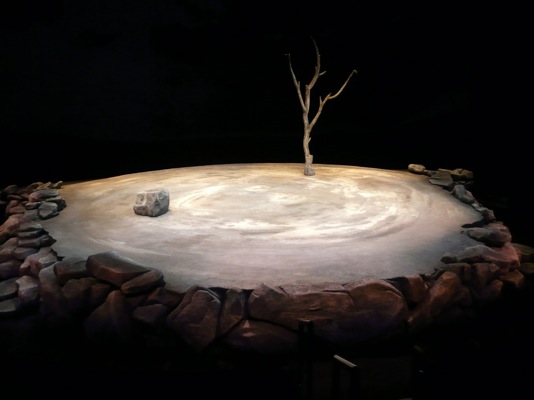



Samuel Beckett’s Waiting for Godot (1948) emerges from a 20th-century shadow shaped by war, existential uncertainty, and the threat of total annihilation. Echoing Bertolt Brecht’s warning about civilisations vanishing after repeated conflict, the play imagines what remains of humanity after catastrophe. Set on a barren stage — “a country road, a tree, evening” — it strips existence to its barest elements, asking what survives when meaning, structure, and hope collapse.
Understanding the play requires understanding Beckett himself. Born in 1906 into an Anglo-Irish Protestant family, he became one of the most influential writers of the 20th century. After moving to Paris in 1928, he was introduced to avant-garde circles by James Joyce, whose influence shaped his early work. Beckett eventually settled permanently in France and, during World War II, joined the French Resistance. Working as a courier and interpreter, he narrowly avoided capture by the Gestapo and later received honours for his service. These experiences — war, and the fragility of life — profoundly shaped his writing.
After the war, Beckett entered a highly productive period, choosing to write in French to achieve a more stripped-down, precise style. This phase produced major works, including his trilogy of novels and Waiting for Godot. Premiering in 1953, the play brought him international recognition, followed by works like Krapp’s Last Tape and Happy Days. He was awarded the Nobel Prize in Literature in 1969, though he accepted it reluctantly. Beckett remained a reclusive figure until his death in 1989.
The world of Waiting for Godot reflects Beckett’s wartime experiences and the broader anxieties of the nuclear age, particularly after the atomic bombings of Hiroshima and Nagasaki. Though never explicitly stated, the play suggests a post-apocalyptic landscape: nearly empty, marked by decay and violence. Its two central characters, Vladimir (Didi) and Estragon (Gogo), exist in a diminished state, struggling with basic tasks and enduring constant hardship. Violence is routine, survival minimal. Humanity has been reduced to mere persistence.
The play famously opens with “Nothing to be done,” a line that encapsulates its central condition: paralysis. Unlike traditional drama, there is no meaningful action, no progression, and no resolution. Didi and Gogo wait endlessly for Godot, a figure who never arrives. This waiting replaces purposeful action and becomes a metaphor for human existence itself — defined not by achievement, but by inertia. Even the name “Godot” hints at eternity (echoing the Irish go deo — “forever”), reinforcing the sense of endless suspension.
Beckett dismantles traditional theatrical structure. Without action, there is no plot; without progress, no climax. The audience shares the characters’ experience of empty time, forced to confront the absence of meaning directly. The play does not simply depict absurdity — it embodies it formally.
Religious and philosophical certainties are also undermined. Biblical references surface only vaguely, barely remembered. Estragon’s fleeting identification as “Adam” suggests humanity reduced to its most primitive state, echoing King Lear’s image of the human as a “poor, bare, forked animal.” Civilization’s intellectual and moral frameworks have eroded.
This degradation is mirrored in the figures of Pozzo and Lucky. Pozzo, a domineering master, drags Lucky, his enslaved servant, by a rope. Their relationship evokes colonial hierarchies and echoes characters like Caliban from The Tempest. Yet this power dynamic is unstable. In Act II, Pozzo becomes blind and Lucky mute, signalling further decline. Authority, language, and thought itself deteriorate.
Lucky’s monologue — the longest speech in the play — encapsulates its themes. A chaotic torrent of fragmented ideas, it mixes philosophical speculation with absurd nonsense. He references a distant, possibly indifferent God and concludes that humanity “wastes and pines … for reasons unknown.” The speech ends with the notion of “unfinished labours,” suggesting both divine abandonment and human failure. Its structure — oscillating between profound and trivial — reflects the coexistence of cosmic collapse and mundane reality. Even as meaning disintegrates, everyday absurdities persist.
Despite this bleakness, the play contains faint traces of humanity. Didi and Gogo, though reduced to near-animal existence, depend on one another. Their companionship, however fragile, prevents total isolation. At one point, they consider suicide but abandon the idea partly out of fear of leaving the other alone — suggesting that connection still matters.
A key moment arises when Pozzo calls for help after falling. Didi reflects that such moments are rare: “It is not every day that we are needed.” He recognises that their response represents all of humanity — “at this place, at this moment of time, all mankind is us.” This realisation briefly restores a sense of shared responsibility. Yet Beckett undercuts even this insight, as all four characters end up helpless on the ground. Action and agency remain elusive.
Pozzo’s bleak reflection — that humans are born “astride of a grave,” with life as a brief flicker between darkness — reinforces the play’s existential pessimism. Life appears transient, directionless, and ultimately futile.
And yet, the play resists complete nihilism. Small signs of hope persist. The tree, barren for most of the play, sprouts a few leaves by the end — a subtle indication that life continues. Didi and Gogo’s bond, their refusal to abandon each other, suggests that even in a devastated world, compassion survives. These moments do not resolve the play’s tensions, but they prevent total despair.Ultimately, Waiting for Godot leaves its audience with an unresolved question: are these fragile remnants of humanity enough? Beckett does not provide an answer. Instead, he forces us, like his characters, to endure uncertainty and ask whether we can — or will — move beyond mere waiting.