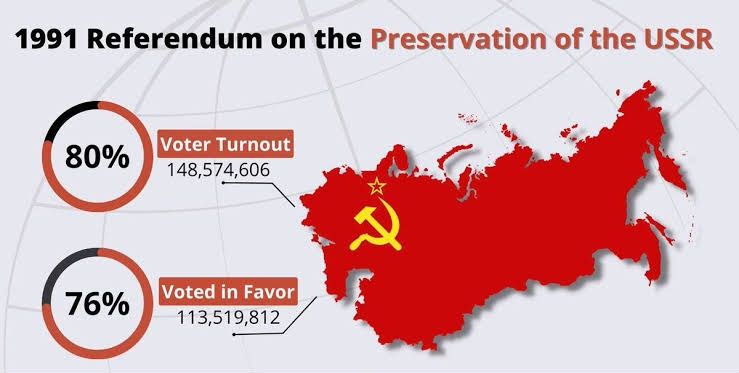


On 17 March 1991, over 148 million Soviet citizens voted in a national referendum on whether to preserve the Soviet Union. In those republics where it was held, 113 million—or 77.85 per cent—voted in favour. At the moment of victory of the counter-revolution, a clear majority supported the continuation of the Soviet Union.
This challenges the assumption that the Soviet Union fell because it lost popular support. Its dissolution was the result of decisions taken within the Party and state apparatus, layers that would soon become the basis of a new oligarchic class. The system was not rejected from below. It was dismantled from above.
To understand how this became possible, it is necessary to examine the longer trajectory of Soviet development, and in particular the shift that occurred after 1953.
The October Revolution emerged from decades of struggle and took power in a country that was economically backward, largely agrarian and devastated by war. Russia at this time was not comparable to advanced capitalist economies, but closer to the least developed regions of the global economy. Industrial capacity was limited, infrastructure weak, and the majority of the population remained tied to low-productivity agriculture.
Socialist construction therefore unfolded under conditions of profound backwardness, civil war and external threat. Within a generation, the Soviet Union emerged as the second industrial power in the world. No country at a comparable level of development in 1917 achieved a similar transformation.
From 1917 to the early 1950s, the general direction of development was clear. Socialised production expanded and commodity relations were increasingly subordinated to planning. Under Lenin, the New Economic Policy recognised the persistence of small commodity production, but within a framework in which the commanding heights remained under state control.
This orientation hardened during rapid industrialisation. It was driven not only by economic necessity, but by survival. The rise of fascism and the hostility of capitalist powers made clear that the Soviet Union faced an existential threat from the prospect of invasion and annihilation. The development of heavy industry, energy and machinery was therefore inseparable from defence.
The decisive principle was not simply state ownership, but the allocation of resources through plan targets rather than profitability. Industrialisation, electrification and defence were pursued according to social priorities rather than immediate return.
From the late 1920s through the post-war period, the Soviet economy developed along these lines. Heavy industry expanded even where it was not immediately profitable. Entire sectors were constructed that would not have survived under market discipline. This transformation underpinned the Soviet Union’s ability to defeat Nazi Germany and establish itself as a major industrial power.
Even non-sympathetic economic analysis recognises this. Robert C. Allen shows that Soviet growth before 1970 was among the most rapid in the world, driven by high levels of investment and structural transformation rather than market incentives, and that the stagnation of the 1970s and 1980s was not a by-product of planning per se, but of misdirected plans by the state apparatus.
However, it is possible to trace the origin of the decline of Soviet socialist economic planning. By the early 1950s, Soviet economic organisation had reached a relatively coherent form. Commodity production persisted, particularly in consumer goods, but the law of value did not regulate the economy as a whole. As argued in Economic Problems of Socialism in the USSR, the means of production were to be allocated through planning decisions rather than profitability.
With the death of Stalin and a new leadership in charge, Khrushchev’s 1956 “Secret Speech” marked a decisive political rupture. Beyond its denunciation of abuses, it reframed the preceding period as distortion rather than foundation. The ideological language of ongoing class struggle under socialism was gradually replaced by the notion of a “state of the whole people.” The sense of socialist construction as a contested process gave way to administrative normalisation.
Economic reforms accompanied this shift. Planning indicators were reduced or restructured. Greater emphasis was placed on profitability and material incentives. Enterprise managers gained expanded autonomy. These measures were presented as technical improvements. But they also altered the system’s regulatory logic. The means of production were progressively treated as commodities, allocated in ways that approximated capitalist categories.
This shift reflected the development of a bureaucratic layer within the Party and state apparatus whose interests became increasingly tied to managerial control and enterprise performance. Over time, this orientation was accompanied by a weakening of class struggle as a guiding principle and a decline in systematic Marxist education within the Party and in its relationship with the wider population.
As this layer consolidated its position, those committed to deepening planning were increasingly marginalised. The growing separation between the Party apparatus and the working class weakened the social and political foundations of the system, contributing to a situation in which the Soviet Union lacked the organised capacity to resist its eventual dissolution.
The result was a hybrid system. It was neither coherently planned nor governed by genuine market competition. Enterprises were expected to respond to profitability without facing full market discipline. Prices remained administrative, but increasingly reflected cost and return.
This generated structural contradictions. Under earlier planning, new technologies could be introduced through deliberate allocation. Under the reformed system, enterprises faced high costs without clear incentives for innovation. Conservatism became rational behaviour, and technological development slowed.
The slowdown that followed was not simply the result of planning itself. As the phase of rapid industrial catch-up came to an end, new challenges emerged. Investment decisions became increasingly complex. Resources were directed toward energy extraction in remote regions such as Siberia, often requiring high levels of capital and infrastructure for relatively lower returns. At the same time, there was a continued emphasis on domestic production even where more efficient alternatives may have existed, and significant resources were allocated to upgrading ageing industrial and energy facilities rather than constructing new, technologically advanced systems.
Taken together, these shifts reduced the overall efficiency of investment and contributed to declining productivity growth compared to earlier periods of rapid expansion.
At the same time, a growing share of scientific and technical capacity was directed toward the military-industrial sector. The diversion of research and development resources toward military priorities contributed significantly to the decline in productivity growth. The most advanced technical capacity was increasingly directed toward strategic rather than civilian development. The issue was not the absence of planning, but the direction of planning.
By the 1970s and 1980s, the effects of these shifts were clear. Growth slowed, innovation lagged, and the system’s coherence weakened. Planning remained, but its ability to direct development had been diluted. The final phase of reform did not attempt to restore planning discipline. Instead, it expanded market mechanisms further. In doing so, it deepened the system’s contradictions and accelerated its disintegration.
The events of 1991 must be understood in this context. The population did not demand the system’s destruction. But the bureaucratic layers that had developed over decades stood to gain from its transformation. The transition to capitalism allowed sections of the Party and state apparatus to convert administrative control into private ownership. The emergence of the post-Soviet oligarchy was the outcome of this process.
Two errors dominate discussion of the Soviet experience.
The first is the claim that planning is inherently inefficient. The historical record does not support this. Planning drove rapid industrialisation under extremely difficult conditions. The second is the failure to distinguish between phases of development. Treating the entire Soviet period as a single system obscures the real shifts that occurred. The key question is how the balance between planning and commodity production evolved over time.
For contemporary socialist strategy, the implications are clear. Socialism is not reducible to state ownership. The decisive question is what regulates the allocation of the means of production. If profitability increasingly determines that allocation, the system will tend toward capitalist restoration.
At the same time, the Soviet experience shows that socialist transformation is a process. Commodity forms may persist, but they must be subordinated to planning if development is to remain socialist. It also demonstrates that socialist construction remains a site of class struggle. Bureaucratic layers with distinct material interests can emerge within the system itself. Without mechanisms to maintain the primacy of the plan, the direction of development can shift.
The significance of 1991 lies in what it reveals about that process. A society in which the majority supported its continuation was dismantled by layers positioned to benefit from its transformation.