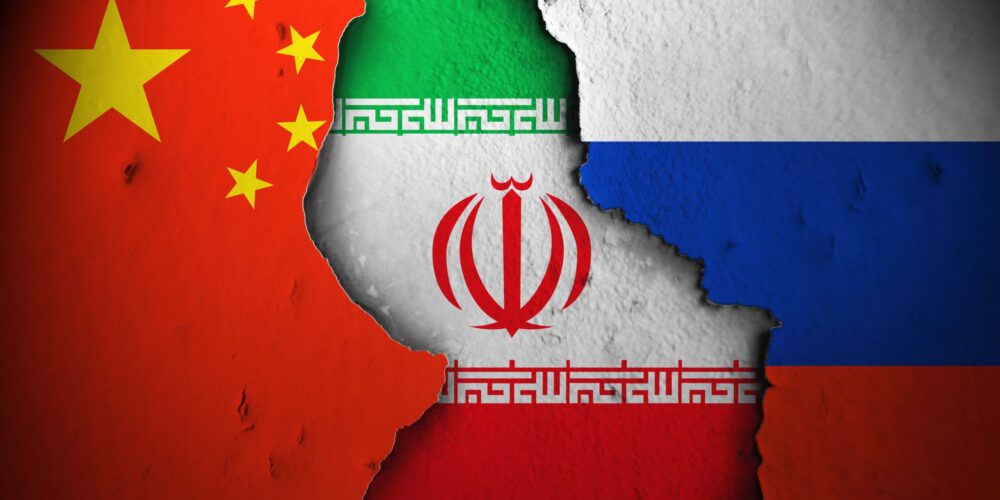



Zbigniew Brzezinski, former National Security Adviser to Jimmy Carter and a key strategist for imperialism during and after the Cold War, said in his 1997 book The Grand Chessboard that the biggest threat to US unipolarity would be a grand coalition of China, Russia, and perhaps Iran—an “antihegemonic” coalition united not by ideology but by complementary grievances.
This worst-case scenario for imperialism has now come together. Imperialism is currently waging a proxy war with Russia in Ukraine. CIA/Mossad-backed protests over the effects of economic warfare on Iran have led, at the time of writing, to a war situation. Meanwhile, imperialism also continues to compete with the Chinese for global influence, while providing military and ideological support for separatists on China’s territory.
Added to this was the terrorist bombing in Caracas and the kidnapping of Venezuelan President Maduro and Cilia Flores. Additionally, economic warfare is being used to strangle Cuba, depriving the Cuban people of necessary fuel supplies and threatening them with starvation. Imperialism can threaten Cubans with starvation in part because of the weakness of the international community in the face of the deliberate starvation of Gazans in the Gaza genocide.
In the recently published National Security Strategy 2025, signed by President Trump, US strategists spoke openly of asserting and enforcing a “Trump corollary to the Monroe Doctrine,” keeping the entire Western Hemisphere locked down for monopoly capital’s interests. Gone is the pretense of sovereignty within a non-existent liberal “rules-based order.”
In his speech to the Munich Security Conference, Marco Rubio extolled the virtues of White, European, Christian civilisation, calling on the EU to remember their shared anti-communism and the need for unity in keeping the world in check. This notion of a civilisational mission has always been key to imperial theorists, from top thinkers such as Brzezinski and Samuel Huntington to Francis Fukuyama.
Of note is that, after Rubio’s speech, the EU liberals stood up and applauded. Several years ago, the EU’s foreign policy chief Josep Borrell remarked that Europe was “a garden” while the rest of the world was “a jungle.” The EU liberals and the American conservatives share a common purpose of defending and supporting the interests of monopoly capital; they only differ on the details.
In an influential article in the journal Foreign Affairs, Finnish President Stubb, an important theorist for the liberals, reflected on the dying rules-based order. He theorised that the world of unipolarity after the end of the Cold War had now changed into a contest between the “Global West”—the EU, US, Britain, Canada, Australia, and Japan—and, echoing Brzezinski, the “Global East”—China, Russia, Iran, DPRK, and others. The focus of the contest was the vast majority of remaining nations in the Global South.
What Stubb calls the “Global West” is what Marxists call imperialism. The Global East, imperfect and complex as it is, is not an alternative imperial bloc, but instead an alternative in defence of national sovereignty—a key building block for socialism. This is not the same as what existed in the Cold War, with an imperialist camp and a socialist camp. However, this is not to dismiss the potential of the Global East.
We can recall Lenin’s criticism of Trotsky after the Easter Rising, with Lenin saying that class struggle which takes a national form is never as simple as one side lining up and declaring itself for socialism, while another side lines up and declares itself for imperialism.
Imperialism’s strategy is openly based on building a military alliance against the Global East, while using control of finance, energy, and supply chains to coerce the Global South into their bloc.
The world’s largest energy exporter is currently the United States—a key development in the past decade due to fracking, the use of LNG, and, particularly, a blatant disregard for environmental concerns. Control of global energy is vital for US dominance, allowing it to draw the Europeans away from buying Russian oil and gas after 2022, and to attempt to draw India away from buying Russian energy post-Ukraine. Crippling Iran’s oil exports and outright piracy over Venezuelan oil makes the situation worse.
Military spending has increased, with the US spending over $1.5 trillion itself, while also encouraging Japan and Germany to spend money on American arms to counter the supposed threat from China and Russia. NATO war spending has increased from 2% to 5% of members’ GDP. The PURL program sees billions spent on arms for Ukraine, with huge profits going mostly to American war companies.
This is why it is so important to link anti-imperialism with the ecology, anti-war, and trade union movements. Just as imperialism has a clear strategy despite its internal disagreements, the working-class forces need the same.