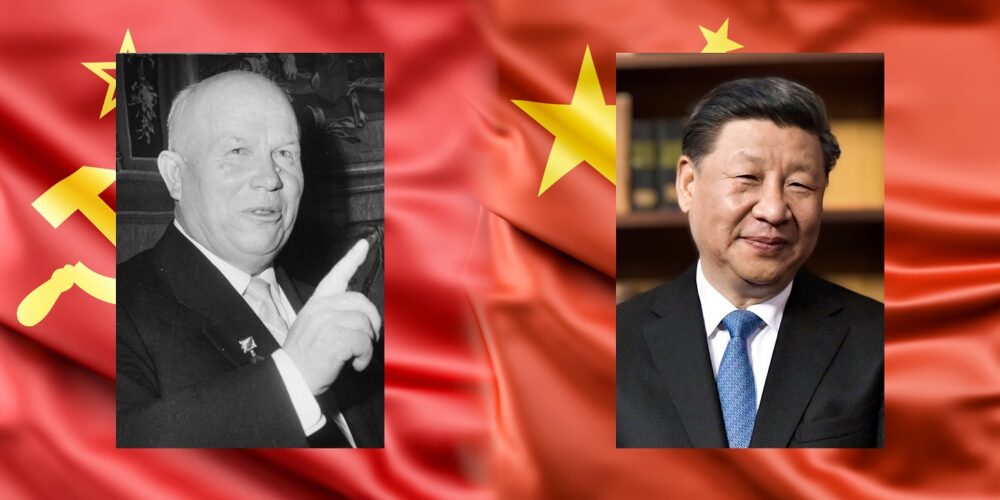


The United States has entered what can fairly be described as a new Cold War with China. The language has changed, but the methods are familiar. Containment, economic isolation, alliance discipline, and pressure on third countries have returned as the organising principles of strategy.
This reorientation is no longer speculative. It now shapes policy across administrations and party lines. Trade restrictions, export controls on advanced technology, supply-chain restructuring, military repositioning in the Indo-Pacific, and diplomatic coercion of allies all serve a common purpose: to constrain China’s rise within limits acceptable to US power.
This confrontation does not take the form of a single decisive clash. It advances gradually, through cumulative pressure applied across multiple theatres. The aim is not immediate war, but the steady weakening of China’s external linkages so that its economic and political autonomy are curtailed. In practical terms, this means persuading, pressuring, or compelling other states to reduce trade, restrict technology cooperation, and align strategically with Washington—even when doing so damages their own development.
At the level of grand strategy, there is broad agreement within the US ruling class that China represents the central challenge. The fracture emerges not over whether confrontation must occur, but over how it should be conducted and what it will cost.
The reason this fracture has sharpened is structural. The United States can no longer sustain universal dominance in the way it once did. The economic base that underpinned expansive global hegemony has weakened. Decades of financialisation and deindustrialisation have hollowed out domestic productive capacity. Social inequality has widened and political trust has eroded. The state retains extraordinary military and financial power, but that power rests on a thinner foundation of consent. In plain terms, the United States still commands immense force, yet fewer of its own citizens believe the system delivers stability or shared prosperity.
Strategic reorientation toward China therefore forces a reckoning. If China is the primary rival, can the United States afford to enforce authority everywhere else at the same time? Can it maintain permanent commitments in Europe, West Asia, and Latin America while concentrating resources in the Indo-Pacific? It is around this question that the ruling bloc fractures.
One tendency argues that overstretch is now the principal danger. Sections of the military establishment, elements within the intelligence community, and capital tied to advanced technology and strategic manufacturing increasingly emphasise concentration. From this perspective, secondary theatres must be stabilised at lower cost or managed through proxies. Alliances must serve the central confrontation rather than define it. The logic is not withdrawal but prioritisation. If everything is treated as vital, nothing can be defended effectively.
A competing tendency insists that authority cannot be selectively enforced. Rooted more firmly in the foreign-policy bureaucracy, established defence networks, and globally integrated finance capital, this position treats retreat in any region as a signal of weakness that would accelerate decline. Alliances forged during earlier phases of expansion are viewed as structural pillars. To relinquish them would undermine credibility across the system.
These disagreements map onto real institutions and material interests. They appear in defence budget allocations, in debates over Indo-Pacific versus European deployments, in disputes over sanctions policy and industrial strategy. They are not rhetorical differences. They concern the architecture of power itself.
At present, no stable synthesis has emerged. Official doctrine increasingly identifies China as the primary competitor and implicitly acknowledges that permanent dominance across all theatres is unsustainable. Yet policy practice continues to reflect the inertia of older commitments. The United States attempts to prioritise without openly conceding limits. It speaks the language of consolidation while continuing to operate across multiple fronts.
West Asia demonstrates this contradiction clearly. Even as China is framed as the principal rival, tensions with Iran have escalated, military deployments have expanded, and serious discussion of potential strikes has re-entered policy debate. Iran is not only a regional adversary; it is increasingly integrated into Eurasian economic networks that intersect with China’s rise. Pressure on Tehran therefore intersects with the broader containment strategy, yet it also risks widening confrontation in ways that drain attention and resources from the Indo-Pacific. The question is whether West Asia is a secondary theatre to be stabilised, or a permanent pillar of enforcement that cannot be relinquished.
The absence of resolution produces instability domestically as well. As elite consensus weakens and legitimacy erodes, the state relies more heavily on administrative authority and security mechanisms to preserve order. Executive power expands, surveillance becomes routine, border enforcement intensifies, and legal boundaries are tested. These developments are not reducible to the temperament of any individual leader. They reflect structural strain. When consent becomes fragile, coercive capacity becomes more visible.
Political finance further narrows the range of acceptable outcomes. Industries invest in politics to secure favourable conditions amid uncertainty. Defence contractors benefit from sustained geopolitical tension. Technology capital aligns with export controls and state-backed industrial policy. Energy interests seek regulatory flexibility and geopolitical leverage. This does not eliminate disagreement within the ruling class; it ensures those disagreements remain within limits compatible with continued imperial dominance.
The MAGA movement reflects this fracture in unstable form. Its base expresses genuine fatigue with endless wars and global policing. Its rhetoric often criticises permanent entanglements. Yet its leadership oscillates between calls for retrenchment and impulses toward confrontation. It channels dissatisfaction with overstretch while intensifying institutional conflict. It exposes the fracture without resolving it. The Democratic Party remains more closely tied to the managerial model of imperial enforcement. It articulates prioritisation through institutional continuity rather than rupture—which in practice often means maintaining commitments while adjusting rhetoric. Neither formation has produced a stable new consensus.
None of this unfolds in the absence of social pressure. Labour militancy, public opposition to foreign wars, resistance to economic precarity, and growing distrust of political institutions form part of the backdrop against which these elite disputes occur. The fracture within the ruling class is not simply an internal debate over strategy; it is also shaped by a society that is less easily managed than it once was. The difficulty of securing consent at home narrows the room for manoeuvre abroad. While this article has focused on divisions at the top, those divisions are conditioned in part by tensions from below—a dimension that warrants deeper examination.
The United States is therefore attempting to reorganise its global position under less favourable conditions than those it once enjoyed. Confrontation with China is treated as unavoidable. The costs of universal dominance are increasingly recognised. The ruling class is divided over how to reconcile these realities.
Empires rarely concede decline in their own language. They respond through pressure, sanctions, military repositioning, and alliance enforcement. The strategies now unfolding reflect that impulse. They are designed to preserve control over trade routes, financial systems, technological standards, and strategic resources. Yet they are also shaped by constraint. Economic leverage is more contested. Technological monopolies are narrowing. International legitimacy is thinner.
This is not the confident expansion of an ascendant empire. It is the tense reorganisation of a system seeking to defend primacy in a world it no longer fully shapes. The fracture within the ruling class is the political expression of that transition.