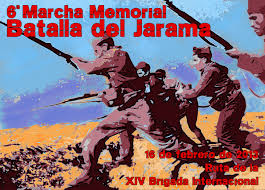


For almost two decades, Friends of the International Brigades Ireland (FIBI) have gathered in Spain to mark important dates in the history of Spanish anti-fascist struggle with other Spanish and international groups maintaining the memory of the defence of the Spanish Republic. The 89th anniversary of the Battle of Jarama was another opportunity for Irish and other international activists to gather at the battlefield and commemorate the efforts of the International Brigades in the Spanish Civil War. Members of political parties, trade unions, anti-fascist organisations and other community groups reflected on the internationalist republican past, and the echoes of it in modern times.
Of the many reflections made in the footsteps of the brigadiers at Jarama, none had the forced ahistorical quality of Fintan O’Toole’s most recent writing on Spain, a column in the Irish Times titled “For Sinn Féin, Tiocfaidh ár lá is being replaced by Turn the Other Cheek”, summarised in print as “Sinn Féin is rightly proud of republicanism’s role in the fight against fascism in Spain. So why is it now opposing assistance for Ukraine?”
O’Toole’s thesis is simple: the Irish republican movement and Sinn Féin have little to be justifiably proud of, and anti-fascist struggle in Spain is one of the very few things on that list. Now, as he writes, “today’s equivalent to the Spanish Civil War is Russia’s attempt to wipe Ukraine off the map of independent nations.” Sinn Féin’s members of European Parliament are not keen to join in on the EU and NATO proxy war operation, and O’Toole wants to hold a Spanish mirror up to their face. What he actually does is hold the mirror up to the press and the war-hungry hawks.
In O’Toole’s ahistorical pattern matching, one concept features prominently: that of Europe. It was Europe that would see fascist aggression after their victory in Spain; it is Europe that is left unprotected after the future victory of Russia (or, how the great man theoretician of the Irish Times would put it, Putin) in Ukraine. The desired coherent image of Europe is somewhat at odds with German and Italian fascism having been at the core of it, and with NATO being synonymous with European integration in most discussions on the continent. The idea of an irrational horde led by a biblically evil mastermind who would destroy Europe once he’s past the Dnieper only works if paired with other irrational tropes we heard before—maybe that “they hate our way of life”?
O’Toole, of course, has to mention the IRA as well, and suggest, tongue in cheek, that Sinn Féin’s refusal to support the war effort in Ukraine should result in Sinn Féin abandoning commemoration of the armed struggle in the North, for consistency. Now, we all know that O’Toole would not be in favour of commemorating “the ‘Ra”, as he calls it—so this particular humorous suggestion does not really work well for him. (Is Ukraine the same as the North, Fintan? Is the North the same as Spain?)
It is interesting that O’Toole apparently has no doubt that NATO is playing the role of the 1936 Soviet Union. This, of course, shows the narrow limits of such shallow use of historical events to justify a demand for Euro-Atlanticist discipline from Irish politicians, and full alignment with the war programme. In Jarama, activists spoke of Cuba, Venezuela, Palestine, the working class and the threat of war, militarisation, and fascist activity at home. Our Spain is not in Ukraine; our Spain is where the working class is threatened by imperialist exploitation, hunger, death. Our Spain is at home.