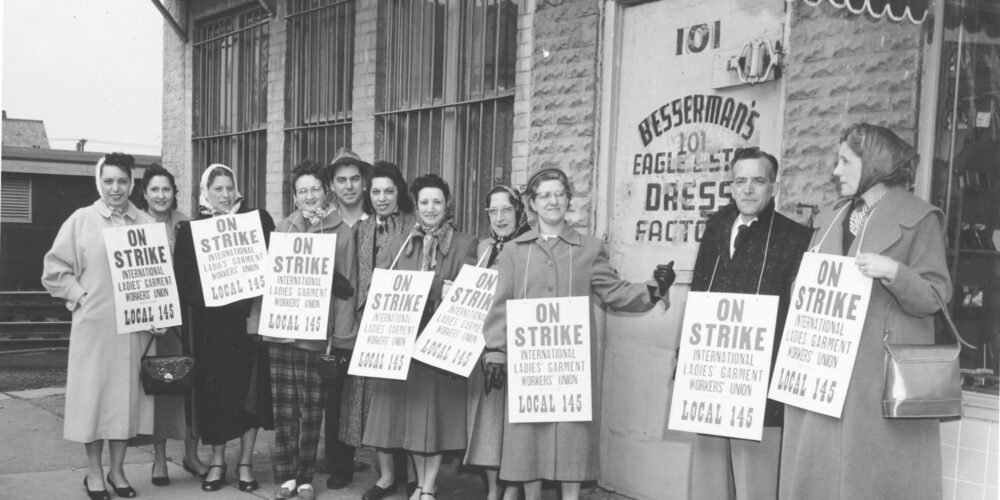


Marx wrote the passage below pointing unions forward, away from narrow sectional interests and towards playing a role within the great push towards socialism underway at the time.
In addition to their original tasks, the trade unions must now learn how to act consciously as focal points for organising the working class in the greater interests of its complete emancipation… the trade unions must succeed in rallying round themselves all workers still outside their ranks. They must carefully safeguard the interests of the workers in the poorest-paid trades…
This was Marx seeking to intervene politically rather than analyse the material basis of unions, which Engels did in 1885 when he spoke of the great English trade unions as forming “an aristocracy among the working class.” And Lenin brought this analysis forward into his critique of imperialism, as the highest stage of capitalism, and the corrupting influence this has amongst sections of the working class in core imperialist nations:
Is there any connection between imperialism and the monstrous and disgusting victory opportunism (in the form of social-chauvinism) has gained over the labour movement in Europe… does its policy represent the masses, does it serve them, i.e., does it aim at their liberation from capitalism, or does it represent the interests of the minority, the minority’s reconciliation with capitalism?
Politically and economically, Ireland has reconciled itself comfortably with imperialism and positioned itself as a conduit economy between peripheral and core, benefitting significantly from capital flows and FDI. This has created beneficiaries both within the capitalist class but also within the working class and public sector (corporate taxes which finance public sector working conditions).
The core ideological perspective of trade unions in Ireland has been shaped by a number of factors, including the murder of politically conscious socialist leadership in 1916 and the civil war, the conscious accommodation of the State to imperialism economically, and the subsequent incorporation of the movement under the guise of ‘partnership’. Indeed, the CIA in the 1950s, reporting back to the US, described the labour movement here as only ‘mildly socialistic’ and no threat whatsoever to the State, even noting how the trade unions were led by conservative political elements.
Today the movement is very dominated by the public sector, the semi-states, by ‘professions’ and higher-end manufacturing in the private sector. The aristocracy among the working class, as Engels put it, is shaping the politics of the movement and limiting its desire to move away from narrow sectional interests to be the protector of the poorest-paid, as Marx hoped it would.
The nature of Ireland’s political economy has also exacerbated already existing Christian notions of individual responsibility and removed, even further, the role of the state in recent times. The privatisation and financialisation of housing, healthcare and pensions, for example, has increasingly tied the upper echelons of the working class—trade union members—into the political economy of the State. If markets do well, their pensions do well and their house, and in some cases houses, increases in value.
These members also often have their employer paying for private healthcare plans, separating them from the 50% of the population depending on an under-funded, creaking public system and creating hostility to the taxation required to fund decent public services. This ties the material well-being of these workers into a conservative political and industrial outlook aimed at servicing and securing their relative ‘position’ in society.
This is why these unionised workers often do not want to upset the markets or challenge the fundamentals of the Irish political economy, and support a form of trade unionism that protects their immediate material self-interest, their position and relative privilege within the working class.
It is also why unions are reluctant to invest the millions required to organise the swathes of low-paid, precarious workers who most urgently need to be collectively organised and who face the most extreme ravages of capitalist conditions. Organised workers, typically, would rather see those resources spent securing their position than spent on high-risk, often unsuccessful, campaigns to take on unscrupulous union-busting companies.
Some on the socialist left attack unions, not on the basis of a materialist analysis, but instead emphasise Weberian notions of bureaucracy. They blame a disconnect in interests between members and union officials, resulting in members being held back and suppressed by a layer of union officials.
This simplistic critique does not look at the material basis of the movement itself or the material connection between those members’ working conditions and the nature of the Irish economy, which lends itself to a ‘don’t rock the boat’ form of trade unionism.
If we are to change this, we need to push for a programme of demands for better working conditions that resonate with “the interests of the workers in the poorest-paid trades.”