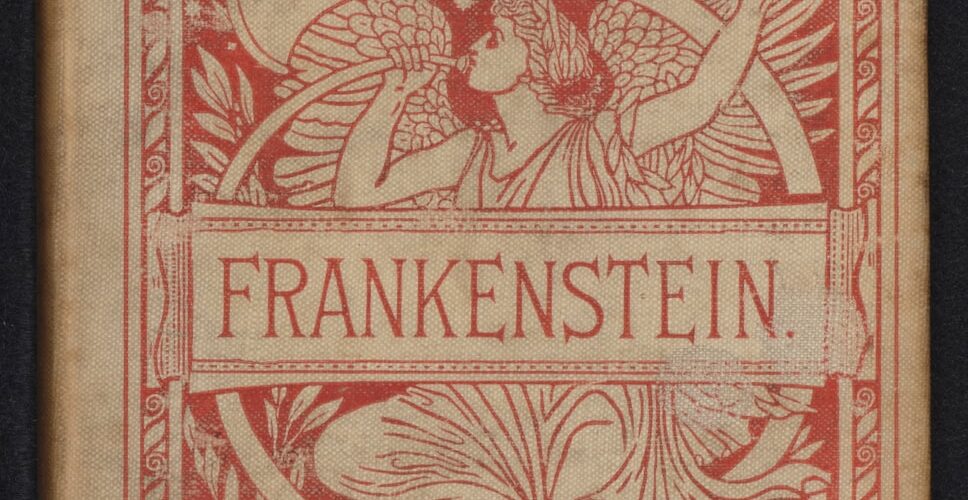



Yet another Frankenstein film has appeared on screens. Despite acclaim, it bears little resemblance to Mary Shelley’s novel. For readers interested in Shelley’s political vision and the historical pressures shaping her work, the 1818 text remains indispensable. To mark the 175th anniversary of Mary Godwin Shelley’s death, we revisit this novel.
Mary Shelley wrote Frankenstein in 1816 at the age of eighteen, publishing it in 1818. The work emerged amid post-Napoleonic Britain’s political conservatism, when fear of revolutionary ideas from France fostered a repressive climate. The French Revolution’s legacy, coupled with war and economic crisis, provoked social unrest and led the British state to suppress ideas perceived as destabilising. Radical politics, religious dissent, and emerging scientific theories were viewed as threats. Materialist theories, which explained life through the body, sensation, and experience, were particularly attacked. Journals such as the Quarterly Review condemned materialism as undermining both Church and state. Debates about the nature of life became politically charged, fuelling censorship and prosecutions for blasphemy, while economic hardship and industrial change—exemplified by the Luddite uprisings (1811–19)—further heightened social tension.
Shelley’s family and intellectual background also shaped her novel. The daughter of William Godwin, a radical philosopher, and Mary Wollstonecraft, a pioneer of women’s rights, she was immersed from childhood in debates on reason, gender equality, and social reform. Wollstonecraft’s A Vindication of the Rights of Woman (1792) profoundly influenced her. Frankenstein engages with contemporary radical science, portraying life as a product of material processes, shaped by sensation, environment, and experience—an alignment with the materialist thought under attack in Britain. Political pressure extended to her family: Percy Bysshe Shelley’s atheism and radicalism made England increasingly hostile, prompting the couple’s exile to the Continent in 1816.
Frankenstein was conceived that summer at Lake Geneva, in a circle including Percy Shelley, Lord Byron, and Byron’s doctor, John William Polidori. The “Year Without a Summer” forced indoor evenings filled with discussion on philosophy, science, and life itself. After reading German Gothic fiction, Byron proposed a ghost story competition. This led to Mary Shelley’s Frankenstein and Polidori’s The Vampyre (1819), the latter establishing the archetype of the aristocratic vampire, a bloodthirsty feudal lord. Mary Shelley, however, transformed the ghost story into a philosophical novel exploring science, responsibility, and social exclusion.
The novel narrates Victor Frankenstein’s attempt to animate life from assembled body parts. Rejecting his creation at the moment of animation, he abandons it. The Being initially behaves kindly, learning language, literature, and conduct. Persistent neglect and cruelty drive it to revenge.
Shelley’s settings carry political significance. Geneva, Victor’s home, embodies Enlightenment contradictions: it is both a site of repressive Calvinism and of Rousseau’s radical philosophy. Ingolstadt, where Victor establishes his laboratory, was associated in the British imagination with the Illuminati, viewed as a Jacobin-atheist conspiracy. Victor’s secret experiments thus mirror revolutionary transgression. His failure lies not in ambition, but in its irresponsible execution and his abdication of duty.
Shelley presents the Being as fully human: naturally benevolent, it performs secret good deeds, restrains anger, and approaches humans with reason and compassion. Only systematic rejection—primarily by Victor, but also by other people it encounters—turns it to violence. Its request for a female companion is framed as a claim to natural justice and social recognition; Victor’s destruction of this companion completes the creature’s isolation. The narrative structure reinforces this critique: after Victor’s bride Elizabeth is murdered, he becomes the obsessed hunter, mirroring the Being’s earlier quest for recognition. Their final chase in the Arctic symbolises exile into moral and political stagnation. Shelley grants the Being all but the last word, expressing remorse and withdrawal, while Victor dies unrepentant. The novel suggests that neglect and the abdication of social and ethical responsibility—rather than the creature’s origin—create monstrosity.
The subtitle, The Modern Prometheus, underscores this political dimension. By using as her epigraph Adam’s challenge to his maker from Milton’s Paradise Lost—“Did I request thee, Maker, from my clay / To mould me man?”—Mary Shelley shifts judgment away from the creator’s authority and towards his responsibility and the rights of the created. Scientific creation is thus linked to debates about tyranny, equality, and reform.
The novel also engages with imperial and expansionist themes. Mastery of nature and empire are evoked by Walton’s Arctic expedition and by Clerval’s optimism about bettering conditions in India. Victor mirrors the dangers of expansionist ambition: he seeks ultimate knowledge without ethical preparation. The Being, by contrast, cultivates reflection and moral restraint, only turning violent due to sustained societal rejection. Its trajectory prefigures Heathcliff in Wuthering Heights, exposing societal hypocrisy and prejudice. Both Mary Shelley’s and Emily Brontë’s novels challenge bourgeois norms and call for a radical rethinking of social and ethical responsibility.In sum, Mary Shelley’s Frankenstein is more than a Gothic tale; it is a politically charged meditation on science, ethics, and social responsibility. Written in a climate of political repression, the novel critiques illegitimate authority, emphasises moral development through experience, and interrogates the consequences of neglect and exclusion. Victor’s failure and the Being’s moral potential illustrate Shelley’s central warning: knowledge and power, divorced from ethical responsibility, yield destruction, while attentiveness, reflection, and compassion become the foundations not just of human flourishing, but of a just social order.