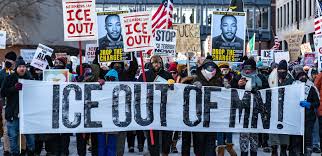


On Friday, January 23rd, several thousand people braved below-freezing temperatures in Minneapolis for the first Statewide Economic Shutdown of Minnesota, a political strike and day of protests against the ongoing crackdowns by Immigration and Customs Enforcement (ICE) agents.
The next morning, tensions surged again with the ICE killing of ICU nurse Alex Pretti on a Minneapolis high street. Pretti is the second person to be killed in the city by immigration agents in the first month of the year alone, following the shooting of writer and mother Renée Good on January 7th, which resulted in hundreds of sizable vigils and protests across the US.
In America’s Twin Cities (Minneapolis and St. Paul), Trump has sent 3,000 armed and masked federal agents to put his foot down on the Midwestern state, unmasking the government’s violent spectacles for many in the process.
“Liberals are being radicalised”, claims Cameron Harrison. The People’s World journalist and trade union organiser arrived in Minneapolis on the eve of the Shutdown to support the Twin Cities Communist Party Club. The organisation has been sending patrols, armed with whistles, around neighbourhoods, providing material aid for those too terrified to leave their homes and reporting ICE deployments.
Harrison says that he and the club were “uplifted” by the broad coalition on strike: “Working people said ‘Enough is enough’”. An estimated 700 businesses closed, while, according to Harrison, many workers used their only available no-fault sick day to attend. “Hundreds of trade unions, civil rights groups, community organisations and faith groups” collectively demanded the removal of Trump’s immigration agents, who have been harassing schools, workplaces and communities since December last year.
A Holy Alliance
The Shutdown kicked off with a morning protest blocking vehicle access to the Delta terminal at Minneapolis–Saint Paul International Airport, demanding the airline end its complicity with deportation flights. One hundred people were arrested, including dozens of faith leaders and clergy members.
Days before, the Trump regime attempted to weaponise an anti-ICE protest outside a St. Paul church, where a pastor was moonlighting as an ICE agent. Facing mass protest, the classic Republican tactic of performative piety clearly had not worked on the ground.
The CPUSA’s block at the main demonstration of the day also saw surprising support from other attendees. Even when warned, protesters at the shutdown had no qualms about marching behind the hammer and sickle.
Harrison spotlighted the new allies and “opportunities to present a class analysis”. Even amongst supporters of Indivisible, the liberal activist group behind the “No Kings” demonstrations, the communist’s analysis of “Trump’s terrorism” and the “terroristic dictatorship of monopoly” is finding a receptive audience.
Amidst the protests, the CPUSA has seen a surge in membership and a growing “Anti-Monopoly Coalition”.
Big Business
Among the hundreds of shuttered businesses and schools, the People’s World reporter noted that “some closed in solidarity with the protesters, especially in the Latino community… Small businesses are being hurt by monopolies, which has been Trump’s tactic”.
In response to the killing of Renée Good, those monopoly interests decided to voice their concerns.
More than 60 CEOs posted an open letter calling for a “de-escalation of tensions” – a far cry from the communists, clergy and everyone in between demanding ICE leave their state entirely.
Target, 3M and Best Buy CEOs all featured, as well as the newest UnitedHealth executive following the assassination of former CEO Brian Thompson in 2024.
Profit margins are not on the minds of most citizens, however.
Building on the #BlackLivesMatter movement, and the high number of neighbourhood collectives and agricultural cooperatives, this sanctuary city has seen some of the most organised resistance in this new “terrain of struggle” and could significantly influence the domestic policy of an empire in decline.