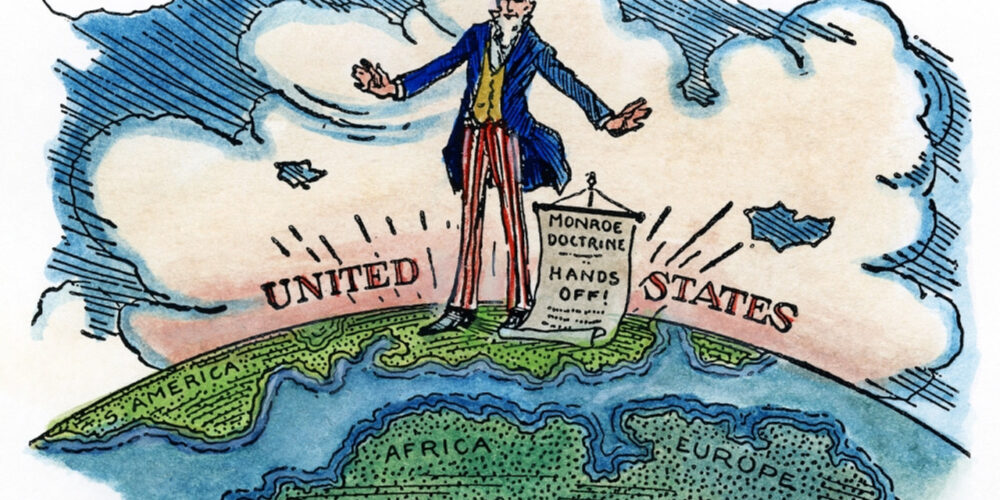

US policy regarding Latin America is nothing new. The Monroe Doctrine (1823) established a US sphere of influence in the Western Hemisphere, which considers Latin America as the backyard of the US and treats any interference there as an act of war. The recent attack on Venezuela took place following negotiations with a Chinese delegation. Sovereign countries of Latin America are prevented from formulating policies that benefit their people. Venezuela is but the latest victim of the devastation caused by the Monroe Doctrine, following Guatemala, Honduras, Nicaragua, Haiti, Chile, El Salvador, and Brazil.
Capitalism is the antithesis of democracy. The advocates of “free trade” never like the term democracy; what they talk about is freedom—i.e., freedom for capital. The US denies democracy and sovereignty when third-world countries make independent decisions to use their wealth to serve their people. If the US was so worried about democracy in Iraq (Saddam Hussein), Libya (Gaddafi), Afghanistan (Najibullah), DR Congo (Lumumba), Chile (Allende), and Burkina Faso (Sankara)—and eliminated them from power—why doesn’t it apply the same logic to Nicaragua (Anastasio Somoza), Cuba (Batista), Chile (Pinochet), the Saudi kings, or Brazil (Bolsonaro)?
So it is not about dictatorship or democracy. The question is whether these countries protect US capital invested there. The US has a long history of installing and supporting the most cruel dictators; if a regime serves the interest of Western capital, the US will say, “He is a bastard, but he is our bastard.”
When the Guatemalan government of Jacobo Árbenz expropriated land from the United Fruit Company, which was exploiting the people and the fertile land, the US openly declared, “United Fruit’s interest is the United States’ interest.” A CIA-led coup d’état followed, and Árbenz was exiled. Lack of democracy in a country is excused if the welfare of capital is preserved; true democracy is detested if the welfare of the people gains priority over the welfare of capital.
Why does the US deny democracy to third-world countries? Democracy in third-world countries that works for the people’s welfare is an impediment to the flow of surplus-value to the imperial countries. These countries are tasked by imperialism to provide raw materials and cheap labour for capital accumulation. Any attempt to serve the people is suppressed by the US with brute force and with the least concern for international law or its own constitution.
A recent example is how the Bolivarian revolution in Venezuela is being strangled economically through sanctions, creating conditions for an uprising to be capitalised on by imperial stooges like Machado. The US does not care about democracy in Iran or Venezuela; all that matters is a regime change that suits the further accumulation of capital. The “Rotten Apple Theory” is a policy of destroying countries that are too independent and do not succumb to imperial pressure, setting a ‘bad’ example for others. Venezuela has been a “rotten apple” since the Bolivarian revolution nationalised oil and began helping another “rotten apple” in the Caribbean region—Cuba. These small countries are not a security threat to the US, but it is the audacity to stand against imperialism that scares them.
The democracy that the US denies to underdeveloped countries is now being denied to its own people. The human rights violations and undemocratic practices devised by ICE are shameful and abominable. They expose the shallowness of US democracy and show that rights can be alienated by fascist means when capital is in crisis. The US, which led the “war on terror,” is now terrorising its own people.
US imperialism under Trump is not only harming its “enemies” but manufacturing new enemies out of friends. Henry Kissinger once said, “To be an enemy of the US is dangerous, but to be a friend is fatal.” Trump’s intention to occupy Greenland is proof of how fatal it is to be a friend of the US—and there is a lesson for Ireland as well. The control of trade routes is a key feature of maintaining global hegemony.
Control of the Suez Canal was instrumental in strengthening the British Empire. Global warming is melting the Arctic ice sheets and may create a new navigation route for trade in the Arctic Ocean. Though the US has a stake in the Arctic through Alaska, major control will lie with countries like Canada, Iceland, other Scandinavian nations, and Denmark through Greenland. The US wants to control this trade route to prevent China from gaining leverage in trade with Europe. Thus, Greenland has become a new geopolitical flashpoint.
Imperialism reproduces the conditions for capitalism to thrive by using force, and it is an inherent tendency of the capitalist system. As long as there is capitalism, there will be the scourge of imperialism.