

The unprecedented real-time broadcast of genocide we witnessed on our phones for two years brought many new faces out onto the streets in protest against the extermination of Palestinians. “Politics aside”, some would say, “the suffering of civilians, of women and children, is heartbreaking, and it needs to stop.” This empathetic rallying call to end suffering was an important first point of entry into the solidarity movement, but was it followed by political education?
Right now, Venezuela and Palestine in the current “ceasefire” period serve as an unfortunate litmus test for the interrupted pipeline of anti-imperialist solidarity. It is a pattern seen again and again in the Palestine solidarity movement: a decline in intensity of support after the most extreme acts of aggression. That it is common, and that it needs to be accounted for, does not mean that it is an unchangeable dynamic. It is worth examining what makes this charitable impulse different from a consistent anti-imperialist analysis.
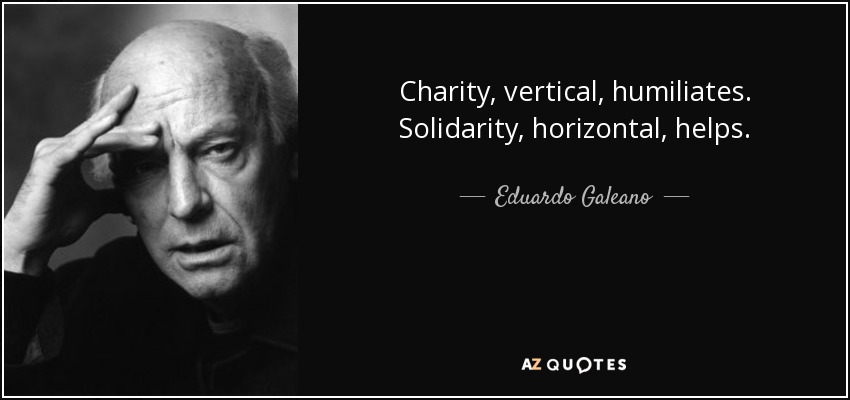
Its roots are similar to those of charity: a surface-level recognition that someone somewhere is in an explicitly, spectacularly bad situation, and a drive to act individually to rectify it. This individual action is an obvious result of an individual experience. Acting collectively and organising cannot stem from a purely personal experience of injustice. It requires consciousness of multiple collectives: the collective the injustice is done to, the collective doing the injustice, the collective seeking change by means of solidarity struggle, and the collective opposing that change.
Otherwise, the understanding of events is limited to the last link of an otherwise invisible chain of cause and effect: the finger on the trigger. Once that finger moves, the deaths do not end, but attention will only remain if the interplay of politics, capital, and power is discovered in time.
The charity gateway to solidarity also needs to overcome the hurdle of perceiving singular evil: figures like Netanyahu or Trump as aberrant individuals whose removal would create a kinder, gentler imperialism. Again, individualisation in analysis stems from an individualist experience. Only with the consciousness of one’s own collective—class!—does the recognition of the capitalist class, its consciousness, and its political machinery come into focus.
The charity gateway has a valuable political lesson to learn from the aggression of US imperialism against Cuba and Venezuela: before the finger on the trigger come the sanctions, the blockades, the social murder by slow strangulation. If the charity gateway does not go beyond and recognise this, it will end up celebrating regime changes as the most vulgar, most cynical spectacles of false freedom.
Yet another hurdle on the road from charity to materialist solidarity is support for anti-imperialist resistance. Charity for victims is easy in its objectification of the victim. In the case of a people fighting back, that support is no longer charity—it grows into material support for an active struggle, support for a fighting subject. This is where the hurdle becomes a springboard.