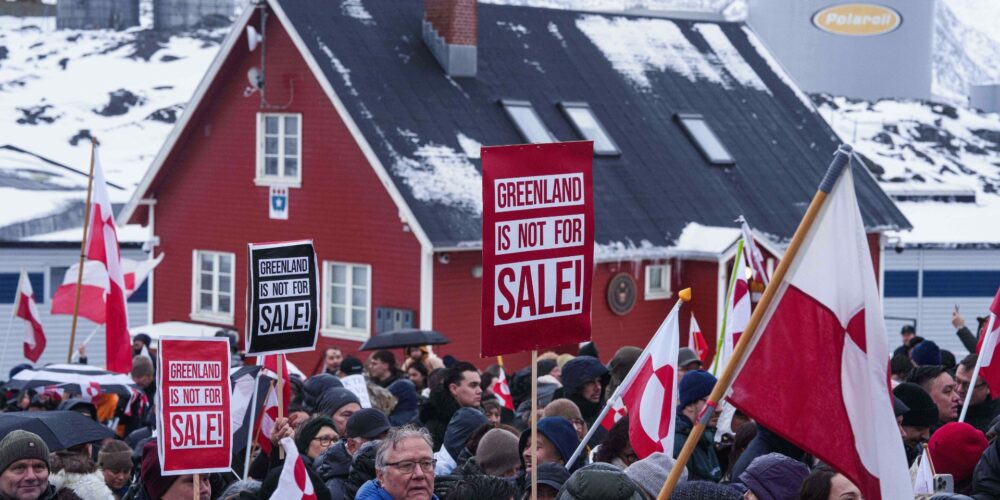


The rallying cry at demonstrations across Denmark over the past weeks has been: “Hands off. Greenland belongs to the Greenlanders.” On the face of it, a country united from left to right in resistance to US aggression.
‘We want democracy, we want freedom, we stand behind Greenland,’ they chant.
‘We don’t want to be owned by the US. We don’t want to be controlled by the US. We don’t want to be part of the US. We want to be Greenlanders,’ they roared at the American embassy in Copenhagen.
The middle-of-the-road Danish coalition government, in the meantime, is vainly trying to preserve the status quo. Ignoring the lessons of history, which teach that appeasement has never prevented a tyrant’s territorial acquisition, they attempt to ward off American imperialism’s land-grab aspirations with offers of military base expansion, the legal framework for which has long been in place.
“There is an open door for increased American military presence in Greenland and the Arctic. This has been open since 1951 1. They only have to ask … Denmark is willing and Greenland is willing and if it’s done within a NATO framework it’s even better …” 2. Such gushing conciliatory responses to US imperialist plans make talk of sovereignty ‘red lines’ and ‘Greenland’s integrity’ ring hollow. With its colonial attitudes intact, Denmark acquiesces and Greenland is ignored.
A recent meeting of the foreign affairs policy committee to discuss Denmark-Greenland-US relations was held without representation from the Greenlandic government, Naalakkersuisut. “They are holding a meeting about us—a historic meeting about us—without us,” Pipaluk Lynge, Chair of Greenland’s foreign and security policy committee, stated.
Denmark owns Greenland. Nominally autonomous, operating under the Self-Government Act 2009, Greenland’s powers are limited to the legal, judicial, and economic concerns of the country. Denmark controls its foreign affairs, security, defence, and monetary policies – the big issues – a classic neo-colonial set-up.
Although the left supports the Act, their ultimate policy objective is an independent Greenland with full control of its resources. The left is more than sceptical of the recent increased military buildup by Danish and NATO forces in the Arctic, which they believe will only serve to escalate tensions rather than promote security for Greenland’s people.
In a recent press release, the DKP states: “Greenland’s dependence on Denmark is the result of colonial subjugation, not a voluntary choice. If Greenland wants to break this dependence, the choice is for the Greenlandic people; but Denmark cannot walk away from its obligations.”
The climate-change-triggered melting ice cap means that Greenland, an island 2.16 million sq. km in area with a population of only 57,000 or so, has unexpectedly become of great geopolitical significance, opening up trade routes across the Arctic and affording easy access to the country’s enormous treasure trove of coveted natural resources.
US might is determined to annex Greenland’s land and wealth in any way it can. And while Trump attempts to put a hatchet tthrough the so-called rules-based global system, enforce his tyrannical, autocratic world order, and reduce Europe—America’s once-unstinting ally—to a has-been on the international political stage, the Greenland crisis indicates that US imperialism’s old order is alive and kicking.
Notes:
1 The 1941 defence agreement between the Kingdom of Denmark and the US gives the US wide access to Greenland. The 1951 Defence of Greenland Agreement formalised this wartime pact, as Greenland’s strategic importance grew with the onset of the Cold War, allowing the US to build and operate bases including Thule (now the Pituffik Space Base). It remains the foundational agreement for the US presence in Greenland. (Source: DIIS)
2 Stated by a Danish Foreign Affairs Committee spokesman on BBC Radio 4 News, Thursday 22.01.26
US Bases on Danish Soil
Defence co-operation between Denmark and the USA extends to boots-on-the-ground in Denmark itself.
In April 2022, 300 armoured vehicles arrived by ship in Esbjerg, west Jutland, landing material earmarked for NATO.
In June 2025, an extended bilateral deal, passed by a large parliamentary majority and attracting little or no popular protest, gave the US exclusive rights over three air bases strategically positioned in west, east, and north Jutland. Considering such backing, we can assume that the Danish government needn’t fear any significant popular opposition if the US insists on a missile shield over Greenland – Trump’s “Golden Dome.”
Key terms and conditions of Greenland’s Self-Government Act (2009) include:
Political structure: Greenland has its own parliament (Inatsisartut) and government (Naalakkersuisut), with the power to take over responsibility for sectors like justice, policing, and immigration, provided they meet required obligations.
Economic independence: Greenland holds the rights to its natural resources (minerals, oil, etc.) and is solely entitled to revenues from them. However, it remains financially dependent on a yearly block grant from Denmark, which constitutes roughly half of its national budget.
Right to independence: The 2009 Act provides a legal pathway for Greenland to become an independent state, which would require a referendum and approval from both Greenlandic and Danish authorities.
International relations: While Denmark handles foreign policy, Greenland can negotiate treaties in areas where it has taken responsibility (e.g., fisheries) and acts as an equal partner with the Danish government.
Language and identity: The act recognises Kalaallisut (Greenlandic) as the official language.
Greenland acts as a “self-governing territory” under the Danish Crown, rather than a completely sovereign state, but is in a “path-dependent” process toward potential full independence.
There is a precedent for Denmark selling territory to the US.
Denmark controlled the Danish West Indies, predominantly St. Thomas, St. John, and St. Croix, from 1672 until 1917, when it sold the colony—renamed the United States Virgin Islands—to the US for $25 million in gold. To encourage the sale, the US promised to recognise Danish claims to sovereignty over the entire island of Greenland, in spite of the stated aim of its 1823 Monroe Doctrine, which precluded further European colonisation.Denmark has controlled the west coast of Greenland since 1721, with Danish expeditions reaching previously impassable areas in north and east Greenland from the 1880s. Denmark formally declared that all of Greenland was subject to Danish rule in 1921. (Source: Nordics.info, Aarhus University)